There are cities you visit, and then there are cities that just take hold of you. Rome does that almost immediately. I never tire of walking around this city for hours on end. It feels like I am moving through several layers of civilisation all at once.
Is it the way ancient ruins appear without warning between busy streets and tiny cafés? Or the sound of water spilling from fountains that have been running for centuries? Or is it simply the feeling that every corner of the city has witnessed something extraordinary.
Here’s a little Rome travel guide for ya.
Ah, those atmospheric Roman facades
Despite all its grandeur, Rome still feels so human. It is chaotic, noisy and wonderfully overwhelming, and that is precisely its charm. It does not preserve history behind glass, it lives alongside it. Like Paris, this combination of history and present humanity is part of why UNESCO has recognised the historic centre as a World Heritage site.
The Colosseum: an oddly moving experience
I expected the Colosseum to impress me. Of course I did. But what I did not expect, was how moving it would feel, standing inside the arena that first time, some 30 years ago now. I still remember it.
Beneath those enormous arches, it is impossible not to think about the thousands of lives that passed through here nearly 2,000 years ago – gladiators, emperors, spectators, workers, prisoners, lions – entertainment for some, life or death for others. The Colosseum certainly reminds you that history was complicated and brutal.
Are you not entertained?
The Trevi Fountain: Mano destra sulla spalla sinistra
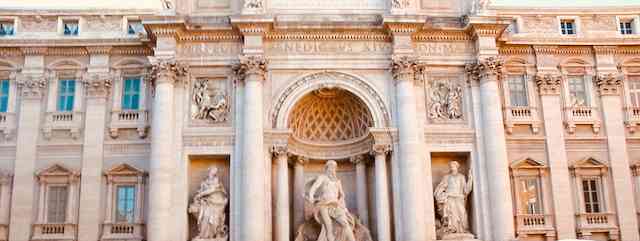
Right hand over left shoulder, with your back to the fountain. This is how you throw a coin in the Trevi Fountain, to be guaranteed a return to Rome. If that is not enough for you, throw in 2 coins – that will make you fall in love with an Italian. 3 coins means marriage – or divorce, whatever your preference.
One day, I will get a photo of the fountain from this angle without heads blocking the view of the water. Promise!
The first glimpse of Fontana di Trevi takes you by surprise. Here you are, wandering down one of the narrow streets in Rome, and suddenly there it is: impossibly grandiose, bursting with movement and sound, water crashing around imposing marble figures.
Yes, it is usually crowded. Yes, everyone snaps away with their phones. And yes – you still have to visit, it is that gorgeous – and so fabulously theatrical.
I stopped by one late evening, on the way home after a long dinner. Must have been well after midnight. I was by no means alone, but there was a strange sense of intimacy to it. People were sitting along the edge of the fountain, just watching the water, and speaking softly.
I threw a coin into the fountain. Just one.
The Pantheon and silence in Rome
The Pantheon is the oldest building in Rome still in use. From 126 CE, it is actually the oldest building on Earth still in use. 1,900 years old this year! Wrap your head around that!
Outside, Piazza della Rotonda is buzzing. Tourists drift across the square; waiters weave between tables like in Ratatouille. Then I step inside Pantheon and everything changes. The noise gives way to a quiet murmur. People speak softly in here. It is that kind of atmosphere.
Looking up at the huge dome, I wonder – for the millionth time – how it is possible. How can this ancient building support this huge thing?
After nearly 2,000 years, the oculus at the centre of the dome is now open to the sky. It fills the building with shifting natural light that changes by the minute.
The eye in the sky above me
There is no grand spectacle inside here, no attempt to overwhelm. It is about balance and proportion. Pantheon feels calm and confident.
I stand there, looking up at the light until my neck begins to protest.
Piazza Navona
A lovely thing to do in Rome is hanging out at Piazza Navona. I have found myself returning to this Baroque square time and time again, not really planning to, but there I am.
It feels unmistakably Roman, this square – elegant yet lively, grand but informal. Built on the site of Circus Agonalis, a stadium from 86 CE, where Olympic-inspired sporting events and music competitions took place, Piazza Navona has retained the same long, oval shape.
Today, there are still musicians here, as well as painters, dancers, magicians, all kinds of street performers. Cafés and gelaterias and wine bars spill out beneath the warm amber facades. And as in so many of Rome’s piazzas, the low hum of conversation drifts on late into the night.
In the centre of Piazza Navona is Fontana dei Quattro Fiumi (Fountain of the Four Rivers). Four marble river gods marble gods recline and twist dramatically around an ancient Egyptian obelisk. They represent the major rivers on each of the four continents known back when Gian Lorenzo Bernini created it in 1651: the Nile, the Ganges, the Danube, and the Rio de la Plata.
Pure Roman extravaganza.
Here’s Ganges, six-pack n’all
I also like Fontana del Nettuno, where Neptune is fighting a sea monster. Cat wasn’t that impressed, though.
She much preferred the carousel.
In December, Piazza Navona turns into a colourful market. The atmosphere feels a bit more chaotic than Christmas markets in northern Europe, but that’s as it should be.
The main act here is not Father Christmas or Santa Claus. Oh no, in Rome, it’s all about a witch. Here’s the story:
Christmas witches on Piazza Navona
La Befana
On their way to Betlehem to see a newborn child, the Three Wise Men got lost. They asked La Befana (old woman) for directions and said ‘why don’t you join us?’ ‘Can’t,’ she said. ‘I have too much cleaning to do.’ But then she thought better of it, and went after them. Sadly, she was too late for the birth, only getting there on 6 January. La Befana has been searching for the child ever since, leaving gifts for children along the way. She still does, and every Epiphany, Italian children rejoice over Legos and PlayStations.
More about La Befana in this post.
Piazza di Spagna and the Spanish Steps
Piazza di Spagna and the famous Spanish Steps is one of the most recognisable gathering spots in Rome.
The sleek steps rise towards the church of Trinità dei Monti. Looking down from the top you might feel you have seen this before, even if it is your first visit in Rome.
The steps are always busy, but in a relaxed way. Probably because almost everyone is sitting down, usually with a gelato in hand, just like Audrey Hepburn and Gregory Peck did in Roman Holiday. No wonder the place looks familiar, eh?
Again, the most profound experience here is the everyday life surrounding the steps; tourists snapping away, locals hurrying to work.
Fashionable streets branch away in every direction, yet the square itself feels old-world. Luxury boutiques stand beside centuries-old buildings. Church bells echo above the tourist chatter.
Horses on Piazza di Spagna. Wonder what they are talking about.
Since I am Norwegian, I’ll mention Sigrid Undset, Nobel laureate and one of our most famous authors. (You may have read Kristin Lavransdatter.) Sigrid travelled to Rome several times in the early 1900s, and was inspired. In return, Rome remembers her on Via Frattina, just steps away from, well, the steps.
Largo di Torre Argentina: Ancient ruins and Roman cats
One day, I was ambling over to Trastevere, because someone had recommended a gelateria there. On the way, I stumbled upon a park filled with ruins – and cats! Lots of cats, stretching out on stone columns, or sleeping next to a 2,000-year-old wall, looking graceful and lazy, as only a cat can.
This is the oldest cat sanctuary in Rome, run by volunteers.
I adore cats, so of course I love this extraordinary place!
In fact, it is extraordinary in many ways. Legend has it, this is where Julius Caesar was assassinated in 44 BCE.
Got my eye on you, tourist!
Et tu, Brute?
Legend also has it, Julius was none too fond of cats. He might even have had ailurophobia – extreme fear of felines. Is it not just marvellously ironic then, that the last place he saw on this earth, is now full of kitties?
It sounds almost absurd, doesn’t it? A cat sanctuary amongst the ruins of a world-changing civilisation? But it works – and feels very Roman. Grand history mixed effortlessly with ordinary life. I keep coming back to that balance!
Alexandra has written about Torre Argentina in this post.
The Vatican
And then, of course, there is the Vatican, a place that feels simultaneously its own world and inseparable from Rome.
Crossing into the world’s smallest independent state is strangely subtle. One moment you are walking through busy Roman streets, and the next you emerge into the vast open Piazza San Pietro, surrounded by Bernini’s sweeping colonnades. Despite the extraordinary size of the square, the atmosphere is often peaceful, especially late in the evening.
More about the Vatican in this post.
Rome’s everyday magic
The real magic of Rome is not just in its famous landmarks. It is in the feeling of wandering aimlessly and chance upon something beautiful: a hidden courtyard, a tiny church, ivy climbing on ancient brick, a fountain echoing in an empty square, a poem taped on a wall.
Alexandra spotted this lovely piece in 2012. Searching the name, I came across a tragic story about a 22-year-old man who died in a traffic accident back in 2011. Is it the same one, or is Adriano Prudentini a common name in Italy?
Via Panisperna with the iconic ivy curtain – in the Rione Monti district.
Rome is not polished. It is worn, and layered, and imperfect in the best way.
It is a city people return to again and again. And I will, too. Guaranteed by that coin I tossed into the Trevi Fountain.
That balance between history and present-day life; love being part of that!

Historic Centre of Rome, the Properties of the Holy See in that City Enjoying Extraterritorial Rights and San Paolo Fuori le Mura is a UNESCO World Heritage site.
Here are more UNESCO World Heritage sites around the world.
Rome: ancient wonders and everyday magic is a post from Sophie’s World