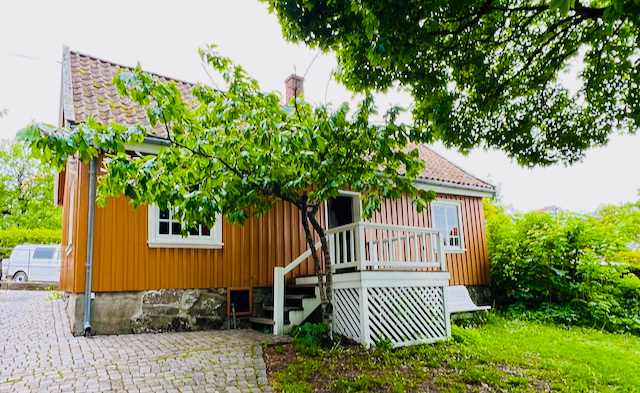
There are some places where history feels carefully preserved behind glass. And then there are places where it feels as though the owner has only just stepped out for a walk. Edvard Munch’s house in Åsgårdstrand is one of those places.
Or… that is what I thought until the guide told us Munch was messy. So messy, in fact, that when the municipality took over the house in 1946, after his death, they had to practically clear – and clean – their way in.
Other than that, the house has been kept intact there on top of the little hill, facing the Oslofjord.
Edvard Munch’s house in Åsgårdstrand
As I enter, I get a strange sensation of entering not just a house, but a state of mind. It is familiar in so many ways. And not just because I have been here before, but it is also so much like a typical Norwegian cabin that has been passed down through the generations. The interior reminds me of the cabin my grandfather built more than 100 years ago. We have it still.
Munch bought the house in 1898. He was 34 at the time, and it was the first home he ever owned. He was very attached to it, and reportedly called it Lykkehuset – House of Happiness. A surprisingly sweet and gentle name, isn’t it – for a man whose life and art are so often associated with anxiety, loneliness, and existential dread.
Munch’s house has modest, almost humble rooms. There is none of the grandeur one might expect from one of the world’s most famous artists here. Instead, there is simplicity: creaking floors, small windows, worn furniture.
As I walk through the little house, it is very clear that he was not searching for luxury, the good Edvard. Atmosphere was his thing. That was his true subject.
Munch’s kitchen
Munch’s significant others
Along the walls in the house, as well as in the studio in the garden, are black-and-white photographs.
And here’s Edvard, with two of his significant women. On the right is the English violinist, Eva Mudocci, his muse and possibly his paramour. (They wrote hundreds of letters to one another). On the left is his most famous fiancée, Tulla Larsen.
They had a turbulent relationship, Tulla and Edvard, fraught with jealousy, dramatic outbursts, and on his part, commitment phobia. Now, Edvard was also very interested in guns. He had several and used his living room walls for target practice.
Guns, booze and a dramatic temper: never a good combination. One night, in deep desperation and after copious amounts of alcohol, Tulla and Edvard get into a fight. A gun goes off and the bullet hits Edvard’s hand, smashing parts of his middle finger. The finger gets so damaged, he has to amputate the top part.
Never mind my reflection, look at Edvard’s finger
Most people know Edvard Munch through The Scream, that iconic image of modern anxiety. But his life was far richer and more complicated than a single painting can capture.
Edvard experienced loss early and repeatedly. His mother died when he was young. One of his sisters died of tuberculosis. Another struggled with mental illness. Munch later wrote that sickness, madness, and death stood beside his cradle from the day he was born. These experiences shaped his art profoundly.
Rather than painting the external world as it looked, he wanted to paint emotions – living people who breathe, feel, suffer, and love. In many ways, he was less interested in faces than in the invisible dramas happening beneath them. And Åsgårdstrand became one of the key stages for those dramas.
Munch’s house: the studio
The present-day studio in the garden is a replica, faithfully rebuilt as the original timber had decayed.
Edvard also liked to paint outdoors in the fresh air. In fact, he would even hang his works outside to expose them to the elements. Rumour has it, his paintings were covered in bird droppings, for a more existential effect. True story? I don’t know, but considering that his paintings are now worth millions, that little piece of trivia is, well… priceless.
One version of The Scream sold for USD 120 million at Sotheby’s in New York in 2012.
Åsgårdstrand is a sweet little place that feels oddly suspended between worlds: part fishing village, part summer retreat, part living painting.
If you take a wander around town, you will recognise many of the landscapes from his paintings: the shoreline, the moonlit water, the winding paths, the gardens, and especially the famous bridge. Works such as The Dance of Life, The Voice, Melancholy, Separation, and Girls on the Bridge all carry the atmosphere of this little seaside village.
The scenery in the paintings is real, but Munch transformed it into something psychological and symbolic. Looking out over the fjord, I can see how it could happen. The landscape is lovely, but not dramatic. It is quiet. Reflective. A place where thoughts have room to grow larger than themselves.
Edvard Munch and the chocolate factory
To view Munch solely as a painter of anguish is to overlook the many facets of his art. His works encompass not only haunting explorations of human anxiety, but also sunlit beaches, tranquil landscapes, and celebrations of life’s pleasures. A vivid example of the latter is the Freia Frieze.
In 1922, the founder of Freia, Norway’s best-known and best-loved chocolate factory, commissioned a piece for the women’s canteen at the plant in Oslo, to provide a bit of cheer in hard times.
And what they got, was a masterpiece: a 12-panel technicolour mural, with no trace of darkness. Just idyllic, coastal landscape and people enjoying it. Edvard certainly had a multi-faceted personality.
Normally, the frieze is exhibited at the Freia factory in a special hall, but it is presently (as at June 2026) on loan, and adorns the walls of the studio here in Åsgårdstrand.
The neighbourhood
Leaving, we wander along Edvard Munch Street.
It is easy to see why Munch was inspired by Åsgårdstrand. And the neighbours, in turn, seem to be inspired by his works:
Even the drain covers are quaint.
We head for the museum shop, located next to the former town hall, a few hundred metres away –
– to have a look at Digital Munch, with interactive stations and a cool 8-minute film presentation, based on his works from Åsgårdstrand and his written words. A worthwhile stop.
Munch’s house practicals
Åsgårdstrand is a 1-hour drive from Oslo, or 30 minutes from Torp Sandefjord Airport.
Wander around the gardens as much as you like, and whenever you like, nothing is locked or fenced in. However, to step inside the house, you must join a guided tour.
Opening hours both for Munch’s house and Digital Munch: Mon – Sun 1100 – 1600 in June, July and August; Sat – Sun 1100 – 1600 in September. For the rest of the year, a private tour is an option – contact booking@vestfoldmuseene.no
The tour takes ca. 30 minutes and costs 150 NOK (June 2026). You can buy tickets directly in the studio or at the museum shop nearby. Up-to-date info is here.
A longer tour is also available, walking in Munch’s footsteps in Åsgårdstrand – ca 1.5 hours.
For your SatNav:
Munch’s house: Edvard Munchs gate 25
Digital Munch: N.C. Nielsensgate 3 A, old Åsgårdstrand town hall
You can park at Åsgårdstrand harbour; some spaces are free, some are not. Be sure to check; parking fines are expensive.
Walking here is like walking amongst my paintings. I so want to paint when I walk here in Åsgårdstrand.
Edvard Munch
Disclosure? Nope, nothing to disclose. No press tickets or anything sponsored.
Edvard Munch’s house of happiness is a post from Sophie’s World