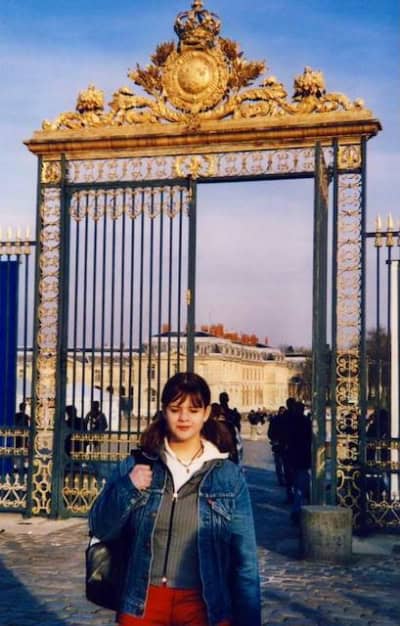
I’ll be honest – Versailles is one of those places that somehow manages to live up to the hype.
You will have seen photos of the glittering Hall of Mirrors or the endless gardens, but nothing quite prepares you for the scale of it all when you arrive in person. From the golden gates outside to the enormous chandeliers inside, everything about Versailles feels like it was designed to impress. And it was.
Just outside Paris, the Palace of Versailles is probably the most iconic landmark in France, and it’s easy to see why. It’s stunning, dramatic, flamboyant, and full of stories about power, opulence, and revolution.
Louis XIV: the Sun King
Versailles became what it is today, thanks to King Louis XIV.
He transformed what was once a fairly simple hunting lodge, into one of the most extravagant palaces in Europe during the 17th century. And when I say extravagant, I really mean extravagant.
Louis wanted to show the world just how powerful France – and he – had become. Every room, garden, painting, and fountain was part of that message. The palace wasn’t simply somewhere to live; it was a massive display of royal sway.
By 1682, Louis had moved the royal court and government to Versailles, turning it into the political centre of France. Noble families competed for the king’s attention, following endless rules and ceremonies at court.
As I walk through Versailles, I can still feel that sense of theatre and performance everywhere.
The Hall of Mirrors really is that impressive
The Hall of Mirrors is the most famous room in the palace, and yes – it absolutely lives up to its reputation: 70 metres long, with 17 enormous arched windows along one wall, and equally enormous, aligned mirrors on the opposite wall. Sunlight pours into the room and reflects everywhere. The entire room sparkles.
First time I was here, a guide said it was because everyone around the table would be able to enjoy views of the formidable gardens. No fighting about which side of the table to sit at. Nice!
20 years later, I asked another guide about this. Main non! she said. The Hall of Mirrors was not used as a dining room. Louis XIV had the mirrors installed to simply magnify the space – yet another way to show off his power.
Well, who’s to say exactly what was going on in the 1680s.
No table in the Hall of Mirrors now, though. At least not last time I stopped by. Would have made for slow movement for the 27,000 tourists who visit every day. But I can easily imagine the table. Lavish! And the view. Equally lavish!
Even more interesting is knowing that centuries after Louis XIV held his grand royal events in the Hall of Mirrors, the allied powers and an unwilling Germany signed the Treaty of Versailles here on 28 June 1919. In this very room. And with that, World War I was officially over, exactly 5 years after the gunshots in Sarajevo, which set off the whole thing in the first place, when Archduke Franz Ferdinand and Duchess Sophie were assassinated. Other than that, it was not a good treaty. So bad, in fact, it led to the rise of the Nazi Party in Germany, and to World War II, 20 years later.
Marie-Antoinette’s escape from life at the court
Poor little Maria Antonia. Married at 14, for reasons not her own. And to a prince who was impotent for 7 years, no less! Next to the Sun King himself, Marie-Antoinette is the most talked-about person who lived at Versailles, remembered for her luxuries and excess.
The reality was more complicated, though. Court life at Versailles was incredibly formal and intensely public, so she often escaped to Petit Trianon, a smaller palace out-of-the-way in the grounds.
Compared with the overwhelming grandeur of the main palace, Petit Trianon is quieter and far more personal. It is easy to see why she loved it.
Marie-Antoinette also created the Queen’s Hamlet, a charming little village designed to look like an ideal countryside retreat.
But while the royal family led a sheltered life at Versailles, tensions in France were growing rapidly. In 1789, the French Revolution took off, and the family was forced to leave the palace.
It feels strange to walk through such magnificent surroundings, knowing how dramatically everything changed.
The gardens are as incredible as the palace
They certainly are. And enormous! Ca. 800 hectares (about 2,000 acres, for you Americans) of grounds, filled with fountains, statues, tree-lined pathways, and perfectly symmetrical flowerbeds.
Not that into gardens? You’ll still want to see these – impossibly neat and carefully planned. Which, of course, was exactly the point. Louis XIV wanted nature itself to appear controlled and ordered.
Some of the highlights include the Apollo Fountain, the Latona Fountain, and the Grand Canal. On sunny days, people spend hours wandering around the grounds or sitting beside the fountains.
If you are here during the Grandes Eaux Musical – Musical Fountain Shows (every Saturday and Sunday between 1. April – 1. November), you’ll see the fountains dancing to Baroque music.
Why is Versailles a UNESCO World Heritage site?
UNESCO added Versailles to its World Heritage List already in 1979, recognising its cultural and historical importance. And honestly, it’s hard to imagine a place more deserving of that recognition.
Versailles influenced palace design all across Europe, inspiring royal residences in several countries, including Schönbrunn in Austria and the Winter Palace in Russia. It still feels like the ultimate symbol of royal grandeur, good and bad.
The ongoing restoration work happening across the estate is also impressive. No small task, maintaining a palace of this size: the rooms, the furniture, the paintings, not to mention the gardens. The responsibility would make my head spin.
Visiting Versailles today
I genuinely think Versailles is worth a visit. It is an extraordinary property, even today, centuries after its golden age.
My advice? Some of the best moments here happen away from the busiest rooms, so get here early and give yourself plenty of time to amble around, especially in the gardens. Have a wander by Grand Trianon, Petit Trianon, and through Marie-Antoinette’s hamlet. In fact, set aside a whole day, if you can.
It’s one of those places that feels both beautiful and strangely human at the same time, Versailles. It’s a monument to ambition, power, and the cruel twists of history.
PS Been a good while since I was last at Versailles, and back then, snapping photos indoors were strictly forbidden. Looks like this has changed now, so I need to go back! I’ll give myself an entire day, and pretend it’s 1785.

Palace and Park of Versailles is a UNESCO World Heritage site.
Here are more UNESCO World Heritage sites around the world.
Vintage Versailles is a post from Sophie’s World