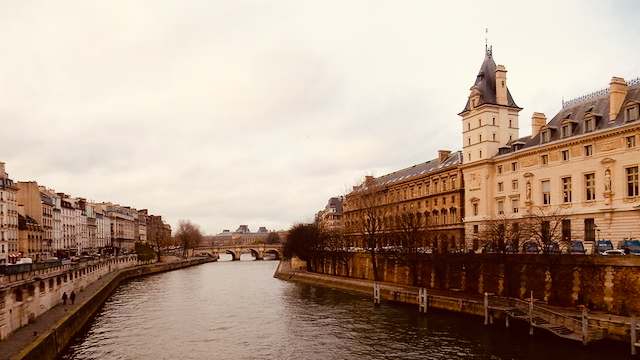
The Seine feels instantly familiar, doesn’t she? The river and the banks – Rive Gauche and Rive Droite – they are timeless and cinematic, and very much alive.
Every time I return to Paris, I somehow find myself back beside the river, on either bank. Often both.
I have walked here often: sometimes early in the morning hurrying to a meeting from my once-temporary digs in the Latin Quarter; other times, with nowhere particular to be, drifting slowly along the quays, letting the river set the pace.
She does not rush, La Seine. She glides.
And somehow, so do I.
A river written into history
The story of Paris begins with this river. Long before cafés, boulevards, and fashion houses, the Seine was a trading route for the Parisii tribe who settled on Île de la Cité. The largest of the three islands in the Seine was the heart of Paris in medieval times.
Over centuries, kings, revolutionaries, artists, and ordinary Parisians shaped the riverbanks into the city’s backbone. Bridges appeared, one by one – and none more symbolic than the ironically named Pont Neuf (meaning New Bridge), the oldest bridge in the city still standing.
Standing here, the layers of time are clearly visible: medieval towers, Renaissance façades, Haussmann balconies. And beneath it all, modern-day life unfolds.
Walking the banks of the Seine today
In the morning, runners pass by quickly and quietly, while delivery boats hum downstream. By afternoon, students sit on the stone embankments, chatting and sharing baguettes. Come evening, the riverbanks transform into an open-air living room for the entire city. I adore the atmosphere here especially on a warm spring day.
Along the quays are the famous bouquinistes. The green stalls sell vintage posters, old novels, and forgotten postcards. I never walk past without stopping, even if I buy nothing. Browsing these open-air bookshops feels almost like a ritual.
Also along the river, on the left bank, just opposite Notre Dame, I often stop by the wonderfully old and dusty English-language bookshop, Shakespeare and Company. You can sit down in one of many hidden nooks and read, or go upstairs to play the piano while looking out the window at the river.
Many sections of the lower banks are now pedestrian zones. Cars have been replaced by cyclists, dancers, street musicians, and families strolling without hurry. I appreciate this. The city feels softer here. And cleaner.
I also love that the river belongs to everyone. The Seine lets me know this random visitor to the City of Lights is welcome to walk along her banks, even though I’m carrying a coffee to go in a paper cup. So non-Parisian.
Well, at least it isn’t Starbucks. But still, to make up for it, I will have a ridiculously expensive citron pressé (no ice), at the iconic Café de Flore later, sitting at a table and reading a book, phone in pocket. Promise.
Landmarks that frame the water
Walking beside the Seine is like moving through an open-air museum.
On one stretch, I see the glass pyramid of the Louvre, and the resilient Notre-Dame Cathedral, its towers reflected softly in the water.
Further along, suddenly the Eiffel Tower appears.
What surprises me is how close everything feels. These icons are not isolated attractions; they are companions to the river, constantly revealed and hidden again as you walk.
I can never seem to get enough photos of this structure.
The island in the river
I wander across a bridge to Île de la Cité, to La Conciergerie, home of kings in the Middle Ages, and later a revolutionary prison. The most famous inmate, Prisoner no. 280, was separated from her children and brought here on the night of 2 August 1793, to live in a barely furnished, damp cell.
74 days later, she was tried and found guilty at Palais de Justice, and the following day, she was taken to the guillotine.
More about the unlucky queen in this post.
The stunning gate to the court d’honneur – the honour court, of Palais de Justice.
On a more cheerful note, the oldest clock in Paris is on a wall at La Conciergerie. It has been telling time since 1371, revolutionary back then – and is still going strong. That’s some impressive mechanics.
The magic of evening along the banks of the Seine
In the evening, the buildings glow honey-gold.
Later at night, they take on a mysterious light. I almost expect Quasimodo to appear on the roof.
On the river, boats drift past carrying softly lit dinners and quiet conversations. Nearby, someone opens a bottle of wine, and someone else plays guitar. No one seems in a rush to leave.
The river reflects the lights of Paris until the water itself appears to sparkle. No wonder artists, writers, and dreamers have gathered here for centuries.
I linger long after dark, watching reflections ripple beneath the bridges, feeling the city breathe slowly around me.
Why the banks matter
UNESCO has designated the central stretch of the banks of the Seine – from Notre Dame in the east to the Eiffel Tower in the west – as world heritage, giving it special protection for the future. And this recognition is not just about monuments and architecture; it is about a rare urban landscape where history, art, and daily life coexist almost seamlessly. The listing helps preserve a way of living with a city rather than merely visiting it.
The Banks of the Seine are not frozen history; they are living heritage.
Paris reveals its true character here: elegant but relaxed, historic yet contemporary – and effortlessly chic.
And perhaps that’s why I keep coming back. Must be 50 or 60 times now. As I walk along the Seine, I’m joining a rhythm that has flowed for thousands of years – one step, one bridge, one moment at a time.
Walking the banks of the Seine isn’t about seeing Paris – it’s about being part of it.

Paris, Banks of the Seine is a UNESCO World Heritage site.
Here are more UNESCO World Heritage sites around the world.
Along the banks of the Seine is a post from Sophie’s World