Wander With Wonder – Discovering Wow Moments Around the World or Across the Street
Looking beyond Everest Base Camp? Discover five unforgettable high-altitude treks, from K2 Base Camp and Kilimanjaro to Bhutan’s legendary Snowman Trek.
Everest gets most of the attention. That is not surprising. It has the name, the history, the photographs, the whole mythology around it. Say “high-altitude trek,” and a lot of people immediately picture prayer flags, stone steps, suspension bridges, and that long, breathless walk toward Everest Base Camp.
And yes, it deserves its reputation. But it is not the only trek that can stop you mid-step.
Other high places feel just as powerful, sometimes more so, because they are not carrying the same weight of expectation. Some are rougher. Some are quieter. Some feel more remote than you imagined places could still feel. Others take you through villages, passes, forests, glaciers, and strange empty stretches where the only thing you can really do is keep walking.
Maybe that is the real pull of high-altitude trekking.
It is not just the view at the end. It is the way these places slow you down. Your world gets smaller for a while. Water, weather, food, sleep, your boots, your breath. That is it. And somehow, inside that smaller world, everything feels bigger.
So if Everest has always been on your radar, but you are curious about what else is out there, these treks are worth a serious look.
K2 Base Camp: A Raw Journey Through Pakistan’s Karakoram
K2 Base Camp in Pakistan feels different from Everest Base Camp.
Less polished, maybe. More raw. The Karakoram has a sharper edge, both visually and emotionally. The mountains do not rise gently in the distance. They seem to come straight at you. The glaciers feel huge. The valleys feel wide and severe. It is the kind of landscape that makes conversation fade for a moment.
You just look. And then you keep walking.
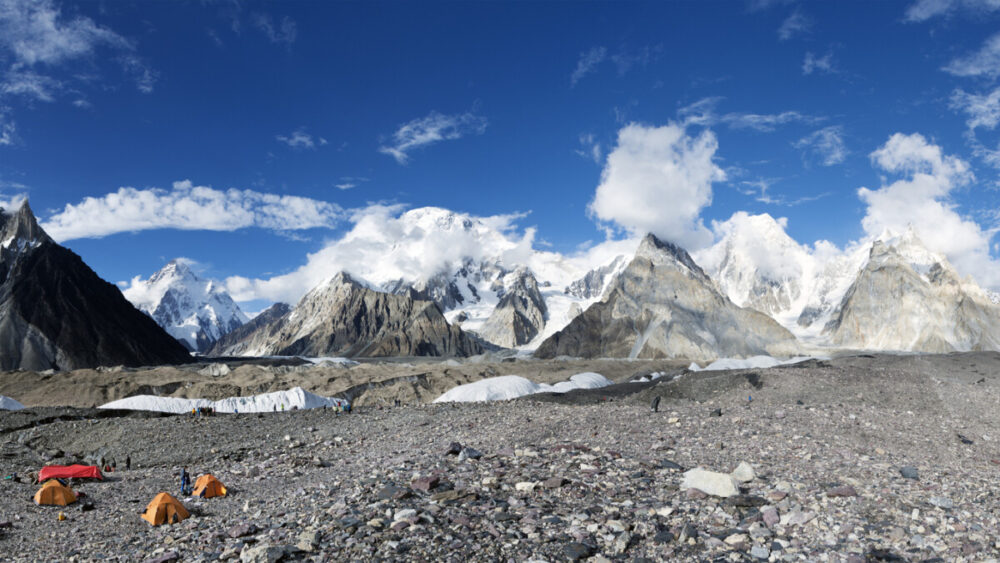
K2 Base Camp, Pakistan. Photo by JossK via iStock by Getty Images
This is not the obvious choice for someone who wants soft comfort or easy logistics. The conditions can be basic, the route is remote, and the trek asks for patience. Real patience. But for people who want a serious mountain journey, not just a famous one, it can be extraordinary.
A well-planned trekking route to K2 base camp offers travelers a compelling alternative to the more familiar Everest trail, especially if they are drawn to glacial landscapes, greater solitude, and the feeling of being far from the usual trekking circuit.
That is part of its appeal.
It does not feel neatly packaged. It feels earned. Not in a dramatic, chest-thumping way, but in the quieter sense that each day asks something from you. A little stamina. A little humility. A little willingness to be uncomfortable without making a fuss about it.
And when the mountains open up around you, the reward is hard to put into normal language.
Annapurna Circuit: Nepal’s Classic Trekking Adventure
The Annapurna Circuit is a classic, but it has a different rhythm from the Everest trek.
Everest Base Camp feels like a journey toward one famous point. Annapurna feels more like a long change in weather, landscape, and mood. You move from lower valleys into higher, drier country. Villages shift. The air changes. The colors change. Even the way the days feel under your feet starts to change.
That gradual unfolding is what people love about it.
View from Poon Hill viewpoint to Mount Annapurna in Nepal. Photo by DanielPrudek via iStock by Getty Images
There are big mountain views, of course, but the circuit is not only about the mountains. It is also about the movement between places. Tea houses. Fields. Forests. Windy high sections. Conversations over hot food when everyone is tired and slightly sunburned.
Some parts of the route have changed over the years because of road development. That can disappoint people who expect the old version of the trek. Fair enough. But with the right itinerary, Annapurna still has a lot to offer, especially for trekkers who want variety and a strong sense of journey.
It is also a good reminder that a trek does not always need one dramatic ending to matter.
Sometimes it matters because of the way it carries you along.
Kilimanjaro: Africa’s Iconic Summit Trek
Kilimanjaro is a different kind of high-altitude experience.
You are not walking to a base camp. You are walking toward a summit. That changes the feeling of the whole trip. The mountain becomes a direct goal, and for many trekkers, that is part of the attraction.
It is often described as accessible because the standard routes do not require technical climbing. That word can be a little misleading. Accessible does not mean easy. The altitude is still serious, and summit night has a way of stripping away any casual confidence you arrived with.
Cold. Dark. Slow steps. Headlamps ahead of you. The quiet sound of people breathing hard.
It gets real quickly.
A beautiful scenery of yellow tents in the Kilimanjaro National Park. Photo by Wirestock via iStock by Getty Images
One of Kilimanjaro’s great strengths is the variety of landscapes. Depending on the route, you may move through forest, moorland, alpine desert, and then the bare upper slopes. It can feel like several journeys stacked inside one.
The route and pace matter a lot. A longer itinerary usually gives you a better chance to acclimatize and enjoy the experience rather than simply endure it. That is worth taking seriously, because getting to the top is not just about determination. It is about giving your body time.
Kilimanjaro is not subtle. It gives you a clear objective.
But the best part may be what happens along the way, when the summit still feels far off, and you realize how much the mountain is already asking from you.
Cordillera Huayhuash: Peru’s Dramatic Mountain Wilderness
The Cordillera Huayhuash has a reputation among trekkers, and once you see photos, it is not hard to understand why.
Sharp peaks. Bright glacial lakes. High passes. Camps that look beautiful and cold at the same time. It is the kind of place that seems almost too dramatic, until you remember that actually being there means carrying yourself over serious terrain day after day.
This is not a gentle introduction to trekking.
Views along the HuayHuash Trek. Photo by Wiley Wilkins via iStock by Getty Images
The altitude is real. The nights can be cold. The passes can feel long. The weather can move in without much warning. But for prepared trekkers, Huayhuash offers one of the most striking mountain experiences in South America.
There is something very simple about the rhythm of it. Wake up. Drink something warm. Pack. Walk uphill. Breathe. Stop. Look around. Keep going. By the end of the day, your world has become very basic, but not in a bad way.
Maybe that is why treks like this stay with people.
They remove the extra noise.
A lake looks bluer when you have worked to reach it. A meal tastes better when your hands are cold. A sleeping bag feels like luxury when the wind has been pushing at you all afternoon.
It is not always comfortable, but it is vivid. Very vivid.
Snowman Trek: Bhutan’s Legendary High-Altitude Challenge
The Snowman Trek is one of those routes that people speak about with a mix of respect and caution.
It is long, remote, and demanding. There are high passes, isolated camps, and plenty of room for weather to complicate things. This is not a trek for someone who wants a quick achievement or a simple tick on a list.
It asks for time. It also asks for patience, which may be harder.
Prayer flags flutter at Bhutan’s Chele La Pass, 13,084 ft. above sea level. Photo by Anne08 via iStock by Getty Images
Bhutan gives the trek a different kind of atmosphere. Yes, there are mountains, and yes, the landscapes can be enormous. But the experience is also shaped by monasteries, villages, local traditions, and a cultural setting that does not feel like a backdrop. It feels central to the journey.
That matters.
Some treks are mostly about the terrain. The Snowman Trek feels more like a passage through a place that does not want to be rushed or simplified. You have to move at its pace. The weather may change the plan. The body may need more rest than expected. The days may blur together, then suddenly one small moment stays sharp in your memory.
A prayer flag moving in the wind.
A bowl of food after a hard day.
A silence between passes.
Not every journey needs to be easy to explain afterward. Sometimes the best ones come back in fragments.
How to Choose the Right High-Altitude Trek
This is where it helps to be honest with yourself. Not the heroic version of yourself. The real one.
How much trekking have you actually done?
How do you handle cold, discomfort, and basic facilities?
Do you want tea houses, or are you happy camping?
Do you want a famous goal, like a summit or base camp, or do you prefer a route that unfolds more quietly?
How much time can you give to the trip?
How remote do you want to be, really?
There is no shame in choosing a less demanding trek and enjoying it fully. There is also nothing wrong with choosing a harder one if you are prepared for what it asks.
It’s important to ask questions and determine the right high-altitude trek for you. Photo by Yulia Y via iStock by Getty Images
The mistake is choosing a trek because it sounds impressive, then resenting it for being exactly what it said it would be.
High-altitude trekking is not only a test of fitness. It is a test of expectations. If you want comfort, choose a route that allows for it. If you want remoteness, accept what comes with that. If you want altitude, respect the slower pace your body may need.
The best trek is the one that fits who you are now. Not who you think you should be.
Responsible Trekking in Fragile Mountain Environments
High-altitude treks pass through fragile places.
That can sound like something people say because they are supposed to, but it is true. Trails erode. Campsites get worn down. Waste becomes a problem. Water sources can be affected. Local communities can feel the pressure of visitors passing through, especially when tourism grows faster than infrastructure can keep up.
So the basics matter.
Choose operators who treat local teams well.
Ask about porter welfare, waste management, safety, and group size.
Carry out what you carry in.
Avoid unnecessary plastic.
Stay on marked trails where possible.
Ask before photographing people.
Listen to guides when they explain what is safe, respectful, or appropriate.
None of this makes the trek less adventurous. It makes it better.
Because the mountains are not just there to give travelers stories. They are living places, shaped by weather, wildlife, water, culture, work, and memory. Passing through them should come with some attention. Some gratitude, too.
Why the Journey Matters More Than the Destination
Everest will always have its place. It has earned that. But it is not the whole story of high-altitude trekking.
K2 Base Camp, the Annapurna Circuit, Kilimanjaro, the Cordillera Huayhuash, and Bhutan’s Snowman Trek each offer a different kind of challenge and a different kind of reward. Some are more remote. Some are more varied. Some are more direct. Some are slower and harder to summarize.
That is a good thing.
There is no single way for a trek to be meaningful.
Sometimes it is the famous view. Sometimes it is the long approach. Sometimes it is the uncomfortable day you did not expect to remember, but do. Sometimes it is the person you become after a week or two of moving slowly through thin air, carrying less than usual, needing less than you thought.
The high places have a way of doing that.
They strip things back.
And maybe, long after the photos are stored away, that is what stays with you most. Not just where you went, but how fully you had to be there.
As you plan your next adventure, remember that the most memorable trek isn’t necessarily the most famous—it’s the one that inspires you to take the first step. We invite you to explore Wander With Wonder for more outdoor adventures and unforgettable travel experiences.
The post Beyond Everest: 5 Incredible High-Altitude Treks Around the World appeared first on Wander With Wonder.