Wander With Wonder – Discovering Wow Moments Around the World or Across the Street
Learn how to experience Japanese Wagyu across Japan, from Kobe to Miyazaki, with tips on grades, regional styles, and the best ways to taste it.
The first time you encounter real Japanese Wagyu in Japan, the experience rearranges what you thought you knew about beef. Maybe it happens at a yakiniku counter in Osaka, where the chef slides a single slice of Miyazaki across the grill and times it to the second. Maybe it’s a shabu-shabu set in Kyoto, the meat so finely marbled that it turns translucent in the broth. Either way, you start to realize that “Wagyu” in Japan is less a single thing than a country’s worth of regional pride, breeding programs, and grading standards stacked on top of one another.
For travelers who want to thoughtfully taste their way through Japan, a little context goes a long way. Knowing the difference between A5 and A4, or between Kobe and Miyazaki, transforms a single meal into a much richer one. Here is what to understand before you go, where to seek out the best regional beef once you arrive, and how to keep the experience going after you fly home.
What “Wagyu” Actually Means
The word Wagyu translates simply as “Japanese cattle,” but in practice it refers to four specific breeds raised in Japan: Japanese Black, Japanese Brown, Japanese Shorthorn, and Japanese Polled. The vast majority of the Wagyu travelers encounter — and the one responsible for the deep, buttery marbling that has made Japanese beef famous — is Japanese Black, known locally as Kuroge Washu.
What sets these cattle apart is not just genetics, although the genetics matter enormously. It is also feed, time, and a culture of farming that often treats individual animals as a kind of regional craft. Many Wagyu cattle are raised for around 30 months on carefully managed diets of grain, rice straw, and water from specific local sources. The result is beef with very fine, evenly distributed intramuscular fat — the marbling that gives Wagyu its signature texture.
How Japanese Wagyu Grades Work
Two characters and a number determine the rank of every cut sold in Japan. The letter is the yield grade: A, B, or C, with A representing the highest ratio of usable meat from the carcass. The number is the meat quality grade, scored from 1 to 5 across four traits — marbling, color and brightness, firmness and texture, and fat quality. The highest grade, A5, requires top scores on every measure.
Within A5, there is still a wide range. Japanese cooperatives use the Beef Marbling Standard, or BMS, to score marbling on a 1 to 12 scale. A5 begins at BMS 8, but the gap between an A5 BMS 8 and an A5 BMS 12 is significant. Higher BMS means denser marbling and a softer, more melting texture. Some restaurants display the BMS score alongside the grade. If you see it on a menu, take note — it explains why two A5 dishes can taste meaningfully different.
A useful tip for travelers: A4 is not a step down so much as a different experience. Many Japanese diners prefer A4 for larger steak cuts because the slightly leaner marbling lets you eat more before the richness becomes overwhelming. For a smaller tasting portion — a single piece of sushi-style nigiri, a few slices of shabu-shabu — A5 is where the texture becomes unforgettable.
Regional Japanese Wagyu Brands Worth Trying
Japan’s three most famous regional brands are Kobe, Matsusaka, and Omi, collectively known as the Sandai Wagyu — the country’s three great Wagyu. Each has its own breeding registry and rules.
Kobe beef comes specifically from Tajima-strain Japanese Black cattle raised in Hyogo Prefecture, slaughtered in approved facilities, and meeting strict marbling and weight criteria. It is the name most travelers recognize, and the standards are unusually tight. Most Kobe stays within Hyogo and Tokyo, so a meal in the Sannomiya district in Kobe city is one of the more direct ways to try it at the source.
Matsusaka beef is raised in Mie Prefecture from virgin female cattle, often fed beer in the final months of life — a practice that has become part of regional lore. The flavor is notably sweet, and the fat melts at an exceptionally low temperature, even by Wagyu standards.
Omi beef, from Shiga Prefecture near Lake Biwa, has the longest documented history of the three, with records of regional beef culture stretching back several hundred years.
Beyond the famous three, the regional brand that has dominated Japan’s national Wagyu competition — the Zenkoku Wagyu Noryoku Kyoshinkai, sometimes called the Wagyu Olympics — for the past several cycles is Miyazaki. Raised in the southern Kyushu prefecture of the same name, Miyazaki beef has earned the country’s top prize repeatedly since 2007. Many chefs argue that, pound for pound, it offers the cleanest expression of what high-grade Japanese Black can be. Travelers who develop a taste for it during a Kyushu trip can often track down Miyazaki A5 Wagyu through US specialty importers like Destination Wagyu after they return home.
Other names worth seeking out include Kagoshima, also from Kyushu, often grilled simply over binchotan charcoal in tiny neighborhood yakiniku shops; Yonezawa from Yamagata in the north, prized for its balance of marbling and beef flavor; and Hida from Gifu, served beside the wooden inns of Takayama. Each one is worth a side trip if your itinerary allows.
Best Ways to Taste Japanese Wagyu in Japan
Yakiniku — Korean-influenced tabletop grilling, where you cook small pieces yourself over a recessed grill — is the most approachable. Order a single-cut tasting set, and the server will bring three or four cuts of the same regional beef so you can compare them side by side. The setting is informal, the conversation easy.
Sukiyaki and shabu-shabu both involve thinly sliced Wagyu cooked in a pot at the table. Sukiyaki uses a sweet, soy-based sauce; shabu-shabu uses a clear kombu broth. Both reveal the marbling differently. Sukiyaki amplifies the richness, while shabu-shabu strips it back to texture and clean flavor.
Teppanyaki — the chef cooking before you on a flat steel griddle — is the version closest to a Western steakhouse experience. It also tends to involve the most theater and the highest price. Reserve in advance and ask if the restaurant lists the specific farm or region of the beef.
Finally, Wagyu sushi and niku-zushi have spread quickly through Tokyo and Osaka in recent years. A small slice of seared A5 over warm rice, dressed with a touch of soy and wasabi, may be the most efficient way to understand why Japanese beef is treated as a craft product rather than a commodity.
Bringing the Experience Home
After a trip, the question that surfaces in nearly every traveler’s kitchen is the same: can any of this actually be recreated at home? The honest answer is that a Tokyo teppanyaki counter cannot be replicated in an American suburb. The room, the chef, the night itself — those stay in Japan. But the beef can come home with you, in a sense. A growing number of US importers now source directly from Japanese cooperatives, and the cuts that arrive in their cold-chain shipments are the same A4 and A5 grades you ate on your trip.
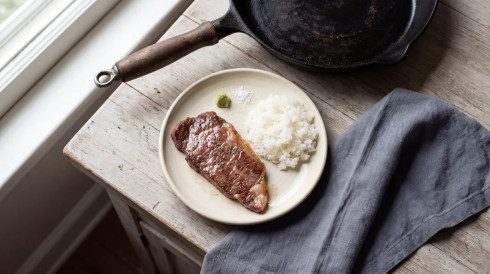
An A5 strip seared dry in cast iron and served simply with rice, fresh wasabi, and finishing salt. Restraint is part of the dish. Photo courtesy of Destination Wagyu.
The cooking method matters as much as the sourcing. For an A5 strip or ribeye slice, a dry, lightly preheated cast-iron pan, no oil added, will render the surface fat and let the meat brown without scorching. Salt after cooking, not before. Rest the meat briefly. Slice across the grain in pieces no thicker than a finger. Serve with rice, a small dab of fresh wasabi or grated daikon, and almost nothing else. Anything more competes with the beef.
Portion size matters too. Two to three ounces per person is typical in Japan, and the richness rewards restraint. If you find that a full meal of A5 is too much, this is where Australian Wagyu becomes useful as a second category in your kitchen. Crossbred from Japanese Black genetics and fed longer than typical Western beef, the better Australian producers turn out steaks with serious marbling but a more familiar steak-eating experience. Many home cooks who first ordered authentic Japanese A5 Wagyu from a US importer like Destination Wagyu keep Australian cuts on hand for cookouts and dinners where a full ribeye, rather than a tasting portion, is the goal.
A Few Practical Notes Before You Travel
If a Wagyu meal is on your itinerary, book early. The most respected restaurants in Kobe, Tokyo, and Kyoto fill up weeks in advance, particularly for omakase and teppanyaki seatings. Many require a credit card hold, and some require a Japanese phone number — ask your hotel concierge to help.
Bring cash. A surprising number of high-end specialty restaurants in Japan are still cash-only, particularly the smaller family-run yakiniku spots that may turn out to be your favorite meal of the trip.
Expect to pay more for Wagyu in Japan than for a typical steak dinner, especially at high-end teppanyaki and omakase restaurants where premium A5 cuts can easily run $100–$200+ per person. That said, travelers on a moderate budget still have excellent options. Lunch menus at upscale restaurants often offer smaller Wagyu tasting sets for $30–$70, and depachika food halls in high-end department stores like Isetan and Daimaru frequently sell beautifully prepared Wagyu bento boxes, skewers, and sliced beef for under $20. Neighborhood yakiniku spots can also be surprisingly affordable if you order smaller portions and compare a few regional cuts instead of committing to a full steak course.
Ask where the beef is from. Servers and chefs are almost always happy to tell you the prefecture, the farm, and sometimes the specific cooperative. The conversation often becomes the most memorable part of the meal.
Eat slowly. Japanese Wagyu is meant to be tasted, not consumed in volume. The pleasure compounds over a small portion in a way it cannot over a large one.
The Lasting Part
The reason Wagyu lingers in travelers’ memories long after the trip ends has less to do with luxury and more to do with specificity. Each region carries its own herd, its own feed practices, its own competitions, and pride. To taste it in Japan is to taste a particular place at a particular moment, the way you might taste a wine in its home vineyard.
Bringing the experience back to your kitchen will never be identical to that night in Osaka or Kyoto. But the through-line — the same regional beef, cooked with the same restraint, eaten in small enough portions to taste — is closer than most travelers expect.
For more culinary travel inspiration and destination guides, explore more food and travel stories on WanderWithWonder.com.
.
The post A Traveler’s Guide to Japanese Wagyu by Region and Grade appeared first on Wander With Wonder.