About a week ago, I promised to write a post about Ancient Tulum. Here we go!
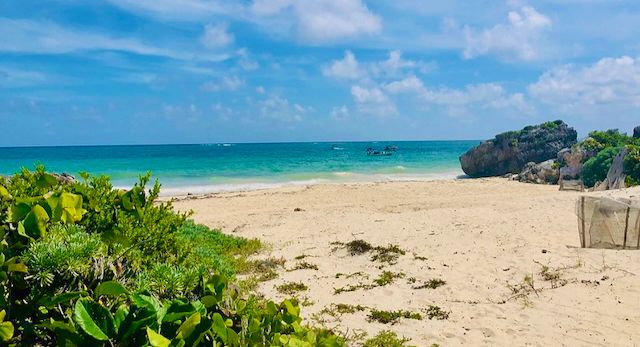
One of the two beaches in Ancient Tulum
You can’t be in Tulum without exploring Zona Arqueológica.
Well, you can, I suppose. But I can’t.
The path to the Mayan ruins winds through scrub and low jungle until suddenly the ocean appears, and then… there they are: stone structures balanced dramatically on limestone cliffs above the sea, just as they have for centuries.
This was the only city the Maya built directly on the coast. The buildings face east towards the rising sun, and the Maya called it Zama – City of Dawn, reflecting their devotion to the sun and cosmic order. Sunrise here was not just a sight to behold; it was sacred, and their way of keeping time.
The name Tulum, meaning wall, came later.
Built ca 1200 CE, Tulum was also one of the last great Maya cities, a thriving place for nearly 300 years until the Spanish came along, wreaked havoc and shattered their world. In a sense, Tulum is a final chapter of independent Maya life – a bridge in time, you could say – between an ancient civilisation and the moment of European contact.
As I walk slowly between the ruins, I imagine traders arriving. Canoes would have approached directly from the sea below the cliffs, ready to exchange jade and obsidian, cotton, salt, honey and cocoa.
Painting on an info board at Zona Arqueológica
The most prominent structure here is El Castillo, a large, multi-purpose building, serving as a ceremonial temple and a symbol of authority, as well as a lighthouse. In my imagination, the paddlers are now arriving at night, guided by the fires and torches at El Castillo, so they could pass safely through a gap in the coral reef.
This little beach beneath the cliffs was a working harbour where trading canoes arrived loaded with goods from across Mesoamerica.
Daily Life in Ancient Tulum
Who were they, the folks living here in the City of Dawn, welcoming the traders?
It was probably not a massive general population. Most likely it was priests, nobles, traders, and skilled artisans who lived in wooden and thatched homes that sadly no longer exist. The stone buildings still standing were mostly administrative offices, or ceremonial and religious spaces.
Their lives would have revolved around maritime trade, astronomical observation, religious rituals and perhaps a bit of agriculture. The sea shaped everything: economy, spirituality, and not least, their worldview.
It feels different here in Tulum than inland at Chichén Itzá. The ruins feel more intimate here. They are not hidden deep in the interior, but face the ocean, watching it endlessly, with wind rushing through the ancient doorways.
Iguanas wander about, completely at home amongst the ancient walls, not caring one bit that I get up close.
Have I just stumbled upon a guardian from the past?
Sacred territory
Ancient Tulum feels mystical, partly because the location had deep cosmological meaning. This was a city of trade, an economic centre. But it was also a symbolic boundary, where land meets the sea. The edge between the known and unknown worlds. Landscape and belief were inseparable.
As I continue this walk through history, I have jungle around me, and panoramic views of ocean ahead. From the cliff edge, I watch waves roll endlessly below and think about how little this view has changed. I am standing where traders and priests once stood. They watched the same view, and saw the same horizon. Feeling the same wind on their face. Hearing the same rhythm of ocean against land. It feels like history has not quite finished here. Just set on pause.
Is time real or something we only perceive? A construct of the mind that we need to make sense of the world? This has been my favourite thought to play with, ever since I was a kid. Decades later, I still don’t have the answer, but it never stops being exciting to think about.
Meanwhile, this coati is just laying about amongst the ruins, looking cute. He is probably thinking about nothing at all.
Ancient Tulum is not a UNESCO-listed world heritage property, but it probably should be. Get on with that job, Mexico!
Ancient Tulum: A Maya city eternally facing the sunrise is a post from Sophie’s World