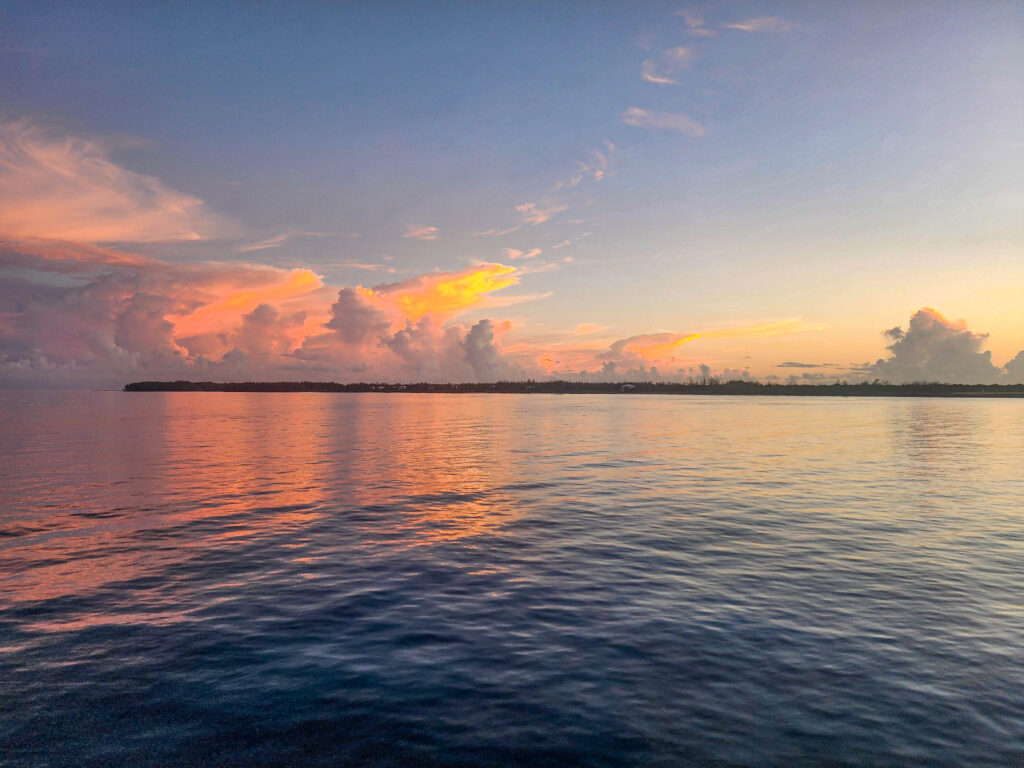
Most people picture a Bahamas vacation with a white-sand beach, a frozen cocktail, and a hotel room where someone magically replaces the towels every morning. We traded all of that for a week on a boat, where the ocean was our backyard, our bedroom moved with the tides, and the nearest restaurant might as well have been on another planet.
We thought we knew what we were getting into because we’d done it before, but living at sea has a funny way of revealing things you never considered when booking the trip. Some surprises were wonderful, some required adjustments, and a few completely changed how we think about what makes a vacation feel luxurious.
The First Surprise Was How Quickly the Outside World Disappeared
Photo Credit: Jenn Coleman.
There’s a particular moment when you leave Nassau behind and realize your vacation is no longer connected to a road, a hotel lobby, or a restaurant reservation. The city gradually fades into the distance, and suddenly the only things surrounding you are open water, scattered islands, and an extraordinary number of shades of blue.
We were aboard the Aqua Cat, a 102-foot catamaran that would be our floating home as we explored the Exuma Islands, a chain of spectacular islands and cays scattered across the turquoise waters of the Bahamas. At first, everything felt like a fairly conventional vacation, just with a different mode of transportation, but as the buildings disappeared, something shifted.
There was nowhere else we needed to be, no traffic to navigate, no dinner reservations to coordinate, and no daily decision about which attraction deserved our limited vacation time. For people who spend much of their lives planning travel, creating itineraries, and juggling schedules, that absence of decisions felt almost suspiciously wonderful.
We hadn’t realized how much mental energy a traditional vacation requires until most of those decisions were taken away. Even though our days would be filled with adventures, the responsibility for making everything happen was largely out of our hands, and that was an unexpected relief.
Sleeping on a Boat Is Nothing Like Sleeping in a Hotel
Photo Credit: Jenn Coleman.
When people hear that we spent a week sleeping on a boat, their first questions usually involve seasickness, cramped quarters, and whether we actually got any rest. Those are reasonable concerns because most of us associate boats with movement, noise, and the uncomfortable sensation of trying to maintain our balance while the floor has other ideas.
The reality was more nuanced, especially aboard a vessel designed for guests to live comfortably at sea rather than simply travel from one destination to another. Our cabin became our personal retreat, but it was a different kind of retreat from the sprawling hotel suites and luxurious resorts we’ve experienced during our travels.
There wasn’t a balcony overlooking a manicured garden, a sprawling lobby downstairs, or a beachside restaurant waiting just beyond our door. Instead, there was the knowledge that the entire world around us was water, and that the view outside could be completely different when we woke up the next morning.
The movement of the boat also became part of the experience, reminding us that our accommodations weren’t anchored to a foundation the way a hotel room would be. Even when anchored in sheltered waters, a boat is still a boat, and learning to move with its subtle rhythms is part of life at sea.
We discovered that sleeping aboard a liveaboard is less about recreating the familiar comforts of land and more about adjusting to a different environment. Some people find the gentle movement soothing, while others need time to adapt, and anyone prone to motion sickness should take that possibility seriously rather than assuming a large boat eliminates it.
What surprised us most wasn’t that we could sleep on a boat, but how quickly the idea of returning to the same stationary hotel room every night started to feel oddly limiting. There’s something wonderfully strange about going to bed in one place and waking up somewhere entirely different without ever having packed a suitcase.
We Expected Good Food, but Not How Much We’d Look Forward to Every Meal
Photo Credit: Jenn Coleman.
Food is one of our favorite parts of travel, whether we’re discovering a tiny local restaurant, enjoying an elaborate resort dinner, or sharing a meal after a long day outdoors. We were curious how that would translate to living on a boat where there was no opportunity to wander into town when a craving struck or choose a different restaurant because the menu didn’t appeal to us.
The Aqua Cat has its own galley team, so we weren’t surviving on packaged snacks or eating the same basic meal every day, but the dining experience was still very different from a conventional vacation. Meals became natural gathering points, creating a rhythm that brought everyone together between diving, swimming, exploring, and relaxing.
On our return trip, the galley team was from Mexico, which made Taco Tuesday an especially memorable addition to our week in the Bahamas. There’s something delightfully unexpected about enjoying Mexican food prepared by a talented galley crew while floating among remote Bahamian islands, especially when you’ve spent the day underwater exploring another world.
The real surprise, though, wasn’t simply the food, but how much we enjoyed having mealtimes built into the day instead of constantly deciding where and when we should eat. On land, dining can become another item on an already crowded itinerary, but aboard the boat it felt like a communal pause between adventures.
We also discovered how satisfying a good meal can be when you’ve spent hours swimming, diving, and moving through saltwater rather than lounging beside a resort pool. It turns out that a spectacular ocean view, good company, and a meal you didn’t have to organize can feel every bit as indulgent as a fancy waterfront restaurant.
Living With the Same People for a Week Is Its Own Adventure
Photo Credit: Jenn Coleman.
One thing that doesn’t get much attention in glossy photographs of liveaboard vacations is the social experiment happening above the waterline. Unlike a traditional resort, where you might encounter hundreds of guests but barely speak to anyone, a liveaboard brings a relatively small group of travelers into the same shared space for an entire week.
You eat together, prepare for adventures together, trade stories about what you’ve seen, and gradually recognize the little habits and personalities of your fellow passengers. There’s no disappearing into a different restaurant every evening or wandering off to explore a shopping district when you want a change of scenery.
For travelers who value privacy, that might initially sound intimidating, especially if the thought of organized group travel brings back unpleasant memories of rigid schedules and forced participation. What makes the experience different is that everyone has arrived with at least one important thing in common: a desire to be out on the water experiencing the world rather than watching it from a beach chair.
Scuba diving naturally gives people something to talk about, whether they’re comparing wildlife sightings, discussing a challenging current, or laughing about something unexpected that happened underwater. Conversations develop organically because the shared experiences are happening in real time, rather than being squeezed into a few polite minutes beside a hotel breakfast buffet.
We found that the boat’s communal atmosphere was less about sacrificing independence and more about discovering how quickly strangers can become familiar when everyone is sharing the same adventure. That doesn’t mean the experience is perfect for every personality, but it offers a kind of connection that’s increasingly easy to miss when travel becomes a collection of private, carefully curated experiences.
The Biggest Luxury Was Not Having to Make Decisions
Photo Credit: Jenn Coleman.
There is a strange contradiction in modern travel because we often spend enormous amounts of money trying to relax, only to exhaust ourselves organizing the relaxation. We compare hotel reviews, research restaurants, reserve activities, arrange transportation, and check opening hours, all while trying to make sure we’re not missing something better just around the corner.
Aboard the Aqua Cat, much of that logistical burden disappeared because the crew handled navigation, dive planning, meals, and the practical details of moving between destinations. Captain James and the crew worked within the realities of weather, tides, and sea conditions, allowing the itinerary to adapt to the environment rather than forcing the environment to accommodate our plans.
That flexibility is particularly important in the Exumas, where a beautiful stretch of water can become a very different place depending on the wind and currents. Instead of constantly watching the forecast and rearranging plans ourselves, we could trust the crew’s local knowledge and experience.
For us, the most surprising luxury wasn’t a particular amenity or extravagance, but the freedom to enjoy whatever was happening without constantly figuring out what came next. There’s a tremendous difference between being busy because you’re managing a vacation and being busy because you’re actually experiencing it.
We still had full days, sometimes with multiple dives and excursions, but the work of making those days happen belonged largely to someone else. For two people who have built a life around adventure travel, that distinction was more refreshing than we expected.
We Didn’t Realize How Much We’d Enjoy Having Nowhere to Spend Money
Photo Credit: Jenn Coleman.
A conventional vacation comes with an almost endless stream of opportunities to open your wallet, from airport snacks and rental cars to restaurant tabs, resort activities, and impulse purchases. Even when you’ve budgeted carefully, there’s often a steady parade of little expenses that add up faster than expected.
On a liveaboard, many of the major expenses are arranged ahead of time, and once you’re out among the islands, there simply aren’t many places to spend money. That’s not to suggest a liveaboard vacation is inexpensive, because scuba-focused trips can involve substantial upfront costs, equipment expenses, gratuities, and additional fees.
The difference is how spending feels once the trip begins, particularly when meals, accommodations, and many activities are included in the arrangement. Instead of wondering whether another excursion is worth the price or whether dinner will blow the day’s budget, we could focus on what was right in front of us.
There’s something freeing about passing an entire day surrounded by extraordinary scenery without seeing a gift shop, an advertisement, or a menu with a long column of prices. When your entertainment consists of exploring a coral reef, watching the water change color, or spotting marine life beneath the surface, the usual machinery of vacation spending becomes surprisingly irrelevant.
We hadn’t expected the absence of shopping and commercial distractions to feel like an amenity, but it absolutely did. It was a reminder that sometimes the most valuable part of a vacation isn’t having access to everything you want, but temporarily escaping the endless temptation to want more.
The Most Memorable Excursions Were the Ones Without Crowds
Photo Credit: Jenn Coleman.
One of the common misconceptions about a liveaboard vacation is that the entire experience revolves around scuba diving, with little opportunity to enjoy the islands above the surface. We love diving, but we also love exploring on land, and our time in the Exumas included experiences that many travelers associate with popular Bahamas resort vacations.
There were swimming pigs, rare iguanas, paddleboarding, and remote pristine beaches. These are some of the same famous attractions featured in glossy resort brochures and shore excursion advertisements, but experiencing them from a liveaboard came with a surprising advantage.
The remarkable difference wasn’t necessarily what we were visiting, but when we were visiting it. The Aqua Cat uses its 28-foot excursion skiff, Sea Dog, to bring passengers to many of the same attractions offered through resort and cruise excursions, but the crew works to schedule visits when other groups aren’t there.
That might sound like a minor scheduling detail until you experience a destination without a procession of tour boats, competing groups, and people waiting impatiently for their turn to take photographs. A place that might feel like a crowded attraction during peak visiting hours can become something far more intimate when you have room to explore and appreciate it.
This is one of the quiet advantages of traveling aboard a boat that can move through the islands rather than relying on a fixed hotel base and conventional excursion schedules. We weren’t discovering attractions no one else knew about, but we were getting to experience familiar places in a way that felt completely different.
For travelers who value authentic experiences over simply checking famous sights off a list, that difference matters enormously. Sometimes avoiding the crowds isn’t about finding a secret destination, but about arriving at a familiar one when everyone else is somewhere else.
Nature Was in Charge, and That Turned Out to Be a Good Thing
Photo Credit: Jenn Coleman.
Our first Aqua Cat trip didn’t unfold the way we’d imagined because the weather interfered with some of the adventures we’d been looking forward to experiencing. We returned to the Bahamas partly because we wanted a second chance at the things we’d missed, including the famous swimming pigs and other experiences that hadn’t worked out the first time.
It’s tempting to think that booking the right boat, choosing the right destination, and planning far enough ahead should guarantee the vacation you’ve envisioned. The ocean, however, has absolutely no interest in your itinerary, your vacation photographs, or how long you’ve been looking forward to a particular experience.
Even on our successful return, the daily rhythm of the trip depended on conditions that no captain or travel planner could control. Dive sites, excursion opportunities, and travel plans have to account for the realities of wind, tides, currents, and safety, which means flexibility is part of the experience rather than an occasional inconvenience.
This could be frustrating for someone who expects every advertised activity to happen exactly as scheduled, but it also offers a valuable lesson about adventure travel. When you’re staying in a resort, it’s easy to imagine the surrounding environment as scenery that exists to enhance your vacation, but living on a boat makes it impossible to forget that you’re a guest in the natural world.
We came to appreciate how much skill and judgment go into making a trip feel effortless, especially when the crew is constantly balancing guest experiences with changing conditions. Rather than feeling disappointed by the things nature controls, we found ourselves becoming more attentive to the opportunities it provides.
Returning to the Bahamas also gave us a perspective we wouldn’t have gained from a perfectly executed first trip. Sometimes an experience becomes more meaningful because it didn’t happen the way you originally imagined, and getting a second chance makes you appreciate the moment that much more.
We Learned That Adventure Doesn’t Always Look Adventurous
Photo Credit: Jenn Coleman.
The obvious highlights of a Bahamas liveaboard are easy to describe because they involve colorful coral reefs, sharks, dramatic underwater landscapes, and excursions to beautiful islands. But some of the moments that make living at sea special are much quieter and considerably harder to capture in a photograph.
There are the ordinary conversations between activities, the pleasure of sitting outside without a particular destination in mind, and the way a day gradually unfolds without anyone needing to announce what should happen next. There’s also the simple novelty of looking around and realizing that everything you need for the week is traveling along with you.
Your bedroom, dining room, transportation, adventure headquarters, and social gathering place are all contained within the same vessel, which feels remarkably different from the scattered geography of a typical vacation. Instead of moving from hotel to restaurant to attraction and back again, the familiar comforts of your temporary home move with you.
For us, adventure has never been exclusively about pushing physical limits or collecting dramatic experiences, even though we’ve spent much of our lives skiing, hiking, diving, and pursuing exactly those kinds of activities. It’s also about stepping outside familiar routines and allowing a different way of living to change how you see the world.
Spending a week at sea accomplishes that without requiring every moment to involve an adrenaline rush or a spectacular wildlife encounter. Sometimes the adventure is simply discovering that you can be completely content without the choices, conveniences, and constant stimulation you’ve become accustomed to having.
Would We Trade Our Favorite Resorts for Another Week at Sea?
Photo Credit: Jenn Coleman.
We love a beautiful hotel, an exceptional spa, and a romantic dinner overlooking the ocean, and a week aboard a liveaboard hasn’t changed our appreciation for any of those experiences. What it has changed is our understanding of what makes a vacation feel indulgent, especially when the greatest reward isn’t an amenity but a temporary escape from the endless responsibilities of everyday life.
A liveaboard isn’t necessarily the right choice for travelers who need unlimited privacy, flexible restaurant choices, constant access to shore, or complete control over their daily schedules. It also requires accepting that the ocean makes some of the rules, and that sharing a relatively small space with other travelers is part of the experience.
But for people who enjoy adventure, meaningful connections, and the possibility of discovering a different rhythm of life, those apparent compromises can become the very things that make the trip memorable. The limited choices, shared spaces, and changing surroundings that might initially sound inconvenient can turn out to be unexpected gifts.
We boarded the Aqua Cat expecting a week of scuba diving and island exploration in the Bahamas, and we certainly found both. What we didn’t expect was how much we’d enjoy the ordinary business of living at sea, from shared meals and changing views to the freedom of having fewer decisions to make and nowhere else we needed to be.
We went looking for another underwater adventure and discovered something equally valuable above the surface. Sometimes the best vacation isn’t the one that gives you everything you could possibly want, but the one that reminds you how little you actually need.