Original content owned & copyrighted by Green Global Travel.
Tunisia is located in the Maghreb region of North Africa, bordered by the Mediterranean Sea to the north and east, Algeria to the west and southwest, and Libya to the southeast.
Though widely considered “off the beaten path” for mass tourism, Tunisia fits Mediterranean beaches, ancient empires, and desert landscapes into a country small enough to explore in a single week.
The distances between them may be short, but the nation’s essential sights are spread out.
So many travelers choose one of the top Tunisia tour packages, which cover the country’s most noteworthy highlights without wasting days on planning logistics.
All transportation, hotels, and guides are arranged in advance, which leaves visitors more time for exploring the places that matter.
Fares Rjeibi, CC BY-SA 4.0, via Wikimedia Commons

Tunis and Carthage: Where the Story Begins
Although everyone’s itinerary is a little different, most trips to Tunisia start in the capital.
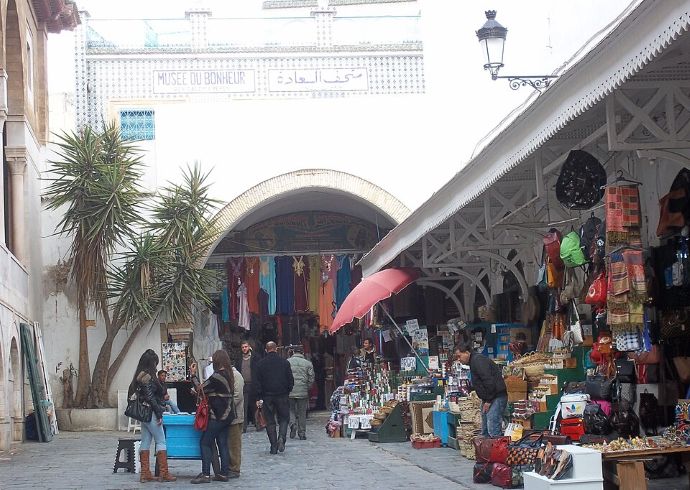
The Medina of Tunis, a UNESCO World Heritage Site, is a maze of covered souks selling spices, brass lamps, leather goods and perfume oils.
Visitors will want to explore with a local guide here, since the alleys are easy to get lost in, and the stories behind the old merchant houses add a lot.
Just outside the city lies ancient Carthage, which was once the rival of Rome.
The Antonine Baths and the Punic ports are the main draws there, and the hilltop Byrsa Museum gives context. Nearby, the Bardo Museum holds one of the world’s finest collections of Roman mosaics.
Majdi15ca, CC BY-SA 4.0, via Wikimedia Commons

Sidi Bou Said: The Village in Blue and White
Located just a short ride away from Tunis, Sidi Bou Said is easily Tunisia’s most photographed village.
The picturesque setting includes stark whitewashed walls, vivid cobalt blue shutters, and ornamental bougainvillea spilling down a hillside toward the sea.
Go there early in the morning, before the tour buses arrive, and finish your day with a cup of delicious mint tea at Café des Nattes.
Pastry lovers should try the local favorite known as bambalouni, a fried donut dusted with sugar.
Agnieszka Wolska, CC BY-SA 3.0, via Wikimedia Commons

Roman Tunisia: Beyond the Capital
Tunisia holds some of the best-preserved Roman sites found anywhere in the Mediterranean:
El Djem: The amphitheater here could seat around 35,000 spectators, and still stands largely intact. Few visitors expect to be able to walk through its tunnels and climb its tiered stairs and seating.
Dougga: A hillside town in the northern countryside, with a theatre, temples, and a capitol overlooking verdant farmland. It is quieter than most major ancient sites.
Bulla Regia: Famous for its underground villas, which were built to escape the summer heat.
These sites are far apart and hard to reach without a car, which is why guided group tour itineraries save visitors so much time and hassle.
weetoon66, CC BY-SA 2.0, via Wikimedia Commons

Kairouan: A Holy City of Islam
Kairouan ranks among the holiest cities in all of Islam.
Its Great Mosque, which was founded in the 7th century, is one of the oldest in the Muslim world, with a vast courtyard and a striking square minaret.
The city is also known for its carpet workshops, where you can watch weavers at work and learn how to judge quality before buying.
anagh, CC BY-SA 3.0, via Wikimedia Commons

The Sahara and the South
The south is where Tunisia feels most different from other neighboring North African countries.
Around Douz (which is known as the gateway to the Sahara), you can ride a camel across the dunes and watch the sun setting over a seemingly endless sea of sand.
Overnight stays in desert camps are a highlight, with traditional dinners, lively music, and clear night skies.
Further on, the salt flat of Chott el Djerid turns pink and silver in changing light. Tozeur and its palm oasis offer shade and date orchards.
Film fans will recognize Matmata and Ong Jemel, where scenes of Tatooine in Star Wars were shot. But the underground Berber homes at Matmata are real, lived-in architecture, not just a movie set!
Luciobocchi, CC BY-SA 3.0, via Wikimedia Commons

Djerba and the Coast
If you want to rest and relax after all this sightseeing, Djerba is Tunisia’s best-known island.
It has calm beaches, the El Ghriba synagogue (one of the oldest in all of Africa, with roots dating back to 586 BCE), and the lively Houmt Souk market.
Hammamet and Sousse offer long sandy beaches and walled medinas, making them good bases for a few blissful days by the sea.
Gigi sorrentino, CC BY-SA 4.0, via Wikimedia Commons

Food Worth Planning Around
Tunisian cuisine features bold flavors and surprisingly affordable prices.
Start with brik– a crisp pastry filled with egg and tuna– then try couscous with lamb or fish and lablabi, a hearty chickpea soup typically eaten at breakfast.
Harissa, the fiery chili paste, appears on almost every table, so be cautious and add just a little at a time.
For dessert, look for makroudh (a date-filled semolina pastry), and finish your meal with a strong coffee or mint tea with pine nuts.
General Tunisia Travel Information
When to Go
Spring (March to May) and Autumn (September to November) are the best seasons to visit Tunisia.
Temperatures then are more comfortable for multi-hour walks through the ruins and cities, and the desert sun is pleasant rather than punishing.
Summer is a great time to visit the Tunisian beaches, but note that the country’s interior gets sweltering hot during this season.
Winter is mild on the coast, but cool in the Sahara at night, so pack extra layers for stays in desert camps.
Practical Tips
Currency: The Tunisian dinar cannot be taken out of the country, so spend or exchange what is left before you fly.
Dress: Light, modest clothing is respectful in religious sites and smaller towns. Carry a scarf for mosque visits.
Bargaining: Haggling is expected in souks. Stay friendly, start at roughly half the asking price and walk away politely if you cannot agree.
Entry rules: Visa requirements depend on your passport, so check them well before you book.
Why a Tour Package Makes Sense
Tunisia rewards variety, but a trip that combines city, desert, and coast involves a lot of moving parts.
The best Tunisia travel packages typically bundle accommodation, transfers, guided sightseeing, and desert excursions into one itinerary, so you’re not coordinating drivers or hotels across several regions.
Many travelers find that this approach saves both money and planning time, especially on a first visit.
When comparing options, check what is included, such as entrance fees, meals and the length of the desert stay, and look for itineraries that allow some free time.
Few destinations offer this much history, scenery and hospitality at such reasonable prices. With the right season, a sensible route, and a well-organized travel package, Tunisia is an easy country to enjoy, and a difficult one to forget! –Alex S. Morrison
The post Tunisia Travel Guide: Roman Ruins, Blue Doors and Sahara Dunes appeared first on Green Global Travel.