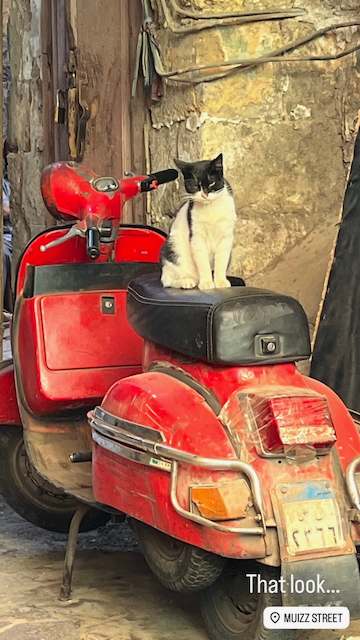
There are many ways to explore historic Cairo. You can follow the pharaohs, or you can explore the legacy of medieval sultans. You can bargain your way through the old bazaars, or spend time gazing at beautiful mosques.
(Or at random cats and dogs.)
Or you can follow a more unexpected historical trail: that of Ernesto Guevara, the Argentine revolutionary, whose life – and ultimately, death – was catalysed by witnessing firsthand abuse of the poor.
Che Guevara probably isn’t the first person that comes to mind when you think about Egypt, is he? Yet here I am, about to follow in his footsteps around Old Cairo. Or more accurately, what I imagine might have been his footsteps.
Come along!
The President and the Revolutionary
It’s June 1959. The Cuban Revolution is still young. Fidel Castro is consolidating his power, and has asked Che Guevara to lead a Cuban economic delegation on a tour of countries in Africa and Asia.
Egypt, then part of the United Arab Republic, is an important stop. President Gamal Abdel Nasser and Che have plenty to talk about: revolution, imperialism, land reform, and the future of the developing world.
Che is particularly interested in the agrarian reforms. He wants to understand how deeply Nasser’s revolution has transformed Egyptian society.
A formal state dinner in an opulent palace, and Che in fatigues. Love the contrast. Photo: EgyptToday.com
As it turns out, the two have rather different philosophies about social change.
According to Egyptian journalist Mohamed Hassanein Heikal, who witnessed the encounter and later recounted it in his book The Cairo Documents (1973), Che believed the success of a social revolution could be measured by how many people from the old order that left. Nasser disagreed, explaining that his aim was to abolish the privileges of the old ruling class, but not necessarily to exclude its members from the new Egypt.
Six years later, when preparing for his mission in the Congo, Che met with Nasser once again. This time Nasser reportedly warned him:
…I don’t want to interfere, but if you want to be another Tarzan, a white man coming among black men, leading them and protecting them…It can’t be done.
As it turned out, Nasser was right on this count.
Following an elusive trail
Our trail could have begun at Qubba Palace, Cairo’s grand royal residence where Nasser hosted a dinner for Che’s delegation.
But he wasn’t exactly your average diplomat, our Che. He wasn’t particularly interested in grand receptions, red carpet affairs, or any kind of protocol whatnot. In fact, he much preferred conversations with ordinary people.
According to accounts of the visit, he repeatedly tried to slip away from his official companions to explore Cairo. Che wanted to meet people and experience everyday life here.
And this, my friends, is the part of the story I find most compelling.
So we won’t begin our Che-stalking at Qubba. Instead, we’ll head directly to the streets. To the older quarters, where vendors call out to customers and delivery carts squeeze through narrow lanes.
The stories don’t give us a reliable street address or a particular place to look for. There is no ‘Che was here’ plaque, no well-marked historical route, no preserved revolutionary hideout. In short, there’s no guarantee we’re following Che’s exact route. But the atmosphere in these old alleys can’t have changed all that much over the decades, and I’m pretty sure we’ll get a glimpse of the everyday Cairo he was keen to discover.
Which means we’re free to do what he apparently wanted to do in the first place: explore. And that’s the point.
In Che Guevara’s (Unofficial) Footsteps in Cairo
Our trail begins at Bab al-Futuh, the imposing northern gate of old Fatimid Cairo.
Built in 1087, the gate was designed to defend the city – and to impress, of course. Looking at its two imposing round towers, thick stone walls and narrow entrance, I’m reminded this was once a fortified capital.
Bab al-Futuh translates roughly as Gate of Conquests
From here, I follow Al-Muizz Street, the historic spine of Cairo, established when the Fatimid dynasty founded its capital in 969.
The street stretches all the way to Bab Zuweila, the southern gate, and is practically an open-air museum of medieval architecture: mosques with elaborate façades and tall minarets, sabils (public water fountains), kuttabs (traditional Quranic schools), madrasas, palaces and old merchant houses.
Looking up, I see intricate carvings on the stone façades. Further along, decorative balconies, domes and minarets compete for attention: Look at me! No, look at me!
I prefer to look straight ahead at eye level. There I see a street very much alive with cafes, shops and workshops. Locals go about their daily business. Street vendors try to entice me into just their shops. Al-Muizz is like a time capsule. History in action.
Watching the world go by
According to local lore, Che also enjoyed sitting in traditional Egyptian coffeehouses, known as ahwas, smoking and watching the world go by.
Soon, I walk past a café with a table and a sofa arranged on a little raised platform overlooking the street. Very Arabian Nights! The waiter notices me looking and beckons me over. Come in, come in!
Must be fate! I was just thinking I should follow Che’s lead: find an atmospheric coffeehouse, sit back, and observe life along the street. This place fits the bill perfectly. It even has a seductively evocative name: Café al-Qamar – Cafe of the Moon. Another sign!
Café al-Qamar also turns out to be a wonderful refuge from the fierce afternoon sun, which has been making it increasingly difficult to see what I’m photographing. I settle into the sofa and order a lemonade – one of those delicious Egyptian ones with lemon and fresh mint. And watch the world go by.
Well, that’s the plan, anyway. Initially, I’m busy catching up with messages on my phone, and nobody pays me the slightest attention. Funny how that works. If you want to be left alone, look at your phone. But the moment I put it away and allow myself a vague, friendly smile in the direction of the passing crowds, things change completely.
It’s like magic. A smile is all it takes.
Children stop to say hello and ask where I’m from. Norway, I tell them. Their response? Haaland! Of course. They grin, while their parents add a warm Welcome to Egypt! A group of teenage girls asks for selfies with me. Soon, others want photos, too. I’m beginning to feel like a minor celebrity.
After a while, the waiter appears again and asks whether I’d like some tea. I accept.
Tea with mint leaves and cloves. The flavour of Yule.
I’m in Cairo on a stopover before flying to Yemen, and have taken advantage of the layover day to see the new Grand Egyptian Museum (fantastic!). Yet my little coffeehouse interlude turns out to be one of the most enchanting experiences here in Cairo. No elaborate sightseeing itinerary, no guide explaining centuries of history. Just a sofa, a mint lemonade, a cup of tea and a succession of spontaneous encounters with people who seem genuinely pleased to meet a visitor.
I wonder whether this is what Che was looking for when he slipped away from his entourage. I like to think that he, too, found that the best way to get to know a place is to sit down and relax, and let people come to you.
Eventually, I have to tear myself away. My unofficial mission isn’t quite finished. Time to resume the hunt!
I finish my tea, pay the waiter, and step back into the crowd, wondering where Che might have wandered next.
Khan el-Khalili
Further along, I turn off Al-Muizz Street into the labyrinthine lanes of Khan el-Khalili, Cairo’s legendary bazaar, dating back to the 14th century. Back then, it attracted merchants from across the region and beyond.
Today, the little streets are packed with shops selling everything from brass lanterns, copperware and traditional jewellery to perfumes, spices, textiles and souvenirs. Artisans still work in some of the workshops, whilst shopkeepers enthusiastically invite passers-by to take a look.
Retro tech all the way
It’s a colourful, noisy, and occasionally overwhelming place, Khan el-Khalili. Exactly the sort of vibrant marketplace where I imagine Che would enjoy observing local craftsmanship, chatting with merchants and perhaps even picking up a tip or two about the art of bargaining.
He might have stopped to admire the intricate metalwork, examine the colourful textiles, or simply lose himself in the maze of alleys. Or he might just have soaked up the atmosphere and chatted with whomever crossed his path.
I can almost picture him enjoying himself so much that he’d forget about his official engagements. But eventually, he must have thought, a bit unwillingly, perhaps: I suppose I’d better get back to Nasser and the rest…
And with that, I imagine our revolutionary reluctantly putting an end to his study of everyday life in Cairo, dusting himself off, and heading back towards the world of presidential receptions and diplomatic protocol.
As for me, I’m quite happy to have followed in his unofficial footsteps, however illusory. We haven’t found a revolutionary hideout, uncovered any secret Che hangouts or even established exactly which streets he wandered. But we’ve discovered a little of the Cairo he might have enjoyed: its historic streets, its busy markets, its old-fashioned coffeehouses and, above all, its welcoming people.
I think that’s as close to Che’s Cairo as we’re likely to get.

Historic Cairo is a UNESCO World Heritage site.
Here are more UNESCO World Heritage sites around the world.
In Che Guevara’s (Unofficial) Footsteps in Cairo is a post from Sophie’s World