There are sensible ways of travelling, and then there is arriving in Marshall Islands without a hotel reservation.
I chose the latter.
To be fair, it wasn’t entirely my fault. Accommodation in the islands is not exactly plentiful. As far as I could work out, there are basically two hotels on Majuro, the main island, and getting a reply from either was another matter altogether.
I had tried. Emails had been sent. Silence had followed.
So I decided to take my chances and just turn up.
This seemed perfectly reasonable at the time.
My fallback plan was to sleep on the beach, which sounds delightfully adventurous – until you remember the stray dogs. As on many Pacific islands, they roam around freely, and some look as though they have spent their entire lives rehearsing for a low-budget horror film.
I wasn’t particularly keen on waking up at three in the morning with a snarling dog staring me in the face.
Surely I’ll find a bed, I thought. Surely.
No room at the inn
I arrived in Majuro, found a taxi and asked the driver to take me to the Marshall Islands Resort.
Simple.
Marshall Islands Resort
Except… when I arrived, there was no room at the inn.
For a brief moment I wondered whether I had made a slight strategic error.
I asked the reception staff to contact the other hotel, to see if they had a room available. Or a dorm bed. Or a hammock. Anything, really.
They did. And Robert Reimers had a room. A nice one, at that.
Robert Reimers hotel
So my carefully considered accommodation strategy of “turn up and hope” had succeeded. I had a bed.
Welcome to the Marshall Islands
Once that small logistical crisis was out of the way, I could actually concentrate on where I was.
My first impression was that Majuro is very, very narrow.
There’s a strip of land, there’s water, and then there’s more water. Majuro is a coral atoll, and in places the land feels like someone has drawn a line in the ocean and then decided to build a road on it.
You can look towards the lagoon and then turn around and see the Pacific on the other side.
It gives the place a slightly surreal quality.
Life along the road
Majuro harbour has its own industrial decoration: stacks of old tyres lining the quay, ready to soften the blow when ships come alongside.
Majuro doesn’t feel like somewhere that exists primarily for tourists. I liked that.
There are cars and taxis along the main road, small shops, houses, people chatting, children playing and all the ordinary things that make a place feel lived in.
Nothing particularly glamorous.
Which is precisely what makes it interesting.
People aren’t performing “island life” for visitors. They’re just getting on with it. You are the one wandering around taking photographs of things that are completely ordinary to everyone else.
I probably looked slightly ridiculous.
But that is one of the privileges of being a tourist.
The heat
It is hot in the Marshall Islands.
I realise this is not exactly a groundbreaking observation about visiting the Pacific, but still: it was hot.
The sort of hot where you step outside and immediately start negotiating with yourself about whether you really need to walk all the way over there.
Fortunately, there is usually a breeze. Eventually you stop trying to beat the heat and simply accept that everything is going to happen a bit more slowly.
Which isn’t necessarily a bad thing.
More than a postcard
Majuro is beautiful, but it is not just a tropical postcard.
The Marshall Islands has a complicated history, shaped by Japanese occupation during the Second World War, decades of American administration, and the devastating legacy of nuclear testing in the islands, particularly in the Bikini Atoll. Then there is the present-day reality of climate change and rising sea levels. Like Tuvalu, the Marshall Islands is one of the countries most vulnerable to the effects of a changing climate.
Standing beside the lagoon, it is difficult not to think about it. The same ocean that makes the place so beautiful is also part of the reason the country’s future is so uncertain. The postcard doesn’t really tell you that part.
The things I remember
Oddly enough, my strongest memories aren’t really the spectacular ones.
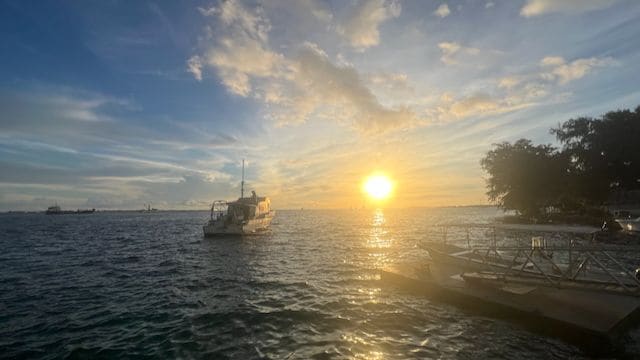
I remember the heat. The road. Sitting somewhere with a drink and having nowhere particularly urgent to go. Watching the light change towards evening. And, of course, being mildly astonished that my hotel strategy had worked.
One evening, I was outside as the sun was setting. The light softened, the heat began to ease and the water gradually darkened.
Nothing dramatic happened. No dolphins appeared. No spectacular tropical storm rolled in. Nobody handed me a cocktail and announced that I had discovered paradise.
I just stood there for a while. And it was lovely.
Those are often the moments I remember most from travelling – the ones where absolutely nothing happens. You stop, look around, and for once aren’t thinking about where you need to go next.
Travel memories are funny like that. You can spend months imagining all the extraordinary things you’re going to see, then arrive and remember something completely mundane.
Sometimes it’s the colour of the light. Sometimes it’s a conversation or a meal. And occasionally it’s the fact that you successfully avoided sleeping on a beach populated by potentially hostile dogs.
Will I go back to the Marshall Islands?
Yes, I think I will.
Not because the islands have a long list of attractions I failed to get through. It doesn’t really work that way.
That said, I would like to visit Bikini Atoll one day. Its history makes it a difficult place to think about, but also somewhere I’d like to see for myself.
I liked it because it made me slow down. There wasn’t a constant sense that I needed to be somewhere else, seeing something else, taking another photograph.
You can sit by the water and simply sit by the water, without doing anything else. Which sounds rather obvious. But perhaps that’s the point.
We spend so much time trying to make our trips interesting that sometimes we forget to actually be there. Majuro reminded me of that.
It also reminded me that, when travelling to remote places, it’s probably a good idea to book a hotel. I may have learned that lesson. Possibly.
Although, given that I somehow ended up with a nice room after arriving with absolutely nothing booked, I can’t promise I won’t do it again.
Utirik, Wotje, Namdrik – loving all these fabulously unfamiliar names appearing on the flight map as we hop between atolls in the Marshall Islands.
Marshall Islands: no booking, no problem… probably is a post from Sophie’s World