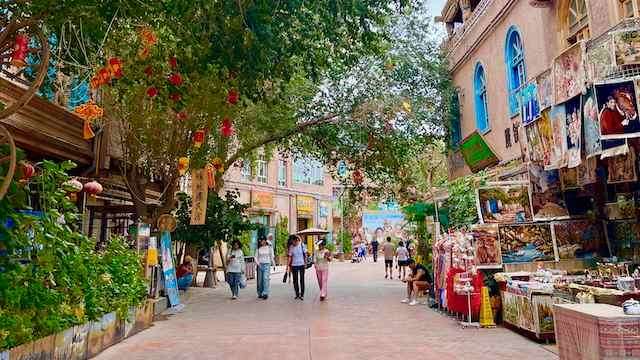
Kashgar! It’s one of those names that conjures up tales of ancient caravans and distant lands, isn’t it? Mysterious. Magical. Right up there with Baghdad, Samarkand, Babylon and Damascus… Places I have dreamt of visiting ever since I first read 1001 Nights at age twelve or thirteen.
And now I have!
Getting here has been an adventure! For the last seven days, we have travelled along the legendary Karakoram Highway, crossed the mighty Khunjerab Pass and journeyed through some of the world’s highest mountain terrain. Then came the Pakistani and Chinese border controls – a project in itself. And now, at last, we are in Kashgar, a city on the fabled Silk Road of Central Asia.
But what will we find here? An ancient trading centre? An energetic Chinese city? A place where different cultures mingle in unexpected ways? I’m eager to find out.
Kashgar: at the crossroads of civilisations
Kashgar – or Kashi as it is known in Mandarin Chinese – lies at the westernmost edge of China’s Xinjiang Uyghur Autonomous Region, where the mountains and deserts of Central Asia meet. For centuries, merchants, travellers and pilgrims have passed through this ancient city, carrying silk, spices, and stories between the Eastern and Western worlds.
Before leaving home, I had searched for information about Kashgar, particularly places to stay and eat, but there wasn’t a whole lot available. In fact, the latest online reviews for some places dated back to 2016!
I also remember watching the 2007 film The Kite Runner (excellent film – and an even better book), in which Kashgar was used as a filming location for the scenes representing Kabul. Magical name aside, I was expecting an unassuming, dry, desert kinda town. The type of place where you’d be hard pressed to find something to do for more than a day or two. And we’ve got all of three days here!
I could not have been more wrong.
Imagine my surprise when we enter this enchanting place.
We arrive well after dark, which turns out to be perfect. Kashgar is delightful at night, with lights and colours illuminating the trees, the streets and the squares.
The guesthouse
Our lodgings looked promising online, and are even better in real life. Xunjiang Bieyuan Homestay has dark wood and woven fabrics in deep jewel colours – my kind of place! The first of many things that will exceed my expectations here in Kashgar.
Also, it sits by the West Gate of Kashgar’s Old Town, just a stone’s throw from narrow lanes lined with restaurants and bars. Dropping our bags, we head out in search of nightlife and pijiu. Beer. A most useful Mandarin word to know.
After less than half an hour in town, we find a lively place outdoors, under the moon. And as we seem to do almost anywhere on the planet we happen to be, we end up returning every night, getting to know the staff – and they us!
Our new friend, boss lady Leyla – and World Cup’s on
Exploring Kashgar
Same gate, daytime
Next morning, I’m off to discover the Old Town as daylight breaks, and it doesn’t disappoint. Sprawling across roughly four square kilometres, this is a maze of earth-toned alleys, courtyards humming with life, and workshops where artisans are already hard at work. I wander for hours, curious what I will find around the next corner. I even manage to get lost a couple of times (although… what else is new…)
Beyond the Beauty: A Note on the Uyghurs
There is a wrinkle, though, when it comes to calling this the Old Town. Much of the original neighbourhood was demolished from 2009 onwards and rebuilt in a traditional Uyghur architectural style. The stated aim was to make the area safer and improve its infrastructure, with wider streets and more earthquake-resistant buildings. But the transformation came at a cost: the loss of much of the original historic fabric and the relocation of residents.
I never got to see the old Old City. And while I regret that loss, I have to admit that I rather like the new Old City, too. Its colourful façades, traditional architecture, and lively street life make it a joy to explore.
Id Kah Mosque
In the middle of the Old Town is a massive public square.
At one end is the 15th-century, yellow-brick Id Kah Mosque with its elegant minarets. With room for 20,000 worshippers, this is the largest mosque in the country.
We’re in China… but we are also clearly in Central Asia.
The food market
Popping across the square, we venture outside the Old Town for a wander through the food market. Cheerful vendors offer up a wide variety of Chinese and Central Asian fare: steamed buns, chacoal-grilled lamb kebabs, Laghman noodles, plov, bakhlava, fruit, nuts, spices, several kinds of bread, their delicious scent tickling my nose…
Then there is food that’s erm… anatomically presented: whole sheep’s heads, chicken that looks like chicken, not disguised as nuggets or fillets or thin slices of meat. Honest food, at least.
The sheep’s heads don’t come as a complete surprise. Serving whole sheep’s heads, eyes n’all, is also a tradition in my country. Still… I much prefer freshly squeezed lemon juice.
The One Hundred-Year-Old Teahouse
Next on the food-trail is a place I’ve been looking forward to visiting: Kashgar’s famous One Hundred-Year-Old Teahouse. So we head back to the Old Town, passing through the security checkpoint and crossing the vast square in front of Id Kah Mosque.
The teahouse – also known as the Century-Old Teahouse, or Ostangboyi Teahouse – is just a few minutes’ walk away.
Remember the place where Baba and his friend Rahim Khan sit and watch kite-fighting in The Kite Runner?
Unlike much of the Old City, which was demolished and rebuilt, the teahouse survived. It was renovated and redecorated in 2013, but the main features were preserved.
The teahouse has been run by the same family for five generations, and is practically a living room for Uyghur locals, particularly the elders. The atmosphere is lively, with people bringing out various string instruments and starting to play and sing. And dance! It all appears to be spontaneous, and anyone can join in.
Cheerful afternoon in the One Hundred-Year-Old Teahouse
The tea selection is quite extensive: from plain black and green teas, to medicinal herbal teas with saffron, rose, ginger, cloves, cardamom, honey – all served in porcelain bowls.
We stop by twice, and manage to snag seats on the wooden balcony one of the times, with excellent views of the busy market life below.
Gaotai Ancient Homes
On a high cliff at the edge of the Old Town is an Uyghur community, more than 600 years old.
According to the sign at the site, the Uyghur name of this area is Kozichiyabeixi, which means ‘earthenware/pottery families on a high cliff‘.
As new generations of clay artisans took over, houses were stacked directly on top of previous generations’ frameworks, resulting in a crisscross street layout, with ‘over-street buildings’, half-street buildings’, and ‘suspended buildings’. Highly literal terminology there.
Until recently, these homes have been a showcase of original, un-renovated Kashgar stacked mud-bricked houses. But sadly for us, when we are here, the area is undergoing renovation work, and is temporarily closed.
“Friendly Announcement Regarding the Upgrade and Renovation Construction of Gaotai Dwellings Scenic Area”
Cloth-Bag Alley
Just next to our homestay is Budai Alley (Cloth-bag Alley), a visually striking lane in the labyrinth of the Old Town. Colourful fabrics are draped above swings, creating a kind of canopy. It’s a welcome patch of shade from the relentless desert sun.
Kashgar’s Ancient Artisan Quarter
Wandering along the winding lanes, you hear the rhythmic clinking of blacksmiths and coppersmiths before you see them. Local artisans are busy forging household items, farm tools, and copper kettles…
Everywhere in the quarter, the scent of woodsmoke mingles with the irresistible aroma of freshly baked nang (Uyghur bread). Mmm…
One pottery shop has turned its entire wall into a giant advert for the family-run craft shop inside. Creative – and fabulous!
Another traditional artisan’s house has a workshop on the ground floor, with the family’s living quarters upstairs – a common arrangement in Kashgar’s old neighbourhoods.
Beyond the beauty: A note on the Uyghurs
It’s impossible to write about Kashgar without acknowledging the wider context. This is a city shaped by Uyghur culture, and also one in a region where serious human-rights abuses have been documented. The UN has raised grave concerns about the treatment of Uyghurs and other predominantly Muslim minorities in Xinjiang.
As a visitor, I can admire the beauty of Kashgar and appreciate the warmth of the people I meet, while recognising that a few days of travel can reveal very little about the realities of life here.
Chairman Mao and the Kunlun Eye
We’ve heard there’s a statue of Mao Zedong in the city centre. Considering all the Lenin statues we’ve come across on our travels (or searched out, more like), well, we can’t very well miss Mao, co-founder of the Chinese Communist Party, now, can we?
All 18 metres of Mao on People’s Square. We are definitely in China.
Not far from Mao is East Lake Park, with a large Ferris wheel: Kunlun Eye.
No messing around in Chinese lifts
We buy tickets (78 yuan pp), and soon we’re in the air. From 120 metres up, the whole city unfolds below us: the lake, the mud-brick rooftops of the Old Town and the Kunlun Mountains in the distance.
A final night out in Kashgar
On our last night in town, we celebrate Tom and Andrew’s birthdays in yet another corner of the world.
I’d come to Kashgar expecting a dusty outpost at the edge of the Taklamakan desert. Instead, I found a city full of colour, character and surprises. A fun city! And three days suddenly didn’t seem nearly enough.
Kashgar: the ancient Silk Road city at the end of the Karakoram Highway is a post from Sophie’s World