When we last left off, I was exploring the unexpected charms of Mongolia’s capital, Ulaanbaatar. Now it is time to leave the city behind and venture into the vast Mongolian steppe. I join three fellow travellers: one from inland New South Wales, another from Romania and a third from Russia/Israel. Together with our guide, the four of us set off into Gorkhi-Terelj National Park.
In the national park, you can hike to Turtle Rock, visit a Buddhist temple hidden on a hillside, ride horses or Bactrian camels, go walkabout, or simply spend hours or even days, just enjoying the silence. You can also stay overnight in a traditional ger camp, the Mongolian yurt. I’m reminded of waking up to horses grazing outside my yurt at Songkul Lake in Kyrgyzstan a few years ago. A travel moment I’ll never forget.
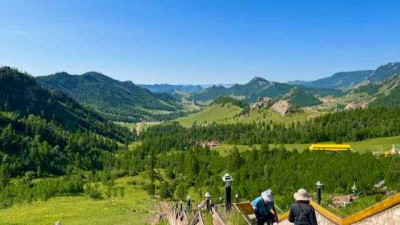
As we head into the Gorkhi-Terelj, the change in scenery is immediate: endless valleys, rocky outcrops, pine forests… the open skies seem to stretch forever.
Melkhii Khad: Turtle Rock
One of the most recognisable landmarks in Gorkhi-Terelj is a 24-metre-high natural granite formation that, from the right angle, looks like a giant turtle resting on the grassland here on the Mongolian steppe. Nature has done an impressive sculpting job here. It’s easy to see why it has become the park’s unofficial symbol.
The surrounding scenery is just as memorable. Rolling green meadows, scattered wildflowers, grazing horses, dramatic cliffs – exactly the kind of landscape I’ve imagined.
Ariyabal: a Buddhist Temple on the Mongolian steppe
Not far from Turtle Rock is a peaceful place: a Buddhist temple hidden on a hillside.
To get there I walk up a winding, rocky path through the forest.
You can’t really see the temple until you’re much closer.
Along the route I pass prayer flags and numerous wooden signs displaying Buddhist teachings and words of wisdom. The quotations encourage visitors to slow down, practise compassion, appreciate the present moment, let go of anger, and reflect on the impermanence of life. The walk can become a quiet meditation in itself.
Every few minutes another message catches my eye. This is going to take a while.
Not all of them are what you would call cheerful reading, though. Morbid, even.
The path to Ariyabal Meditation Temple crosses a narrow suspension bridge. It sways gently under my feet, but it’s not nearly as wobbly as Hussaini Suspension Bridge in Pakistan’s Hunza region. (post coming up).
From the bridge, there are lovely views over the rugged hills and the valley below.
Getting closer!
There it is!
Now for the 108 steps up to the temple.
Do you have a sudden urge to break into song, or is it just me?
With songs they have sung, for a thousand yeeeears…
Up at the temple are colourful prayer wheels and carved stones. Prayer flags flutter in the breeze, and the only sounds are birdsong and the wind. Religious or not, it’s a calming place inviting you to a moment of quiet reflection.
And inside, the temple is stunning.
I could stay a while.
Chinggis Khan Equestrian Statue Complex
Legend has it; Chinggis Khan found a golden whip at Tsonjin Boldog, on the bank of the Tuul River about 54 kilometres east of Ulaanbaatar. Surely a sign from the heavens, an omen of the magnificent destiny that awaited him. A source of inspiration for his future conquests.
Today, the site is home to one of Mongolia’s most ambitious monuments: a colossal stainless-steel statue of Chinggis on his horse. You can see the gleaming figure from miles away across the open landscape.
40-metre Chinggis
Touristy? Definitely. Over-the-top? Fabulously so.
Possibly the largest equestrian statue in the world
You can take a lift and some flights of stairs up through the horse to a viewing platform on its head, with wide views across the Mongolian plains.
Warning: On busy days, the viewing platform is not for the claustrophobic. The lift and stairs are even less so.
At the complex are museums exploring the history of the Mongol empire, displays of traditional armour and weaponry, paintings –
– souvenir shops, a cafe/ice cream shop, and a gigantic 2-storey Mongolian boot.
Camels and falcons
Not far away, local families offer short rides on Bactrian camels, the distinctive two-humped ones that have long been associated with the Gobi Desert and the ancient Silk Road.
Eagle handlers will let you try holding a bird, leather glove n’all. Mongolia has a long tradition of eagle hunting, especially amongst the Kazakh communities in the western part of the country.
Food
We stop for lunch in one of the ger restaurants nearby, which turns out to be an experience in itself.
We’re all in with attention marketing
Inside the circular felt ger are brightly painted wooden supports and a central stove.
Mongolian cuisine is simple and filling, made for surviving harsh winters, and comfort food is on the menu.
Rich, meaty goulash, and khuushuur, deep-fried pastries filled with minced meat
Next time on the Mongolian steppe: Przewalski’s horses
Next time in this mysterious country, I want to visit Hustai National Park, home to the rare Przewalski’s horse, the only wild horse species left on Earth. I have seen these remarkable animals at Nordens Ark (The Nordic Ark), a wildlife park in Sweden dedicated to protecting endangered species and helping secure their future. But seeing these magnificent horses roaming freely across the vast Mongolian steppe must be an unforgettable experience.
Prayer wheels at Ariyabal Meditation Temple
Onwards to the Mongolian steppe is a post from Sophie’s World