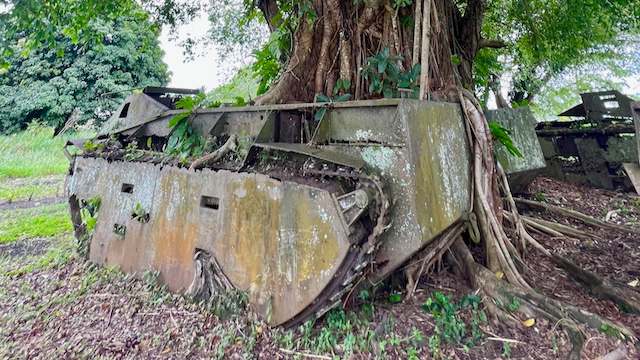
In many places – maybe even most – history is safely contained in a museum, behind glass and printed labels. On Guadalcanal it is not.
Here on the largest of the Solomon Islands, the history of World War II is part of the landscape. A road passes a former battlefield, a quiet hillside carries a memorial, and beneath the clear waters offshore are ships and aircraft from some of the fiercest fighting in the Pacific.
World War II in the Pacific
I have been thinking about how little we learned about the Pacific theatre in Second World War when I was in school.
It wasn’t that many decades after, and we certainly knew lots about the war in Europe and especially at home in Norway. We all had parents or grandparents who had lived through the occupation; that was very much a part of our family histories. We knew people who remembered, we knew the places, we heard the stories… stories of fear and bravery, of scary close calls, of clever ways to outsmart German soldiers, of unexpected humour in dark times… in short, the cost and comedy of survival.
Maybe that was enough back then.
But having spent the last few weeks in the Pacific, I’ve become acutely aware of just how little I know about what was going on in this part of the world. So I’ve been putting all those hours in the air to good use reading – about the battles fought, about the thousands of young men, boys really, who fought and died on these islands.
Arriving in the capital Honiara, the natural follow-up is to find someone to show me the wartime landmarks.
A battlefield that changed the Pacific War
The Guadalcanal campaign began on 7 August 1942, when US Marines landed on the island in the first major American amphibious offensive of the war. Their principal objective was to capture a Japanese airfield near the north coast. They did, and it became Henderson Field, a name that would soon become synonymous with the struggle for control of Guadalcanal.
Japanese and Allied forces fought on land, in the air and across the surrounding seas, with the airfield at the centre of the campaign. The fighting continued for six months, and by the time the Japanese withdrew in February 1943, the human cost had been enormous – on both sides.
Today, Honiara has grown around and beyond that wartime landscape, and the modern international airport occupies part of the former Henderson Field. It’s an odd feeling realising that the runway beneath me was once one of the most fiercely contested pieces of ground in the war.
My guide for the day is Samson. He shows me five different sites: the Vilu War Museum, Bloody Ridge, the Japanese and American war memorials and Tetere Beach.
Vilu War Museum
We begin at Vilu War Museum, a short drive west of Honiara. It’s less polished than conventional museums, but that makes it more real and near, more immediate.
Much of the collection is out in the open air. It’s a striking contrast: military hardware, once terrifying technological power, is now lying about, rusting amongst palm trees and other tropical vegetation.
Inside a warehouse are Browning belt-fed machine guns, as well as more ordinary items, like pots and pans, glass Coca Cola bottles. I see black-and-white photographs, and read handwritten letters and newspaper clippings from 8 December 1941.
Out back is a rusted Japanese light tank and more aircraft remnants, as well as an enclosure that used to be a small crocodile pool. Poor things. Thankfully, there are no crocodiles there anymore. Today, the fence around the enclosure is used for hanging clothes to dry.
The museum is in Betikama, an area owned by the Seventh-Day Adventist Church that has rather unique street names.
Bloody Ridge and the hills around Honiara
In a small valley between two hills is perhaps the most evocative site on Guadalcanal.
Bloody Ridge, or more formally Edson’s Ridge, was a crucial defensive position south of Henderson Field. In September 1942, Japanese forces repeatedly attacked the ridge, attempting to break through to the airfield. The fighting became one of the most brutal battles of the Pacific War.
Standing here on Hill no 1, I’m reminded of Flanders Fields, where poppies now cover the ground where once thousands of young boys bled to death. Here, in the valley between Hill no 1 and Hill no 2, there are no poppies, but lush green grass covering the valley floor once filled with the bodies and the blood of young Japanese and American boys.
There are other battlefields around Honiara, as well, including the areas around the former airfield perimeter. But the jungle, development and, well, time have reclaimed much of the terrain. Some places have monuments, others are simply there in the landscape, and you need a local guide to explain their significance and the historical context, otherwise it might just look like an ordinary hill or a river crossing.
Seeing the battlefield here somehow becomes the most meaningful part of this journey. That’s where I get the most immediate sense of war. As in the dugouts in Zonnebeke, it’s as if I can smell blood. And fear.
The memorials on Bloody Ridge
Two monuments on opposite sides of the former battlefield, looking out over the same landscape. Two different memorial traditions. Both telling a story about the human cost of war.
The two sides had different experiences of the campaign. But it seems to me that these memorials are not about who won and who lost.
There is also a shared Japanese-American plaque.
American and Japanese veterans and their families continue to come here to remember their dead. We drive the short distance between the two hills. Most do. But not the Japanese. Samson tells me they prefer to walk, like their soldiers once did.
The main Japanese and American war memorials
The Japanese War Memorial (Solomon Peace Memorial Park)
Hill 35 was an important position during the battle of Mount Austen. The Japanese War Memorial was funded by veterans and families of the dead and missing, and comprises two white concrete pillars, with a space between them through which I can see the ocean. It is beautiful and peaceful in its simplicity.
There’s also a moving bronze sculpture of a fisherman, designed by Eikichi Takahashi, a Japanese soldier and artist who fought and died right here on Guadalcanal. He created the piece as a tribute to the peaceful daily life of the Solomon Islanders.
The Guadalcanal American Memorial
On Skyline Drive, a hill above Honiara, is a huge American memorial, honouring American and Allied soldiers who died on Guadalcanal. The centrepiece is a tall pylon, surrounded by 4 walls representing the main battle areas.
Both here and at the Japanese memorial, the expansive views help make sense of the geography of the fighting. These views must have been different in 1942, but the landscape remains the same.
Tetere beach
Remember I mentioned the American amphibious offensive? These are the strange vehicles that helped make it possible, carrying people and supplies from ship to shore – one of the most unusual sights on the island.
Just a few metres from Tetere beach is a remarkable collection of abandoned American amphibious landing vehicles known as LVTs, or ‘amtracs’ – amphibian tractors. More than 30 rusting vehicles – my guide says more than 60 – are scattered amongst the vegetation.
These vehicles were developed to carry troops, weapons, ammo, gear, and food directly from ships, across shallow water, and onto beaches. It’s a striking reminder that war is also a massive logistics operation.
Later, the US Marines used this spot for amphibious training.
Today, nature is slowly reclaiming the machinery: the steel is corroded, vegetation has grown around the hulls, and trees are forcing their way through the shells. The distinction between battlefield relic and jungle is becoming increasingly blurred.
At the major memorials, we are being asked to remember. Here at Tetere, we’re a long way from the memorials elsewhere on the island. This feels almost accidental. They just sit here, these rusty vehicles, while the landscape slowly but surely takes it back. I think this is the most atmospheric of Guadalcanal’s wartime sites.
Nature always wins in the end
Ironbottom Sound
Guadalcanal’s war history doesn’t end at the shoreline.
Off the northern coast is Ironbottom Sound, where numerous ships and aircraft from both sides were lost. The wrecks are still there, now covered in coral, reef, and marine life – interesting diving and snorkelling experiences.
The Solomon Islanders and the war –
What about the locals? We don’t hear much about them and their role in this war fought on their territory.
The islanders were not simply a backdrop to the fighting, they were crucial to the Allied war effort. They were scouts, guides, labourers, rescuers, often in very dangerous circumstances. Their knowledge of the terrain was indispensable.
– and the aftermath
That brings up uncomfortable questions.
Guadalcanal is heavily contaminated. The warring parties left behind enormous quantities of military hardware, ammunition and wrecks, rusting away in the jungle and on the seabed.
I ask why they haven’t come back to clean up their rubbish. It has been 83 years, after all.
Turns out, it’s complicated. It is expensive and logistically challenging, and on the plus side, it brings visitors to the country. As for environmental concerns… well, that wasn’t on the agenda in the 1940s.
But what about now?
Unexploded ordnance
That visual and environmental pollution pales in comparison with an even more urgent question.
The island has a staggering amount of unexploded ordnance. People are still being injured and killed by bombs left behind more than 80 years ago, and children are particularly at risk. In 2024, hundreds of unexploded bombs were removed from underneath a school.
Solomon Islands can’t deal with this themselves. Nor should they have to. They didn’t leave highly dangerous rubbish lying about.
Considering that the islanders were massively heroic in helping the USA win the war in the Pacific, it seems beyond unfair that they now have to suffer the consequences of unexploded bombs left behind.
Why is this still the responsibility of the Solomon Islanders, 80+ years later, when the original combatants created the problem?
It’s expensive, I hear. Yet again. And challenging. Those who planted the explosives didn’t exactly leave behind maps.
Meanwhile, children in the Solomon Islands must deal with things no child should have to. When they see an object that looks like a bomb, rocket, or grenade, they must follow three rules:
Do not touch it
Do not go near it
Report it to an adult or the police immediately
Experts estimate that a total cleanup will take another 20 years. I say the United States and allies must step up and assume responsibility. No more waiting – get it done!
Seeing Guadalcanal as a whole
Guadalcanal is much more than a collection of wartime sites, so let’s resist seeing it solely through that lens.
Yes, the war is everywhere: Henderson Field, Bloody Ridge, the memorials, Vilu, the wrecks in Ironbottom Sound – all tell that wartime story.
But there is another Guadalcanal beyond the war. The markets in Honiara, the villages, the arts and crafts, the music, the tropical rainforest, beaches and reefs, the everyday island life – it gives a very different perspective. It’s an island with a much older history and a living culture that persisted through the war and still does.
The lesson here must surely be that the battlefields do not remain frozen in the past, but rather become a part of the living landscape. The jungle grows back, reefs grow over wrecks, cities and modern airports develop over former military installations.
The monuments are about remembering the dead. The rest of the island reminds us life goes on.
Guadalcanal practicals
Samson from Hapi Isles Tours was my guide. I paid 1500 SBD (ca 160 EUR/187 USD) for a private 5-hour tour around Guadalcanal’s war sites.
I flew to Honiara with Air Niuguni. Other options include Solomon Airlines, Fiji Airways and Qantas.
I stayed at Grace Hotel on the main street for 100 EUR/night (August 2026).
Guadalcanal and the battlefields of the Pacific is a post from Sophie’s World