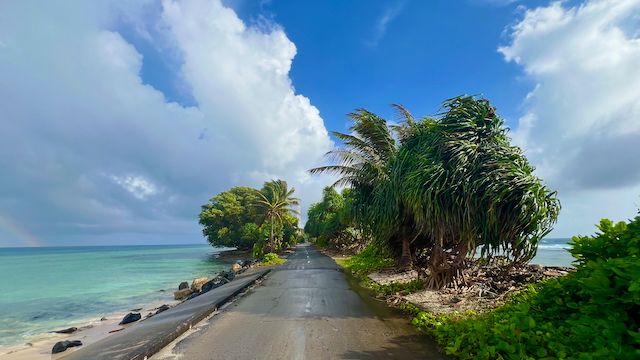
Imagine a paradise with an expiration date.
Usually, we travel to tropical islands to relax in beautiful surroundings, and Tuvalu certainly has that. But it also forces you to witness a crisis. Here at the climate frontline, the ocean is not just a view, it’s a countdown clock.
As I look out the window of the descending propeller plane, the blue Pacific and the swaying palms are quickly overshadowed by a sharp realisation: this island is tiny! Already when the wheels touch down at Funafuti, I can sense that life here is different. I have arrived somewhere important. Somewhere critical.
Scooters, strays and life on the runway
If there is one sound that defines Funafuti, it is the constant buzz of scooters.
I first spot them behind the airport gate. A small army of riders waiting for the barrier to lift, so they can zip across the open runway. People don’t just ride along the narrow main road here; the tarmac itself is a highway.
Sometimes, the riders become targets for local dogs. Strays roam freely across the island, and while most are harmless, some are highly territorial. Every now and then, a lone bark triggers a chain reaction, and suddenly a whole pack is racing alongside a scooter like an impromptu motorcycle-chasing posse. It’s a funny sight, but also a bit alarming. Mostly, though, the dogs are just part of the scenery, sleeping in the shade, or casually appearing where you least expect them.
And they absolutely consider the airport their personal territory.
When the tarmac becomes the village green
The moment the planes leave, Funafuti’s airstrip transforms into something completely different: a lively community park.
Coming from a world of high-security airports with strict barriers and guards, it takes a moment for me to process this. But here, because land is incredibly scarce, the runway belongs to everyone.
People stroll along the tarmac. Kids play football. Families gather to socialise. A few runners pass me. On very hot nights, or during power outages, locals even bring out mats and pillows to sleep on the concrete, to catch the cool ocean breeze. It is a beautiful tradition, though not without risk if a scooter zips past in the dark.
Of course, this means the local wildlife does not always understand when aviation needs the runway back. When a flight is due, airport staff face the frantic task of clearing the strip. This involves chasing away stubborn dogs and the occasional runaway pig from a nearby farm. It is a truly surreal contrast: a commercial aircraft preparing to land while people are herding animals off the runway.
Here in Tuvalu, the extraordinary and the ordinary coexist effortlessly.
A stark reality on the frontline
But beneath the humour lies a stark reality.
Tuvalu is on the frontline of climate change. Beyond the stunning blue water, this entire nation is fighting a quiet, desperate battle against the rising tide. Because these islands are so low-lying, the threats are already here: crumbling coastlines, poisoned drinking water, and fierce storms.
As I walk down the narrow main road, that danger shifts from a headline to a heartbeat. The ocean isn’t a distant view. It is everywhere!
The sheer fragility of this place hits me. I look out at the water and realise just how little land there actually is.
The narrowest part of Funafuti atoll.
The ocean presses against the homes, swallows roads, and crowds the narrow strips of land where people live. The relationship between Tuvalu and the sea is intimate, it’s constant, and it’s unavoidable.
I find that deeply unsettling.
As a visitor, it is easy to look at the turquoise water and think paradise. But for the people who live here, that same ocean threatens their future. What happens when the sea rises further? What happens to their land, their homes, their culture, and their ancestral roots?
These are not theoretical questions. They are questions about survival.
That truth changes how you see the landscape. The coastline is still beautiful, but it is also vulnerable. Heartbreakingly so.
Archiving a homeland: the world’s first Digital Nation
But Tuvaluans are not simply waiting for the waves to claim their home. They have not surrendered. Instead, they are turning to technology to save their identity and protect their sovereignty. Out of sheer survival, this tiny nation is transforming itself into the world’s first digital nation.
By 2050, rising seas could make Tuvalu uninhabitable. Faced with this countdown, the radical question is this: can a nation preserve its history, culture, government, and identity entirely in digital form?
To find out, Tuvalu is mapping its islands down to the millimetre. They are building a virtual twin of their land, their heritage, and their culture.
It sounds like science fiction, doesn’t it? A country creating a digital backup of itself so its identity can survive the loss of its land.
But the more I think about it, the less abstract it becomes. After all, a nation is not just a collection of pixels, or coordinates on a map. A nation is a tapestry of homes, memories, family histories, and an ancient relationship with nature. The digital project is not just about saving data, it is about archiving a homeland.
The idea is extraordinary – and devastating.
The Falepili Union: planning for an uncertain future
Yet, digital archives cannot house real people. We all need physical soil for our physical bodies. This harsh truth led to the Falepili Union, a historic treaty between Tuvalu and Australia.
Named after the Tuvaluan value of good neighbourliness and mutual respect, the treaty safeguards Tuvalu’s permanent statehood and at the same time offers a pathway to permanent residency for the islanders in Australia.
Importantly, the treaty does not just plan for an evacuation. It commits Australia to helping Tuvaluans adapt and stay on their land for as long as possible. But if the worst happens, it guarantees mobility with dignity, a choice for those who decide that living elsewhere is part of their future.
That distinction matters. Choosing to leave is entirely different from being forced out. Having the choice to stay and fight, or to move while keeping your culture intact – that changes everything.
Poster at Funafuti airport
An International Court of Justice ruling in 2025 clarified that loss of its physical territory due to sea-level rise does not automatically result in the loss of its statehood or sovereignty, allowing Tuvalu to remain a nation state with rights over its ocean resources and a seat at the UN, even if its islands are underwater.
Being here has made climate migration very real. It is no longer just an abstract policy debate. It makes me look differently at the people going about their day here in Funafuti: riding their scooters, playing football and socialising on the airstrip. They are not statistics in a climate report. They are people. Just like me. Just like you.
And this is their home.
A different kind of neighbourliness
When one house in a neighbourhood faces a storm, the others do not just shut their doors. They help. In a world of vastly unequal resources, Australia has stepped forward. Instead of treating Tuvalu’s crisis as someone else’s problem, they have acknowledged that what happens to this small Pacific nation matters on a human level, not just politically.
The Falepili Union is a mighty example of what true neighbourliness looks like. It ensures that whatever the future brings, the people of Tuvalu retain their identity and their voice.
That kind of solidarity matters for Tuvalu, and in a wider sense, it matters for all of us.
Of course, no treaty can single-handedly solve the global climate crisis. But no nation should ever be forced to surrender its homeland because the rest of the world failed to act quickly enough. Protecting the dignity, sovereignty, and future of our neighbours is an important place to start.
Travel, redefined
Ultimately, it is the fleeting, everyday moments here that linger. It is the endless stream of scooters, the local dogs darting across the road, and the laughter of children playing on the airport runway – a space that would be completely off-limits almost anywhere else in the world.
But what stays with me above all else is the extraordinary resilience of Tuvalu. This is a country fiercely determined to preserve not just where it is, but who it is.
I have travelled for decades, and have visited nearly every country in the world. Yet, my days in Tuvalu have changed how I think about travel. Too often, we jet off looking for something spectacular: a famous landmark, a pristine beach, a perfect photo op. Tuvalu has the beauty for that perfect picture, for sure. But its true impact only hits you after you put the camera down.
When you put the lens away, the heavy realities set in. Identity, survival, what does that mean? What does it mean to be a nation when the physical land beneath your feet is disappearing? What does it truly mean to call a place home?
Tuvalu is tiny, remote, and easily missed on a world map. But as I stand here on this narrow atoll, looking out at the beautiful, unforgiving ocean, it feels like I am looking directly into the future. Our common global future.
It doesn’t need attractions, this little country. Its story is the attraction.
The heart of the atoll: the people
When I said I was from Norway, these kids excitedly shouted ‘Haaland’. (That guy has gotten me lots of international goodwill lately just for being from the same country, and even a couple of free drinks.)
If there is one thing that makes the practical challenges of visiting Tuvalu entirely worthwhile, it is the people. I am continually struck by the profound warmth and hospitality of the islanders. There is a genuine, unmanufactured openness here that instantly makes you feel welcome.
As I walk along the narrow island road, complete strangers smile, wave, and strike up easy conversations. That human kinship completely changes the experience of being somewhere so incredibly remote. You are no longer just an outside tourist looking at a crisis from behind a lens; you are listening to real stories and glimpsing daily life through the eyes of those who call this extraordinary place home.
Watching the plane depart at Funafuti airport
The turquoise lagoon might be the spectacular view that lures you to Tuvalu. But it is the people who will stay with you forever.
**********************
Tuvalu practicals
Tuvalu is remarkably rewarding, but it is not a destination you can visit on autopilot. Getting here takes careful planning. Once you arrive, the limited infrastructure is not a hurdle; it is part of the adventure.
Getting there: the journey to FUN
For almost all visitors, the adventure begins at Funafuti International Airport, and how can you not love a destination with the airport code FUN?
Air services to Tuvalu are highly limited. Currently, the only option is with Fiji Airways, which operates routes out of Nadi and Suva a couple of days a week. Note that because there is no competition, tickets are notoriously expensive.
Due to unpredictable island weather and operational delays, flight schedules are rarely set in stone. Do not book tight connections on either end of your trip; you absolutely need to build in a few days of breathing room.
The remoteness is palpable the moment you step onto the propeller plane. As you watch the vast, empty Pacific Ocean stretch out below, you quickly realise that the journey itself is an integral part of the experience.
Getting around: scooters, strolls and the runway
She sells sea shells by the sea shore. (Sorry, couldn’t help myself.)
Once you land in Funafuti, navigating is straightforward. There is only one main road on the island, and driving from one tip to the other takes less than an hour.
Scooters & Cars: Most locals and visitors get around on scooters. Hiring one is cheap, convenient, and the best way to catch the island breeze. Cars are also available for rent.
Walking & Cycling: Because the island is so compact, you can easily walk or bike everywhere. This is the best way to notice local life, but keep a respectful distance from the island dogs. Don’t stare at them or assume they want to be pet; to a dog a direct stare is confrontational and predatory behaviour. Give them their space and use your common sense.
The Runway Rules: Between flights, the airport runway transforms into a massive community park. It is a fantastic place to hang out, but remember it is an active airstrip; aircraft operations always have the right of way.
Where to stay: stepping outside the resort bubble
Accommodation in Tuvalu is highly limited and usually locally owned. This lack of commercial chains means you are instantly connected to the local community.
Book ahead: Because rooms on the atoll are scarce, you must secure your spot and confirm your booking directly before you travel.
Manage your expectations: Facilities are usually simpler than what you might find in mainstream tourist hubs. But that is the charm. You do not come here to hide in a luxury resort bubble, you come to experience the real Tuvalu.
Eseta and Soloseni, owners of Esfam Lodge. Esfam = Eseta Soloseni FAMily
I’m staying at the family-run Esfam Lodge, a two-minute walk from the airport, for 150 AUD pr night, breakfast included. Happy to recommend it. (And no, this isn’t sponsored.)
Where and what to eat: embracing flexibility
Food in Tuvalu is simple, fresh, and influenced by the Pacific. However, menus and ingredients rely on the latest arrivals or what can be harvested locally. Because of this, fresh vegetables can be hard to come by.
Lodge dining: Your accommodation may offer dinner for guests. Mine does, but it must be booked in advance.
Chinese restaurants: a few of them, serving staples like chop suey, fried rice, and chow mein
Sue’s Kitchen: Directly opposite the airport and right next to the active runway, this is a must-visit. Famous for friendly hospitality, great burgers, and fish and chips.
The Heineken rumour: According to an American I met, Sue’s is also the only spot on the island where you can grab a Heineken. I’m far from a beer connoisseur – I don’t even like the stuff – but for those who care, I reckon that is a bit of a selling point!
What to do: the art of slowing down
The absolute best thing to do in Tuvalu is to throw away your bucket list. There is no endless line of tourist traps to tick off. Instead, the magic lies in slowing down and letting the country happen around you.
Explore at human scale: Cruise the narrow atoll on a bicycle, scooter, or on foot. It is the best way to watch daily life unfold and discover the sheer pleasure of just being here.
Embrace the lagoon: Spend hours sitting beside the spectacular, turquoise lagoon. If conditions and local advice permit, dive in for a swim or a snorkel.
Visit the conservation area: Hire a local boat to take you across to the Funafuti Conservation Area. It is a stunning sanctuary filled with pristine marine life and untouched natural beauty.
Witness the runway magic: Hang out by the airstrip in the late afternoon. Watching it seamlessly transform from a serious airport runway into a bustling community park – and back again – is unforgettable.
Connect and learn: Strike up conversations with locals. Take the time to truly listen and understand Tuvalu’s climate challenges. Here, environmental crisis isn’t a headline; it is a living reality that shapes the future.
Essential tips: rules of the atoll to keep in mind
Cash is king: Tuvalu is an entirely cash-based economy. The local ATMs do not accept international bank cards. You must bring physical Australian Dollars (AUD) to cover your entire stay.
Disconnect to connect: Internet access is highly limited and slow. Prepare to unplug from the grid and enjoy the digital detox.
Pack light – and smart: Resource supplies are unpredictable on a remote island. Pack all your personal essentials and health supplies; you will not find mainstream convenience stores here.
Protect the frontline: Use reef-safe sunscreen and eco-friendly products. Fresh water is a precious, limited resource here, so use it sparingly and minimise your waste.
Respect local culture: Dress modestly, always ask permission before taking photos of residents, and listen carefully when locals explain community customs.
Mind your mindset: Never treat this fragile nation like a tourist theme park. It is a deeply cherished home.
Tuvalu Government building, housing all the ministries
Most importantly, I will say it one last time: leave ample time in your schedule. Tuvalu is not a place for packed itineraries or rushed checklists.
Leaving Tuvalu
Even leaving the country is a unique experience in Tuvalu.
Tuvalu: paradise with an expiration date is a post from Sophie’s World