Hello hello good people!
We’re about to take a trip along the fabled Karakoram Highway. Can’t wait! But first, a few days to settle into Pakistan.
I was not sure what to expect from Islamabad. Like many, I have heard more about the country’s intense and chaotic cities and the dramatic mountain landscapes in the north than its capital. But after spending a few days exploring this uniquely planned green city – the tree-lined streets, the mountain views, the order… well, what’s not to like?
Unlike many capitals around the world, Islamabad feels calm and relaxed. The city sits against the backdrop of the Margalla Hills, and no matter where you go, nature never seems far away. Very relatable for this Norwegian.
So here you go: a few postcards from Pakistan’s greenest city.
Inland, local, and international
The Pakistan Monument and a look at Pakistani culture at Lok Virsa Museum
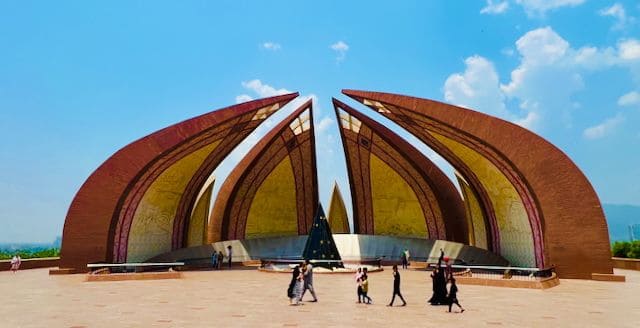
First order of the day: a look at the Pakistan Monument in Shakarparian Hill, a powerful symbol of the unity of the Pakistani people.
It’s a beautiful structure, with four large petals, representing the major provinces (Punjab, Sindh, Balochistan, and Khyber Pakhtunkhwa) and three smaller petals, representing the territories (Gilgit-Baltistan, Azad Jammu & Kashmir, and the former Federally Administered Tribal Areas).
The surrounding area also offers great views of the city.
The Lok Virsa Museum across the little square showcases the country’s many cultures, traditions, and regions. Colourful textiles, traditional music, handicrafts – every exhibit feels like a mini journey across Pakistan.
For first-time visitors like us, the Pakistan Monument and Lok Virsa are an excellent place to start.
Margalla Hills National Park
Next we go into the hills along the northern side of Islamabad. This is the westernmost foothills of the Himalayas, with high biodiversity. One thing we quickly learn is that the locals love the outdoors. Again, very familiar for a Norwegian.
Daman-e-Koh viewpoint
The trails in the Margalla Hills range from easy walks to challenging hikes. We haven’t planned any serious trekking; it’s simply too hot in the summer, and I have an injured leg. Even so, a short hike is enough to reward us with spectacular views over the city.
We make our way to Daman-e-Koh, a hilltop viewpoint and garden with panoramic views of Islamabad. Along the way, there are opportunities for horse and camel rides, but the offers are refreshingly low-key. Monkeys, colourful birds, and even leopards live in these hills, but they mostly keep away. Sensible creatures.
At the top, we stop for views and peach juice at the Princess Diana terrace at The Dome restaurant. She is one of several VIPs who has visited Daman-e-Koh, according to a photo gallery along the walls.
Daman-e-Koh is a famous spot for sunset watching, and we will come back for that later. But for now, Islamabad stretches out before us, with wide boulevards, green parks, and the iconic Faisal Mosque visible in the distance. Time to have a closer look at what is probably Islamabad’s most famous sight, but first…
Saidpur Village
The restored Saidpur Village is at the foot of the Margalla hills, and has historic architecture and art spaces. Walking through narrow streets, and across little bridges feels worlds away from the modern parts of Islamabad.
Faisal Mosque
Faisal Mosque is designed to resemble a Bedouin tent, rising dramatically against the backdrop of the hills.
Pakistan’s national mosque is one of the most striking sights in the city, and one of the largest mosques in the world, covering an area of 130,000 square metres (32 acres). And while there are quite a few people out and about today, it doesn’t feel crowded.
Wear a headscarf if you’re female, and no shorts allowed for any gender.
There’s a shop on the grounds –
– selling books (holy and otherwise), souvenirs and an eclectic mix of quirky gifts and curiosities.
Step back in time at the Golra Sharif Railway Museum
The Heritage Railway Museum is one of Islamabad’s lesser-known attractions. It is a must for train geeks, and equally rewarding for anyone curious about Pakistan’s past. Wandering amongst the beautifully preserved locomotives, vintage carriages, and fascinating railway memorabilia, it is easy to imagine an era when trains were the lifeblood of travel across the country.
The small museum is a nostalgic journey through the history of Pakistan Railways and the important role it played in connecting cities, towns, and remote communities.
Hop on over to Rawalpindi
Right next door to Islamabad is its twin city Rawalpindi.
Although the two cities sit side by side, they feel worlds apart. Islamabad is calm and carefully planned; Rawalpindi is vibrant, chaotic, and packed with historic buildings, bazaars, and mosques. Cars and people mingle in an unruly mix, and rickshaws buzz through narrow streets. Have we crossed eras?
Markazi Mosque
The Markazi Mosque is Rawalpindi’s most prominent religious landmark, beautiful and blue, and in the midst of the city centre pandemonium. The gate is locked, but our driver manages to persuade the guard to open it for us, for a few minutes.
The Markazi Jama Masjid – inside and out
Liaquat Bagh
For me, the most thought-provoking sight in Rawalpindi is Liaquat Bagh.
This rather ordinary park was known as Company Bagh (Park) in the days of the East India Company, but renamed Liaquat Bagh after Liaquat Ali Khan, Pakistan’s first prime minister, was gunned down here in 1951.
In more recent memory – and something I remember well – Pakistan’s first and only female prime minister, and first prime minister of a Muslim country, Benazir Bhutto, suffered the same fate, just here.
Benazir had given what was to be her final speech at a political campaign rally, from this stage in the park on 27 December 2007. It was widely thought that she stood a good chance of winning the elections in January 2008, just two weeks later, and would become Pakistan’s prime minister for the third time.
As she left the park and got into her white bullet-proof SUV, she stood up to wave to the crowd from the sun roof, and was hit by a bullet and the explosion from a suicide bomber.
Both Benazir’s and Liaquat Ali Khan’s murders remain unsolved and their killers walk free.
Rawalpindi is only a short taxi ride away from Islamabad, an easy day trip. Together, the two cities offer visitors a unique glimpse into both the modern and traditional sides of urban Pakistan.
Rawal lake
On the way back from Rawalpindi, we stop at Rawal Lake, which looks to be a fave spot for a family outing.
Families picnic under the trees, children play along the shoreline, and people are having fun on the water. It feels less like a tourist attraction and more like a place where Islamabad residents come to relax and enjoy their city.
Eating our way through Islamabad
Well, that heading is perhaps a bit ambitious, since we only try three places, but here you go:
Dawat
The first night in town, we have dinner at Dawat, one of several restaurants at the Serena Hotel. We are here at Ashura, the peak of Muharram, the Shia holiday commemorating the Battle of Karbala and the martyrdom of Imam Husayn (grandson of the Prophet Mohammad), so it’s quiet. But the Paksitani food is tasty, and the service is friendly. So friendly, in fact, the staff takes the time to chat and show us around.
Turns out, we are dining in the same restaurant as the Iranian delegation.
Like most Serenas I have seen, this is a beautiful property, and well worth a wander around. There is also a cosy-looking outdoor BBQ-restaurant, the Baradari – normally with music, but not this weekend, because of the holiday. Next time in Islamabad! (And no, nothing sponsored, ICYW.)
The Dome
The next day, we go back to The Dome at Daman-e-Koh in the Margalla hills for sunset. The weather gods decided on a more subdued sunset this evening, but the food is good.
I have a closer look at the photo gallery, and spot Benazir Bhutto.
An evocative moment, after our day in Rawalpindi.
Sky 24
Since we have to be up at 04.00 the next morning, we decide to take it easy and have dinner at Sky 24, the rooftop bar of our hotel, where we’ve had mocktails the other nights (cause dry country), watching the city sparkle below.
My take on Islamabad
What has surprised me most about Islamabad is not a particular landmark or attraction, but the overall feeling of the city.
It is clean, green, and peaceful. Mountains frame the skyline, nature is woven into daily life, and there is a sense of calm that’s rare in many capital cities.
What was meant to be just a few days’ stopover before setting off along the Karakoram Highway, turned out to be a destination worth exploring in its own right.
All photos by Andrew Morland, Tom Brothwell and myself.
Islamabad: Pakistan’s green capital is a post from Sophie’s World