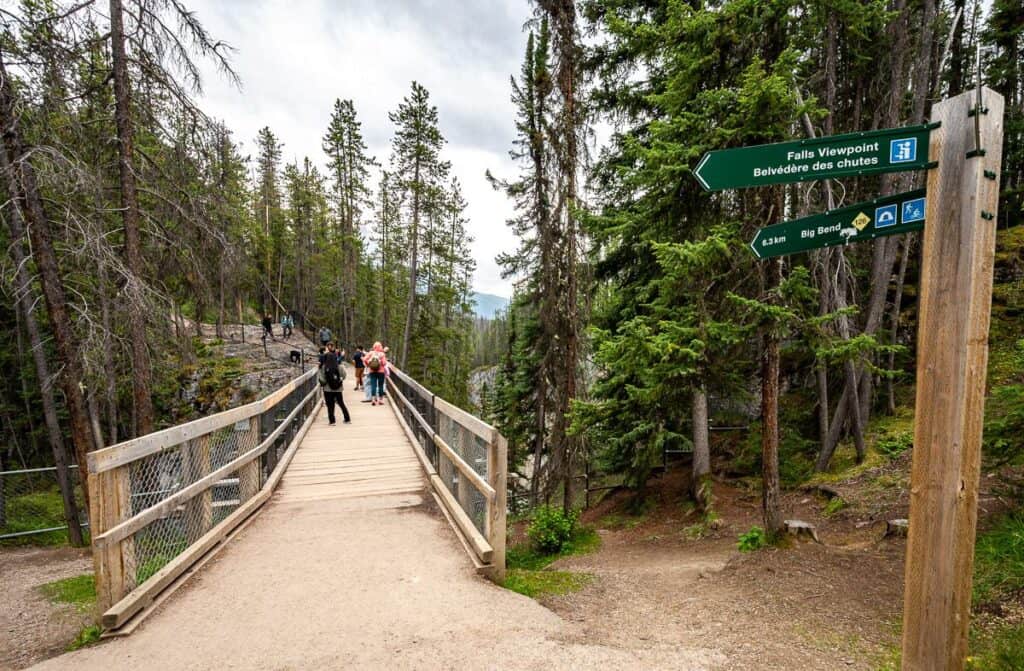
The Chaba Trail begins just after you cross the bridge over Sunwapta Falls, one of the most popular stops along the Icefields Parkway in Jasper National Park. Every summer, thousands of visitors stop to admire the powerful waterfall before continuing their journey, unaware that one of Jasper’s best beginner backpacking trips starts just minutes away. That was actually me until very recently.
If you’re looking for a first overnight backpacking adventure in the mountains, the Chaba Trail is a great place to start. The route travels through a valley to meet the Athabasca River. Navigation is straightforward, you lose rather than gain elevation, and the riverside campground is a beauty – overlooking the Athabasca River with mountains and glaciers in your line of sight. The Chaba Trail offers many of the perks of a Rocky Mountain backpacking trip without the commitment or difficulty of some of Jasper’s longer wilderness routes like the Skyline Trail.
I’ve got a compilation of beginner backpacking trips in the Canadian Rockies that are wonderful options for first-time backpackers. The Chaba Trail will be my latest addition because it combines easy logistics and navigation with a beautiful campground and a true backcountry experience.
In this guide, I cover everything you might need to know to plan your own Chaba Trail backpacking trip. That includes getting backcountry permits for campsites, what to expect on the trail, what I learned from my own experience, and useful tips to make your first overnight backpacking trip a success.
This post includes affiliate links. If you make a qualifying purchase through one of these links, I may earn a small commission at no extra cost to you. Thank you for supporting my website.
The Chaba Trail starts at Sunwapta Falls
Chaba Trail Overview
Hikers should take personal responsibility for their safety by researching conditions, preparing appropriately, and making informed decisions.
Distance: 12.6 km return to Big Bend campground, 29.6 km return to the Athabasca Crossing Campground
Elevation gain/loss: Approximately 50 m descent to Big Bend Campground, with about 113 m of elevation gain on the return
Time required: 2-3 days return as a backpacking trip
Difficulty: Easy to Big Bend and moderate to Athabasca Crossing because of distance
Campgrounds: Big Bend and Athabasca Crossing
Best season: August and September after the mosquitoes and other bugs have died back
Dogs: Yes, on leash
Permit required: National Park pass and a backcountry camping reservation if you plan to camp
Trail towards the campsites beside the Athabasca River at Big Bend campground
How to Get Backcountry Campsites on the Chaba Trail
Every year backcountry campsite reservations for Jasper National Park open sometime in late January. For 2026, they opened on January 28 at 8 AM MT. From that day forward you can book for the coming summer either online – or by calling 1 -877-737-3783 in North America or 1-519-826-5391 outside North America.
Online can be confusing at first. Click on backcountry, then backcountry zone, then Jasper National Park under park, and then select your access point – which in this case is Sunwapta Falls. Then you can pick the campground you want from there.
If you can’t get the dates you’re after, set up an alert with Schnerp – and you will get notified when there is a cancellation.
Getting to the Trailhead for the Chaba Trail
The Chaba Trail shares the trailhead to Sunwapta Falls, one of the popular stops along the Icefields Parkway.
From Jasper it’s about a 55-kilometre drive south on the Icefields Parkway. Allow about 40 minutes. If you’re coming from Lake Louise it’s a 177-kilometre drive that will take around 2 hours.
There is a side road off the Icefields Parkway adjacent to Sunwapta Falls Rocky Mountain Lodge. Turn right if coming from Jasper, or left if heading north and drive down it to reach a parking lot and the trailhead. PLEASE, park in the first open spot you find to avoid creating a traffic jam.
Chaba Trail Hike Topo Map
Chaba Trail starting from Sunwapta Falls
Why Backpack the Chaba Trail?
The Chaba Trail is short and easy, perfect for bikepackers and backpackers looking for a quick one night trip into the backcountry. Although much of the hiking is an uninspiring walk through the forest, the Big Bend Campground on the shores of the Athabasca River is a beauty – and it alone makes the trip worthwhile.
The Chaba Trail is at lower elevation than many of the Jasper National Park trails, so it makes a good early season trip if you can beat the bugs. Otherwise, wait till August when they’ve died back. Trust me on this one. It’s also not very busy, except at the exciting start beside Sunwapta Falls.
There is the option to do and out-and-back hike as a day trip to Athabasca Crossing – far preferable in my books to lugging a backpack that distance. If you’re lucky like we were, you might see a moose off in the distance, and there were certainly plenty of bird species around to keep things interesting.
We saw a moose across the Athabasca River from the Big Bend Campsite
Chaba Trail Backpacking Itinerary
We had planned to spend two nights at Big Bend Campground but after the first night we called it quits and didn’t do the planned out and back day hike to Athabasca Crossing – all because the MOSQUITOES were so BAD.
Day 1: Trailhead to Big Bend Campground
It’s a straightforward hike from Sunwapta Falls to the Big Bend Campground. The Chaba Trail starts on the far side of the viewpoint bridge over Sunwapta Falls Canyon. Follow an old road as it descends very gradually through dense forest to reach the turnoff to the Big Bend Campground.
There are some minor ups and downs, a few muddy sections, some roots, and lots of wildflowers along the edges of the Chaba Trail if you’re backpacking it in late June into July. The mosquitoes became noticeable about 2 km before we reached the campground.
The final 250 m of the trail gives you an inkling of just how close the campsite is to the Athabasca River. Big Bend Campground is beautifully situated with the best views at the eating area. You also get a breeze here which helps to keep the bugs at bay. The campsites are situated close to the Athabasca River – where you’ll find the bugs to be much worse.
Sunwapta Falls view from the start of the Chaba Trail
Hike along an old wooden road near the start of the Chaba Trail
Didn’t expect to see boardwalk while backpacking the Chaba Trail
Signage pointing to the Big Bend Campground
Almost at the Big Bend Campground on the Athabasca River
Day 2: Explore Farther up the Valley
If you have a second night at the Big Bend Campground you could hike 17.2 km return to Athabasca Crossing. One look at the topographical map, and you can see that the trail is almost entirely flat over its full length.
There is a short side trail you can take to explore tiny Long Lake. And until 2014, adventurous backpackers could cross the Athabasca River via the Athabasca suspension bridge and continue for another 8.6 km to Fortress Lake in BC’s Hamber Provincial Park.
Day 3: Hike Back to the Sunwapta Falls Trailhead
After nixing the hike to Athabasca Crossing, we enjoyed breakfast and a couple of cups of coffee while enjoying superlative views of the mountains and Athabasca River. We had the campground to ourselves after a lone bikepacker took off first thing in the morning. The campground had been fully booked, but no one showed up except the bikepacker, who arrived around 8 PM. And he had planned to camp at Athabasca Crossing but saw that he wasn’t putting anyone out by camping with us.
What to Expect on the Chaba Trail
On the Chaba Trail you can expect dense forest until you reach Big Bend Campground. Then the magic happens – with wonderful vistas up and down the Athabasca River. There are some muddy sections but most of the trail offers easy hiking.
Peek-a-boo mountain views from the Chaba Trail
Chaba Trail Campsites
Big Bend Campsite
Distance from trailhead: 6.3 km
Water: Treat everything or filter
Tent pads: Four down by the Athabasca River
Food storage: Bear locker
Views: Athabasca River, Dragon Peak up valley, glaciers
Facilities: Fire pit, picnic tables, pit toilet
Athabasca Crossing Campground
Distance from trailhead: 14.8 km
Water: Treat everything or filter
Tent pads: Four by the Athabasca River
Food storage: Bear locker
Views: Athabasca River, Upper Athabasca River
Facilities: Fire pit, picnic tables, pit toilet
Big Bend Campground with view to the Athabasca River
Wildlife and Bear Safety
Like every trail in the Rocky Mountain national parks, it pays to be prepared for wildlife encounters.
Before you go, refresh your memory regarding bear safety tips. Every adult should carry a can of easy to access bear spray and know how and when to use it. Make noise, especially when you’re hiking through thick vegetation. Your voice does a much better job of alerting bears than do bear bells.
At camp, keep all your toiletries and food in the bear lockers. Keep a clean campsite too.
Other animals you might see include elk or moose. Give them space and they shouldn’t present any problems.
Use the bear boxes at the Big Bend Campground to keep you and your food safe
Best Time to Backpack the Chaba Trail
I’d recommend backpacking the Chaba Trail as soon as the snow has melted and the campground is officially open – but before the bugs show up. It might be muddy but it also feels so good to be out in the mountains backpacking early in the season. Beware of river levels and any Parks Canada trail warnings before you head out.
Then give the Chaba Trail a pass until sometime in August. You might still get some wildflowers and you’ll lose the nasty biting insects. September might offer fall colours, at least in the understory. And the campground is also slightly quieter – not that it’s ever going to be crazy with just four tent pads.
Glorious views of the river and Rocky Mountains from the Big Bend campsite
What to Pack for the Chaba Trail
Pack as lightly as you can for a more enjoyable hike in, but be sure you’ve got the hiking essentials in your backpack. A warm coat, hat, mitts and a raincoat are all worthwhile additions – even in summer.
Water filter: You’ll need a way to purify your water. Lately I’ve been using the Katadyn BeFree 1L collapsible microfilter and simply refilling my Nalgene bottles by squirting clean water from the filter into it. I also always carry water purification tablets, especially as they weigh almost nothing.
Paper maps: Gem Trek Jasper and Maligne Lake or NTS maps Athabasca Falls 83C/12 and Fortress Lake 83C/95.
Insect repellent: Forget it at your peril. It’s worth getting a repellent with Deet in it. If you’re visiting in peak bug season bring a head net too.
Tips for First-time Backpackers on the Chaba Trail
Keep pack weight reasonable
Start early so you’re in well before dark
Trekking poles help if you have bad knees or there is a lot of mud around
Purify your water
Bring layers for cold nights
Reserve campsites early. If you don’t get the days you want, try Schnerp and you’ll be notified of cancellations on your chosen dates almost as soon as they happen.
Finishing the Chaba Trail at Sunwapta Falls
FAQs – Chaba Trail Backpacking
It’s 6.3 km one way to the Big Bend campground from the Sunwapta Falls trailhead and 14.8 km one way to the Athabasca Crossing campground.
Normally you do need a Parks Canada pass, but sometimes there are free periods where you do not. If you’re planning to camp you need a backcountry reservation.
There may be bears though it is rare to see them. Still, you should know what to do if you meet a bear, and always carry quickly accessible bear spray.
You’ll cross the Sunwapta River on a sturdy bridge by Sunwapta Falls but that is the only formal river crossing.
No. You must camp in one of the designated backcountry campsites along the Chaba Trail – either Big Bend or Athabasca Crossing.
No. It’s an easy trail, especially if you only go as far as the Big Bend Campground. There is only about 130 m of elevation gain thanks to rolling hills along the route.
Yes though they must be leashed.
Yes, especially if you stop at the Big Bend Campground as it’s only 6.3 km one way with very little elevation gain.
Final Thoughts on Backpacking the Chaba Trail
The Chaba Trail is one of the best beginner backpacking trips in Jasper National Park. It’s a great one for a first overnight – even with younger families, but watch your kids along the Athabasca River like a hawk. The Big Bend Campground is one of the most beautiful ones I’ve visited – and it’s well laid out too. The downside to the trip is that the Chaba Trail to the campground isn’t that interesting (though at least it’s short) and in late June and well into July it can be uncomfortably buggy.
More Beginner Backpacking Trips in the Canadian Rockies
The Glacier Lake Hike in Banff National Park – An easy to moderate 9 km round-trip hike to pretty Glacier Lake surrounded by alpine peaks.
Tonquin Valley Hike – What You Need to Know – A multi-day backpacking route in Jasper National Park passing Amethyst Lakes, open meadows, The Ramparts in prime wildlife habitat.
Tombstone Lakes Hike & Camping Trip in Kananaskis – An easy backcountry hike to a couple of pretty alpine lakes, ideal for a quiet overnight trip deep in Kananaskis Country.
Backpacking to Jewell Bay Campsite on Barrier Lake– A scenic and family-friendly backpacking trip featuring an easy lakeside trail, mountain views, and a peaceful backcountry camping experience in Kananaskis.
Little Elbow Hike to Mount Romulus Campground – A quieter backcountry hike near Bragg Creek that follows the Little Elbow River to a scenic campground beneath Mount Romulus.
Click on the photo to bookmark to your Pinterest boards.
The post Chaba Trail Backpacking Guide: One of Jasper’s Best Beginner Backpacking Trips appeared first on Hike Bike Travel.