Wander With Wonder – Discovering Wow Moments Around the World or Across the Street
From Sierra trout to San Diego tuna and Delta bass, a biologist’s guide to the best places to fish in California in 2026 — and when to go.
You can catch a wild golden trout in a snowmelt creek above 10,000 feet and, the same week, hook a tuna in blue water off San Diego that pulls you halfway across the cockpit. Both are in California. Few places on earth pack this much fishing variety into one set of borders—alpine lakes, desert reservoirs, the largest estuary on the West Coast, big salmon rivers, and a Pacific coast that runs from kelp forests to canyon-deep tuna grounds.
That range is the gift and the catch. There’s no single “California season” or one right place to go. The state is really a dozen fisheries stacked together, each running on its own clock, and the trick for 2026 is matching the destination to the time of year you can travel.
It also means the rules are a moving target. Salmon seasons in particular have swung from open to closed in recent years as managers respond to low returns, and trout, bass, and ocean regulations all shift by region and date. Before you commit to a trip, it’s worth reading a current California fishing seasons guide, because a destination that’s wide open one spring can be restricted the next. Here’s where I’d focus.
The California Delta: One Spot, Three Great Fisheries
Where the Sacramento and San Joaquin rivers meet the tide, they form a sprawling maze of sloughs, islands, and channels — the California Delta. It’s brackish, tidal, and absurdly productive, and it gives you three serious fisheries in one place.
Largemouth bass thrive in the Delta’s grass and structure, and the tidal current makes it a unique puzzle: fish position and feed on the moving water, so you learn to fish the tide here the way a coastal angler does. Striped bass run up the system on a seasonal migration, chasing bait through the channels. And the Delta is one of the best places anywhere to tangle with white sturgeon — prehistoric giants that hold in deep holes and feed on the bottom, biting best in winter and early spring when high, dirty water gets them moving.
Spring is the headline season for bass as the spawn fires; winter belongs to the sturgeon crowd. Fish the tide either way.
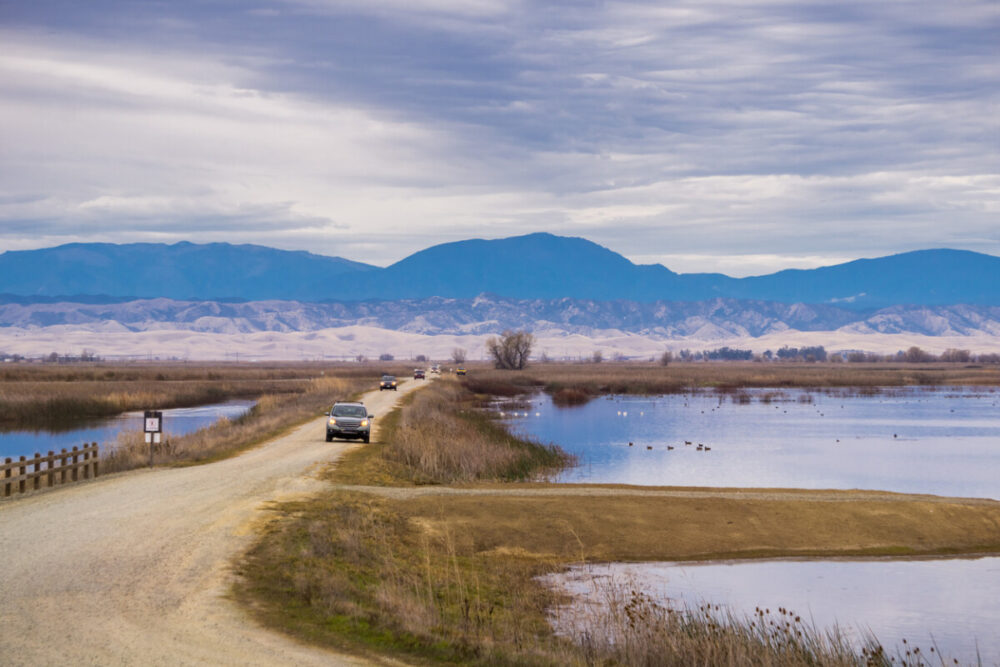
Cars driving on the auto tour route through the restored wetlands of Sacramento National Wildlife Refuge, California. Photo by Sundry Photography courtesy of iStock via Getty Images.
Clear Lake: California’s Big-Bass Factory
A couple of hours north of the Bay Area sits Clear Lake, one of the most fertile natural lakes in the country and a legitimate contender for the best bass lake in California. The nutrient-rich water grows enormous amounts of forage, and that forage grows fat largemouth. The lake routinely produces fish that would be the catch of a lifetime elsewhere, and it does it in numbers.
Spring pre-spawn and spawn—generally from late winter into spring, depending on how warm the year runs—are prime, with fish staging at the transitions between deep water and the shallow spawning flats. Tule edges, docks, rock, and submerged grass all hold fish. Match your approach to the weather: a warming trend pulls fish shallow and aggressive, while a cold front sends them tight to cover and demands a slower presentation.
The Eastern Sierra: Trout in the High Country
Cross the mountains to the Eastern Sierra, and the fishing turns cold, clear, and scenic. The corridor around Mammoth Lakes, Crowley Lake, Bishop, and the June Lake Loop is trout country—rainbows, browns, and the chance at the native golden trout that gives the high country its magic.
The biology is all about cold, oxygen-rich water. These trout thrive in the snowmelt-fed lakes and streams, and the fishing follows the thaw: high-elevation waters fish best from late spring through fall once the snow clears, while the lower lakes open earlier. Crowley Lake is famous for big, healthy trout fattened on its rich insect and baitfish life.
Reading a Sierra stream is the same skill as anywhere—trout face the current and hold where food and shelter meet, behind boulders, in the seams, at the tail of a pool. Drift a fly or a small spinner naturally through those lanes, and you’ll move fish that ignore a sloppy cast.
Photo by DPERKPHOTO courtesy iStock via Getty Images.
San Diego: Trophy Bass and Bluewater Tuna
San Diego is two world-class fisheries in one zip code. Its city reservoirs—the chain of lakes around the county—have historically produced some of the largest largemouth bass ever documented, fish fattened on stocked trout in deep, clear water. The fishing is technical, and the fish are pressured, but the size potential is unmatched.
Then there’s the ocean. San Diego is the launch point for the long-range fleet that runs offshore to catch yellowfin and bluefin tuna, and in warm-water years, the tuna push shockingly close to the coast. Yellowtail, the bulldog of the kelp, calico bass, and white seabass round out the inshore action. The whole offshore game keys on water temperature and bait—when warm water and bait schools move in, usually from summer into fall, the bite turns on hard.
San Francisco Bay and Monterey: Coastal Variety
San Francisco Bay is an underrated fishery hiding under all that fog and traffic. Halibut ambush bait on the sandy flats in spring and summer, striped bass move through chasing schools, and white sturgeon hold in the deeper channels. The strong tidal current dictates everything, so you fish the moving water and the structure that breaks it.
Down the coast, Monterey Bay drops off into a deep submarine canyon nearshore, which draws cold, nutrient-rich water upwelling right against the coastline. That fertility feeds a tremendous rockfish and lingcod fishery over the reefs, plus seasonal salmon when the runs and regulations allow. Bottom fishing here is about finding hard structure and dropping into it; rockfish ambush prey from the rocks, much like bass relate to cover.
Lake Tahoe and the Northern Rivers
For something different, Lake Tahoe holds mackinaw (lake trout) in its deep, cold, impossibly clear water—fish that hold deep and require getting bait down to them. It’s a unique, scenic pursuit best handled with local knowledge of the depths and structure.
The northern rivers—the Sacramento, Smith, Klamath, and Trinity—are the state’s salmon and steelhead arteries. When runs are healthy and seasons are open, fall brings king salmon pushing upriver, and winter into spring brings steelhead. These fisheries are the most regulation-sensitive of all in California, so they’re the ones to research most carefully before planning a trip around them.
Planning 2026 Around the Calendar
The smart way to fish California is to think in seasons, not in single destinations:
Winter: Delta sturgeon, San Diego bass, and lowland trout.
Spring: the bass spawn at Clear Lake and the Delta, plus Bay halibut starting up.
Summer: high-Sierra trout in their prime, and the offshore season building off San Diego.
Fall: peak tuna off the south coast, salmon and steelhead in the north when open, and a strong second bass bite as the water cools.
The other constant is water—temperature, flow, tide, and clarity. A warm year pulls the bass spawn forward and brings tuna close; a heavy snow year keeps the high lakes locked up later but feeds the rivers all summer.
Pick the fishery that fits when you can go, check what’s actually open for 2026, and read the conditions the week you arrive. Do that, and California will hand you more kinds of great fishing than you can fit into a single year—which is exactly the problem worth having.
The post Best Fishing Destinations in California for 2026 appeared first on Wander With Wonder.