Florence made an unexpected literary reminder for me today. Not through a guidebook or a blog, but through Alexander McCall Smith’s 44 Scotland Street series, which you know I really enjoy. I love getting a feel for the atmosphere, and getting to know the characters who live on this Edinburgh street, all with various delightful quirks. Well… perhaps not all delightful.
Stendhal Syndrome
I just finished rereading the 6th book in the series, The Importance of Being Seven. In it, Antonia Collie, a minor character with a tendency to meddle and a rather relentless interest in men, travels to Italy. In Florence, Antonia succumbs to Stendhal Syndrome, and, overwhelmed by the sheer force of Renaissance beauty, she moans and collapses dramatically on the floor of the Uffizi Gallery.
The episode unfolds with gentle humour, yet beneath it lies a truth: beauty is not just a passive decoration in Florence. It is an experience powerful enough to unsettle, astonish, and transform even the worldliest traveller.
Stendhal Syndrome is a psychosomatic condition said to occur when an individual is exposed to an overwhelming amount of beautiful art, particularly in a concentrated setting such as Florence.
The term is named after the French writer Marie-Henri Beyle (better known by his pen name Stendhal), who described a powerful emotional and physical reaction during a visit to Florence in 1817. In his travelogue Rome, Naples et Florence, he wrote:
I was in a sort of ecstasy, from the idea of being in Florence, close to the great men whose tombs I had seen. Absorbed in the contemplation of sublime beauty . . . I reached the point where one encounters celestial sensations . . . Everything spoke so vividly to my soul. Ah, if I could only forget. I had palpitations of the heart, what in Berlin they call ‘nerves’. Life was drained from me. I walked with the fear of falling.
Reported symptoms of Stendhal Syndrome include rapid heartbeat, dizziness, confusion, anxiety, and fainting. Some researchers consider it a cultural or psychological phenomenon rather than a clinically defined disorder.
It is sometimes compared to Jerusalem Syndrome, a rare condition in which individuals experience intense religious preoccupation or delusional episodes when visiting Jerusalem.
Everyday beauty in Florence
You expect grandeur in Florence, don’t you? It is the Renaissance capital of the world, after all. The cradle of art history.
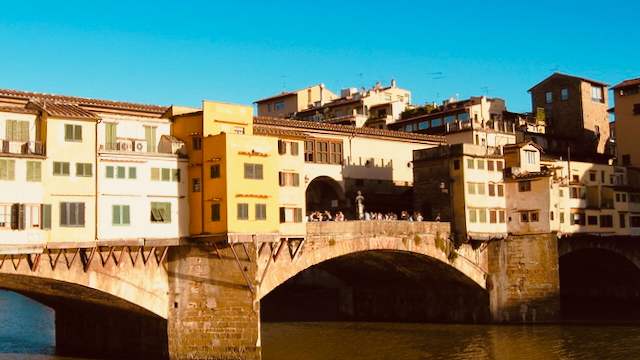
But Florence is not loud. What strikes me first is intimacy. The streets are narrow, and well, domestic. Plants spill from beneath shuttered windows, a bicycle leans casually against a warm yellow wall, unlocked! Scooters hum past. At a gelateria, someone is ordering an almond granita. (I notice, because it’s my favourite). The Arno River floats beneath the Ponte Vecchio, unremarkable and constant. Ordinary stuff, all of it – and yet, somehow that is enough.
Then, suddenly, a church façade appears, in perfect proportion. Beauty exists alongside daily life, not apart from it. A sculpture stands beside a small supermarket. Another masterpiece waits casually in a square. History and everyday routine move together, side by side.
As I walk on, beauty begins to accumulate quietly. And then I realise I have stopped. Like Antonia, I am no longer just observing a city; I am being affected by it. And that is what we want, isn’t it? To be moved. To feel something unexpected. That’s a big part of why I travel – hoping for a wonder, even if only for a moment.
And Florence is good at that. It is like a soft ambush, unsettling and wonderful at the same time.
UNESCO added the historic centre of Florence to its World Heritage list already in 1982, only 4 years after the list was created, specifically naming 25 individual buildings and monuments. This is a city that asks for your time!
Leonardo, from nearby Vinci, one of the most interesting people that ever lived.
Galleria degli Uffizi
I’ve been in Florence a couple of times, but I have not yet visited the Uffizi.
But reading about Antonia and her unusual syndrome, I think it is high time. I’ll find out whether Florence overwhelms me – or whether I’m immune.
Throwback to our first visit, when a certain 6-year-old thought the naked replica of David outside the Uffizi was not cool.
*******
PS What becomes of Antonia, you ask? The story continues in the 7th book, Bertie plays the blues. After her breakdown, Antonia is admitted to a psychiatric hospital, and then sent to a farm in the Tuscan countryside, where she is cared for by nuns. She feels a calling to work with them and eventually to become a nun herself, so she remains there, and sells her flat in 44 Scotland Street.
PPS Florence is twinned with a whole lot of interesting cities, including Bethlehem in Palestine, Kyiv in Ukraine, Sydney in Australia, and… Edinburgh.

Historic Centre of Florence is a UNESCO World Heritage site.
Here are more UNESCO World Heritage sites around the world.
Florence inspired by a fun & easy read is a post from Sophie’s World