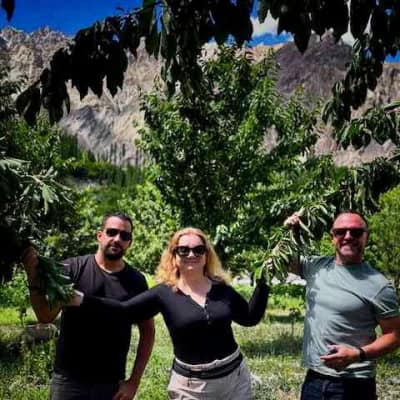
When we left off, we were in a cherry grove in the Hunza Valley, 7,000-metre peaks rising all around us.
Time to continue to Sost, the last Pakistani town on the Karakoram Highway.
Now, Sost is a gateway town. Those are usually more functional than charming, and not somewhere I’d expect to find much to write home about. Still, you never know: sometimes, the most interesting encounters happen in the least promising places.
Sost
Sost marks a change of pace. After days of following the Hunza River through villages, orchards and imposing mountain ranges, we’re now in a busy border town with customs buildings, warehouses and lorries. Lots of lorries. The Sost Dry Port, an important cargo and customs hub on the Pakistan – China trade route, is a reminder that this is a place of business, not tourism.
China is just within reach. What has felt like a distant destination for days, is now just up the road.
Pakistani lorries are waiting to load and unload cargo, ready to cross the Khunjerab Pass into China. Many are elaborately decorated with intricate patterns, vivid colours, polished metalwork and painted panels. They look fabulously theatrical against the stark mountain backdrop.
We spend the late afternoon happily snapping photo after photo. Before long, the drivers notice our fascination and seem genuinely amused. Some wave, others beckon us over, and soon we’re invited to pose beside their lorries – and in their lorries!
Once the first photo has been taken, the smiles grow wider and the requests more enthusiastic. One driver wants another picture; then someone else joins in, laughing as we all squeeze into the frame. What began as an attempt to photograph these magnificent vehicles turns into a cheerful exchange, with the drivers enjoying their moment in the spotlight almost as much as we enjoy capturing it.
So much for Sost being just another border town.
Our last evening in Sost carries a certain anticipation. The Pakistani side of the journey is almost complete. The next morning, passports, customs checks and border gates will replace mountain villages and quiet roads.
Over a final glass of juice (watermelon) on the roof terrace of our lodgings, I think about all the people that have travelled this route before me: merchants, explorers and modern-day adventurers, all following the same corridor through the Karakoram towards the lands beyond.
Karakoram Highway, day 7: Khunjerab Pass and onwards to Kashgar
Today, we leave Pakistan and cross into China. Immigration and customs formalities will take up a good part of the day; crossing this border isn’t exactly straightforward.
Formalities of leaving Pakistan take place at the border terminal in Sost.
We’ll enter Khunjerab National Park towards the pass, and pay an entrance fee (30 USD for foreigners, as at July 2026).
Then, we’ll cross the border at Khunjerab Pass.
Next up is the Chinese customs checkpoint, a ways beyond the border.
Passport control is in Tashkurgan, about a 2-hour drive from Khunjerab Pass.
Once everything is cleared at immigration in Tashkurgan, we can finally continue towards Kashgar, a further 5 hours away.
Since all of China is on Beijing time, we move 3 hours into the future when we leave Pakistan.
There’s one important catch: you can’t simply drive your own vehicle across the border. Only buses are permitted to make the crossing. Travellers normally take a bus, but we’re hoping to reach Kashgar in a single day, so we’ve arranged for a car to take us all the way. Somehow, the driver has managed to get it defined as a bus.
Before leaving Pakistan, we say goodbye to our companions: our fixer, Saqib, and our driver, Ajaz. They’ve been part of our journey through northern Pakistan, and now it’s time to continue without them. They’ve been easygoing company; travelling on our own is going to feel a little strange.
Khunjerab Pass
From Sost, the Karakoram Highway climbs steadily towards the border, and the landscape grows increasingly austere. The trees disappear, the slopes become barren and expansive, and the mountains seem to close in around the road.
The world’s highest highway reaches its highest point at Khunjerab Pass, 4,693 metres above sea level.
It’s a remarkable place to cross an international border, Khunjerab Pass. There is little here beyond mountains, sky, and road. We have followed the Karakoram Highway as far as it will take us through Pakistan. Now it leads us somewhere new: over the pass and into Xinjiang, a region fraught with ethnic and political tension.
Crossing the pass itself is surprisingly matter-of-fact. After all the kilometres travelled, the villages explored and the countless bends negotiated, we suddenly find ourselves at the border, looking across into China. It’s a slightly surreal moment.
The enormous border gate makes it all official, but it’s the mountains that stick with you. We stop to snap a few final photos of Pakistan, and take in the thin air and the extraordinary emptiness around us.
China
On the other side, the landscape looks much the same at first: vast mountains, barren slopes, and the same high-altitude terrain. Yet we’ve crossed into another country, and a new chapter of the journey is beginning.
After passing through the gate, we drive to Chinese customs, where we scan a QR code, and wait whilst our bags are searched, then eventually get the go-ahead to continue.
Driving along, I look at the map and spot names I remember from Pamir: Alichur, Murghab, Karakul. In fact, Murghab, the Tajikistan/Kyrgyzstan border town, looks pretty close. It’s only about 100km away, as the crow flies. In reality, it involves yet another international high-mountain pass to cross, so those 100km would take about 4 hours.
Oddly exciting to think that eight years ago, we were driving along the other side of this border.
Tashkurgan and onwards to Kashgar
Our next and final stop for border crossing bureaucracy is the city of Tashkurgan, about two hours away.
When we finally reach immigration in Tashkurgan, the officials appear to have gone for an early dinner. Or something. Nothing to do but wait until they return from their break.
Eventually, all border crossing procedures are completed. Our paperwork is in order, and we’re officially in China.
Eager to press on, we don’t take the time to explore Tashkurgan. Still, the little I see suggests a place quite different from the scattered settlements and rugged terrain of northern Pakistan. Tashkurgan looks more like a typical Chinese city, with wide, orderly roads and a distinctly modern character. The surrounding mountains, however, are every bit as spectacular as those we’ve left behind.
It’s an odd feeling to realise the road we have been following for so long has carried us from Skardu, through the mountains of Pakistan, and into a place that feels like another world.
In Tashkurgan, we find a taxi to take us to Kashgar. It’s another six hours or so on the road, and by the time we arrive, the sun has long since disappeared.
But that’s a story for another day. For now, we’ve crossed the mighty Khunjerab Pass, negotiated border formalities and made it from Pakistan into China. Not bad for a day’s work.
All photos by Andrew Morland, Tom Brothwell and myself.
A journey along the Karakoram Highway, part II: Crossing the Khunjerab Pass from Pakistan to China is a post from Sophie’s World