When we left off in crazy Kabul, I was standing beneath an enormous white flag, looking out over the city and wondering how I had ended up there. Now it’s time to leave Afghanistan’s capital behind and head to Bamiyan and Band-e Amir.
We meet Ali – our guide for the rest of this Afghan journey – and head west, trading the traffic jams and dusty streets of Kabul for mountains, hair-raising roads, ancient history and some of the bluest lakes I’ve ever seen.
In other words, the adventure is about to get considerably more, erm… vertical.
On the road in Afghanistan
Leaving Kabul, the landscape changes dramatically.
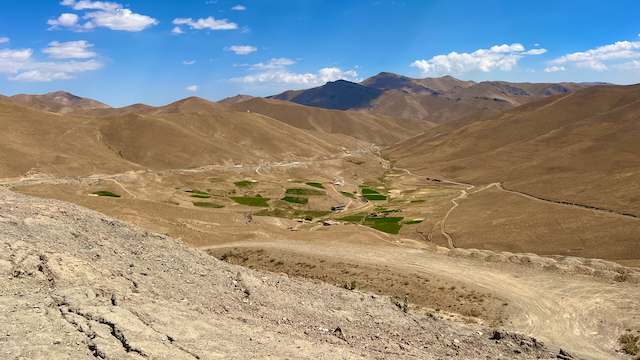
The road towards Bamiyan takes us through increasingly mountainous country, with enormous expanses of rock and barren slopes, broken by occasional farmland and scattered villages.
A little shop along the road to Bamiyan and Band-e Amir. Energy drinks are popular in Afghanistan.
The journey itself is as memorable as the destination. The landscape keeps changing – from valley to mountain to rocky gorge to open plains. And there is an extraordinary sense of remoteness.
There are several Taliban checkpoints along the road between Kabul and Bamiyan. We are stopped once and asked to show our passports. At all the others, we are simply waved through without questions. I just have to remember to slip my headscarf on before approaching one.
In short, no problems.
Eventually we reach Bamiyan, where we make a brief lunch stop, then head directly to Band-e Amir.
The long way round to Band-e Amir
We don’t take the main road to Band-e Amir. Instead, we take an alternative road, because there are no checkpoints on this route. Women travelling the main road to Band-e Amir are frequently stopped.
This backroad is a narrow track cut into the mountainside. On one side is rock; on the other is a sheer drop. There are no guardrails, and for long stretches the edge of the road seems to disappear straight into the valley below.
It is quite possible for two cars to pass each other here, Ali insists. I refuse to believe it. And if one appears, I am definitely getting out of the car until that passing has, well, passed.
Our driver is excellent, which is just as well. We round a bend and there’s a lone donkey, just centimetres from the drop. I sit very still until we are safely past.
Careful, little one!
Then comes another bend. And another.
The road twists around and around. Loose stones crunch beneath the tyres. Looking out of the window gives me an uninterrupted view straight down the mountainside, so I quickly decide that looking ahead is the better option. Or even close my eyes altogether. Psychology is a funny thing.
At one point the road curves around a cliff and I can see the valley opening up below. Far far below. There is nothing between the car and the drop. No crash barrier, no fence, nothing but a narrow strip of road and empty space.
The driver carries on calmly, negotiating the bends as though this is the most normal journey in the world.
All of a sudden a small hill appears. Strangely, the driver speeds up. We’re all wondering what is on top of this hill.
Mel filmed this little short from the front seat. Watch till the end .
What a relief to get out of the car, even if only for a few minutes!
The six lakes of Band-e Amir
Once I remember to breathe again, I realise we’re now on a plateau. I take a look around, and there they are: lakes so impossibly blue they almost don’t look real.
No photo could have prepared me for this stunning scene.
Band-e Amir is Afghanistan’s first national park. Deep blue water sits between vast cliffs of pale rock, with almost nothing around it to interrupt the view. The six lakes are separated by natural travertine (freshwater limestone) dams high in the mighty Hindu Kush range, creating a series of enormous pools. The intense colour is a result of the pure mountain air and exceptionally clear water.
Up on the plateau is a lone motorbike, and a guy – its owner, presumably – just sitting there, just at the cliff edge!
I daren’t look at him, for fear of having to watch him fall off, so I focus on the bike instead.
After the chaos of Kabul and the precarious mountain road, the silence up here is extraordinary. No horns, no traffic, no city noise, no wafting evil eye-protective smoke in our face. Just mountains, water and an enormous sky.
Five minutes ago, I swore never to get on this terrifying road again. Now, standing here looking out over the lakes, I think that, somehow, it was worth every single kilometre.
Band-e Amir village and Lake Band-e Haibat
We make our way down to the village, a very relaxed place. The village comprises a little street with a few shops and a few places of accommodations up in the hills around. The vibe is relaxed. I’m also fairly relaxed, more so than just a few minutes ago. Although… I can’t stop thinking about the return. We are taking the main road back, and Ali says it is much worse. Ouch!
A 10-minute walk from the village is Band-e Haibat, the largest and deepest of the six lakes.
A few locals are out on the lake in paddle boats shaped like swans, and of course we have to join in. (Renting a swan costs 300 Afghani – 4 EUR/5 USD – for 1 hour.)
Soon we’re bobbing around on this startlingly blue water, mountains all round. It feels a bit surreal – part mountain expedition, part holiday resort.
David even takes the opportunity to have a swim. Watching him disappear into the water, shimmering against the barren Hindu Kush mountains, miles and miles from anywhere even remotely familiar, makes the whole scene feel otherwordly – as if we have wandered into some kind of mountain dream.
View from the swan
The sun is making its final descent. It’s time to leave the lake and wander back to Band-e Amir village. Someone is cold and wet, and needs a cup of tea.
After the spectacular landscape, the village seems almost ordinary: a small settlement where everyday life carries on beneath some of the world’s tallest mountains. It is a useful reminder that this isn’t simply a beautiful backdrop for travellers; people actually live and work here.
In the village we meet a Polish traveller who is motorbiking through Afghanistan on his own. He has had some trouble finding a place to sleep in the village; not everywhere is open, or available to, foreigners.
Band-e Amir village
The main road back
And now it’s time for the road back to Bamiyan, where we’ll spend the night. I’m wondering (read: dreading) just how much worse the main road can possibly be? And now we’re doing it in the dark! I brace myself.
As it turns out, Ali’s definition of a bad road is rather different from mine.
For Ali, a bad road is a bumpy road. For me, a bad road is a narrow strip of gravel clinging to the side of a mountain with a sheer drop a few centimetres from the tyres.
The main road is, indeed bumpy. Very bumpy. But it is also wide, and, most importantly, nowhere near any terrifying drops. I’ll take bumpy any day.
Turns out I have been worrying for nothing.
Today began in the hustle and bustle of Kabul. After the long road across the mountains to Bamiyan and Band-e Amir, scary backroad included, and just the sheer drama of the landscape, I can’t imagine a more spectacular end to the day.
Next day in Bamiyan
Bamiyan itself sits in a broad valley surrounded by dramatic mountains and today is our day to have a wander around Bamiyan.
Unfortunately, my digestive system has other plans.
During the night, whatever has been brewing finally declares war. I’m not blaming Afghan food – this is on me and my apparent ignorance of the paralysing effect of loperamide. I was in Haiti very recently; a mild stomach upset started there, and apparently I over-compensated.
So whilst Mel and David head out to explore the valley, I remain firmly attached to my hotel room this morning. A shame, because I have really been looking forward to it, especially seeing the place where the ancient Buddhas once stood.
Two centuries-old Buddha statues once stood carved into the cliffs here, 55 and 38 metres high, respectively. In 2001, the Taliban destroyed them, leaving only the huge empty niches.
Sadly, this is as close as I get. Isn’t it just the most magnificent view from a hotel room balcony ever, though?
It is a strange sensation, looking over at something I know through photographs and history books, and then realise that what I am actually looking at is the space where it used to be.
And even from here, the empty spaces are striking – because the sculptures are gone. I am looking at absence. A huge absence. Something stands here for nearly 1500 years, and then suddenly they are no more.
It is possible to climb up into the Buddha niches and explore the caves behind them, and view the valley from inside. No standing directly in front of them or climbing the cliffs for me. But here are some of David’s visuals, to give you an idea:
up the stairs –
– and from the inside looking out:
The site is testimony to the tragic destruction by the Taliban of the two standing Buddha statues, which shook the world in March 2001.
There is something profoundly sad about looking at these enormous empty niches. This feels like one of the saddest UNESCO World Heritage sites I have ever seen – and I’ve seen a few…
It isn’t quite how I imagined experiencing Bamiyan. But perhaps that is fitting in its own way. The empty niches are what remain, and for me, they become the view from a hotel balcony.
Three days, a thousand impressions
Three days in Afghanistan isn’t nearly enough time to understand the country, of course. It isn’t even enough time to scratch the surface.
But it is enough to produce an absurd collection of memories: Kabul traffic that seems to operate according to its own laws, buying an abaya, wandering through the delightful silence in Babur Garden, browsing the shops of Chicken Street, being confronted with an endless succession of carpets and buying a completely outrageous one covered in Kalashnikovs, tanks and helicopters, watching a craftsman cut a gemstone, standing beneath an enormous Afghan flag, looking out across the mesmerising blue of the Band-e Amir lakes, and finally seeing the empty niches of the Bamiyan Buddhas (from the balcony).
This has been a journey of extraordinary contrasts.
Chaotic and peaceful. Ancient and startlingly modern. Crowded and almost completely empty. Beautiful and marked by a history that is impossible to ignore.
And on the floor in the hall back home, I have that insane Afghan carpet.
Every time I look at it, I remember the shop, the mountains, the traffic, and the slightly surreal thought that, yes, I really did travel halfway across the world and came home with an Afghan war rug.
A few Afghanistan practicals
We booked our journey with Ali Reza Mahboobi. He suggested a route and accommodation options, and made any changes we wanted (and we did want a few). We were probably not the easiest of customers; Mel and I stayed three days, whilst David stayed a few extra days and visited Mazar-i-Sharif, as well. We happily recommend Ali’s services. PM me for his WhatsApp.
We stayed one night each at Kabul Intercontinental Hotel (no relation to the international chain), Bamyan Royal Hotel, and Kabul Central Hotel. All were fine.
All photos by Melissa G. Mitruen, David Røgler, and myself.

Cultural Landscape and Archaeological Remains of the Bamiyan Valley is a UNESCO World Heritage site.
Here are more UNESCO World Heritage sites around the world.
Bamiyan and Band-e Amir: Into the mountains of Afghanistan is a post from Sophie’s World