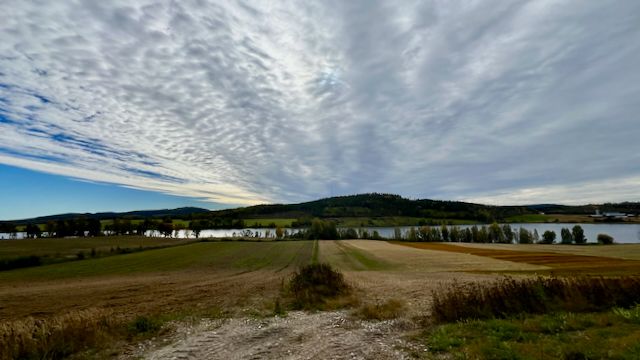
Travelling through Sweden, the province Hälsingland is easy to overlook. At least, it has been for me. Every time I have been in the neighbourhood, I’ve kind of forgotten about it. Even when driving in Dalarna, the province next door, to visit the UNESCO-listed Falun Copper Mine some years ago, it didn’t occur to me to stop by Hälsingland.
But realising the decorated farmhouses in Hälsingland was the only World Heritage site in Sweden I had not yet visited, it was time to set things right.
I set off from Stockholm’s Arlanda airport early this morning, in a hired Volvo EX30 (sharp, clean design, very comfortable ride, but terrible battery range) and headed north on the E4 motorway. Although… it’s only really a motorway part of the way. After Gävle, it becomes a road that alternates between having 1 and 2 lanes in either direction, allowing for passing every few kilometres. Must admit, it’s rather practical, and it doesn’t have the huge cost – for both the national budget and for the forest environment – of building a full 4-lane motorway. But I digress.
The decorated farmhouses in Hälsingland
Driving through Hälsingland is pleasant. The roads wind through forests and open farmland, past red wooden houses and quiet villages. Here and there, solid timber buildings, painted in familiar reds and surrounded by barns and fields. Typical traditional Swedish farmhouses.
In fact, there are ca 1,000 preserved, historic farmhouses – Hälsingegårdar – in this region.
In 2012, UNESCO added seven of them to its World Heritage list. These seven are merely a snapshot of Hälsingland’s heritage. Many unlisted farms are just as impressive, often with even more spectacular interiors.
Bommars
Bortom Åa
Erik-Anders
Gästgivars
Jon-Lars
Kristofers
Pallars
Most of the farms are named after the original owners in one way or another, except Bortom Åa (meaning Beyond the River), and Gästgivars (meaning Innkeepers’ Farm). Bommars belonged to the Bommar family; Kristofers was named after Kristofer, and Pallars is a contracted and shortened version of Pål Andersson. Erik Andersson built Erik-Anders, and Jon and Lars Andersson, two brothers, built Jon-Lars. (Although… an info board outside Jon-Lars claim the brothers were named Anders and Olof…?)
Ol-Anders
In the 1,000-year-old farming community of Alfta, I find Ol-Anders farm. This is not one of the seven, but it’s a good stop anyway, both because this house from 1575 is quite beautiful, and there is a UNESCO visitor centre here, as well as an emigrant museum.
Trouble is… it’s all closed for the season. Spoiler alert: the same is going to happen with all the rest.
So, there I am, stuck on the outside looking in, much as at the Stocklet House in Belgium. Though at Stocklet, that was because it isn’t open to the public at all. Here, it’s the result of bad planning – or rather, no planning – on my part.
Live and learn. Maybe.
Ol-Anders was built by yet another Andersson: Olof. You won’t be surprised to learn it was – and still is – the second most common Swedish surname.
On an info board by Ol-Anders, I learn there’s a dedicated trail – the 28-kilometre-long Stora Hälsingegårdars väg (Great Hälsingland Farm Trail) – between Alfta and Edsbyn. Along this trail are several farmhouses, including two of the listed ones – Jon-Lars and Pallars. Off I go.
I enjoy the drive. There are no grand city streets or famous landmarks here, just forest and peaceful countryside.
For long stretches it’s just me and the road, with sunlight flickering through the pine trees. Every now and then it opens onto fields of tall grass, red farmhouses and barns weathered silver by the seasons. The air smells of warm earth. After a while, the rhythm of the road becomes part of the journey.
I stop whenever something catches my eye. A small village. An old church. Fika at a roadside cafe.
I also notice that I am looking at the landscape differently. The farms no longer seem like isolated old houses. They are part of a much larger story – of families, farming, craftsmanship and generations of people who wanted to make their homes beautiful.
Jon-Lars
Jon-Lars is by far the largest of the seven, and very well preserved. The farm has been in the same family since the 1600s, and is still in use, so I don’t step beyond the gate.
Two brothers built this together and furnished one half of the house each.
Pallars
Pallars is also a family home, and you cannot just pop around outside designated visitor days. Understandable, of course. This is as close as I dare go:
I wonder what it feels like living in a UNESCO-listed farmhouse.
Back on the trail, I pass the 18th century Alfta Church, and feel compelled to stop and look.
Wandering through the quiet paths of the adjacent cemetery, I notice that many of the old gravestones carry familiar names. The air seems especially still here. Subdued. A chance to think about the generations of people whose lives are woven into this landscape.
By late afternoon, the light turns warmer. I drive on, passing red farmhouses glowing against the green of the countryside.
Hälsingegård Västerby
One of the Hälsingegårdar not on the list is Västerby, an old, clustered village comprising around thirty buildings, some dating back to the 17th century.
Hälsingegård Västerby
Erik-Anders
About an hour east of Alfta, in the Söderala community, I arrive at Erik-Anders.
Interiors of the decorated farmhouses of Hälsingland
You (and I) will want to see the inside of the farms, with the elaborate wall paintings and interior murals. Beautifully decorated rooms made for weddings, feasts and visiting guests. People living ordinary rural lives yet choosing to fill a room with colour and imagination.
Here is one extremely rare exception to our strict ‘only photos snapped by us’- rule:
Photo: Ovanåkers kommun (Ovanåker Municipality)
Practicals
The decorated farmhouses in Hälsingland are a 3-hour drive from Stockholm.
Don’t make the same mistake as I did. Check opening times:
Ol-Anders farm/visitor centre: Ovanåker Municipality (use google translate) or email tourism@ovanaker.se.
Erik-Anders farm: Erik-Anders, or email info@erik-anders.se. You can stay at a bed-and-breakfast at Erik-Anders, which would be a very cool experience. More info here.

Decorated Farmhouses of Hälsingland is a UNESCO World Heritage site.
Here are more UNESCO World Heritage sites we have visited around the world.
Hälsingland’s decorated farmhouses: A Swedish road trip is a post from Sophie’s World