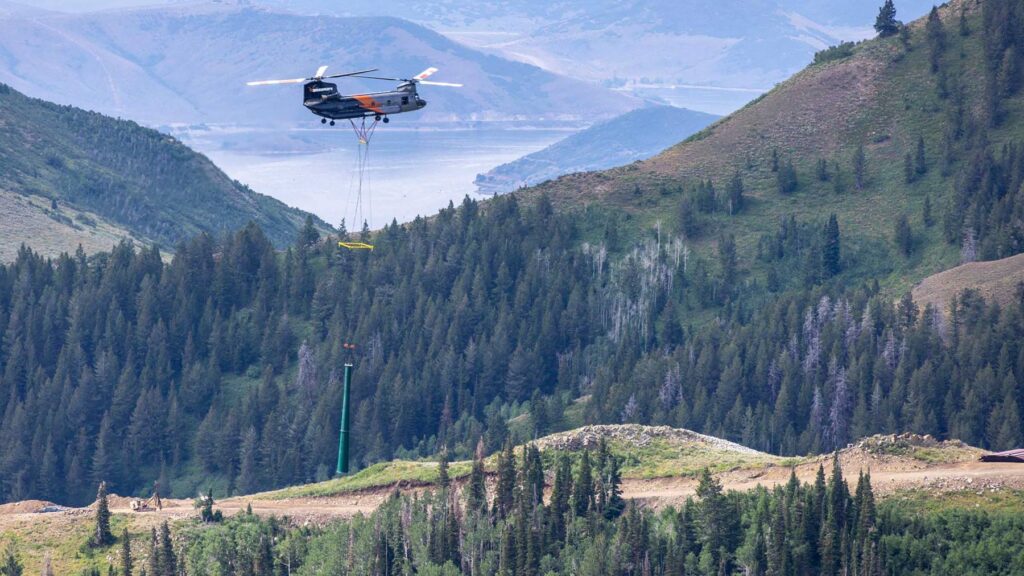
Deer Valley Resort is heading into the 2026/27 ski season with another major addition, and this one arrived with a little mountain drama. Helicopters recently hovered above the resort’s newest terrain, carefully lowering chairlift towers into place for Hail Peak Express, the latest piece of Deer Valley’s rapidly growing East Village expansion.
When the new lift opens this winter, it will unlock another 200 acres of skiable terrain and seven new runs on the eastern edge of the resort. Deer Valley is scheduled to open for the season on December 5, 2026, conditions permitting, and returning skiers may find that the mountain feels noticeably different from the one they remember.
The reason is simple. Deer Valley has been expanding at a remarkable pace, adding terrain, chairlifts, snowmaking, parking, dining, and entirely new guest areas as part of its ongoing Expanded Excellence initiative. Since December 2024, the resort has more than doubled in size, making the upcoming season another milestone in one of the biggest transformations in modern skiing.
Helicopters Bring Deer Valley’s Newest Chairlift to Life
Photo Credit: Deer Valley Resort.
Chairlift construction is usually hidden from guests until a new lift quietly appears on a trail map, but Deer Valley turned the installation of Hail Peak Express into a memorable mountain spectacle. On September 9, 2026, invited spectators watched helicopters transport and position the steel towers that will support the resort’s newest lift.
Using helicopters for this type of construction allows crews to place heavy equipment in steep, rugged terrain without relying entirely on temporary roads or large ground vehicles. It also offered a rare behind-the-scenes look at just how much engineering goes into building access to a new section of mountain.
Deer Valley Resort President and Chief Operating Officer Todd Bennett described the construction as a major turning point in preparations for the upcoming ski season. He said the resort is building on the momentum of last winter’s historic expansion while continuing to increase access and open new terrain.
For skiers, the most important part of that progress is what happens once the lift starts spinning. Hail Peak Express will make an entirely new collection of runs accessible from Deer Valley East Village, further extending the ski experience into terrain that was not part of the resort only a few seasons ago.
Hail Peak Express Adds 200 Acres and Seven New Runs
Photo Credit: Deer Valley Resort.
Hail Peak Express will transport skiers from Deer Valley East Village to new terrain on Hail Peak, opening 200 additional skiable acres. Seven new runs are scheduled to debut with the lift during the 2026/27 season, giving visitors another reason to explore the rapidly developing eastern edge of the resort.
The lift itself will feature 86 chairs and is designed to move approximately 2,400 people per hour. Its haul rope stretches 8,099 feet, while the lift covers an inclined length of 3,975 feet and climbs approximately 1,130 vertical feet from bottom to top.
Those numbers translate into something much more interesting once you are on skis. Hail Peak Express will create another substantial vertical zone within Deer Valley, giving guests access to long laps and fresh terrain without requiring them to cross the entire resort.
That matters even more as Deer Valley continues to grow. At 4,500 skiable acres, the resort is no longer a place where most skiers will casually cover everything in one day, and new lifts like Hail Peak Express are turning individual sections of the mountain into destinations of their own.
One New Trail Comes With a Local Utah Connection
Photo Credit: Deer Valley Resort.
Among the seven runs opening on Hail Peak is one with a distinctly Utah name. “Hill Yeah” pays tribute to Hill Air Force Base in northern Utah and ties into Deer Valley’s Salute to Service program for military members and their families.
The Salute to Service initiative includes special lodging, lift ticket, and resort offerings designed for members of the military community. Naming one of the newest trails after Hill Air Force Base gives that relationship a permanent place on the mountain.
Ski trail names often carry bits of local history, culture, or humor, and Hill Yeah fits neatly into that tradition. It also gives skiers one more story to associate with terrain that will be completely new when the season begins.
Deer Valley Will Offer 4,500 Skiable Acres This Winter
Photo Credit: Deer Valley Resort.
The scale of Deer Valley’s expansion becomes especially clear when looking at the resort’s current mountain statistics. For the 2026/27 season, Deer Valley expects to offer approximately 4,500 skiable acres spread across 209 runs.
The resort’s highest elevation now reaches 9,570 feet, while its lowest elevation sits at approximately 6,450 feet. That creates a total vertical drop of 3,120 feet, with the longest run stretching approximately 4.8 miles.
Deer Valley will also operate 32 aerial lifts, including two gondolas, 23 detachable chairlifts, and seven fixed-grip chairlifts. Another eight surface lifts and conveyors serve learning areas and other specialized zones.
For travelers who remember Deer Valley as a relatively compact luxury ski resort near Park City, those statistics tell an important story. The mountain has become dramatically larger, and the expansion has created more opportunities to spend a full day exploring different zones instead of repeatedly returning to the same familiar terrain.
Eleven New Lifts Have Arrived Since December 2024
Photo Credit: Deer Valley Resort.
Hail Peak Express is only the newest addition in an aggressive lift-building program that has transformed Deer Valley in less than two years. Since December 2024, the resort has added Keetley Express, HooDoo Express, Aurora, Galena Express, Pioche Express, Neptune Express, Vulcan Express, Revelator Express, Pinyon Express, Hail Peak Express, and the Deer Valley East Village Gondola.
Adding that many lifts in such a short period has changed how skiers move through the resort and how quickly they can access different areas. It has also shifted some of Deer Valley’s focus toward the East Village, which is emerging as one of the most important gateways to the expanded mountain.
The Deer Valley East Village includes approximately 1,200 day-skier parking spaces, giving visitors another major place to begin their ski day. For guests staying on the eastern side of the resort, that can mean easier access to new terrain without first traveling through Deer Valley’s traditional base areas.
For returning visitors, it may be worth studying the trail map again before arriving. Entire areas that were once outside the resort boundary are now part of the Deer Valley experience.
More Terrain Means More Snowmaking
Photo Credit: Deer Valley Resort.
Adding hundreds of acres of terrain also creates a need for more reliable snow coverage, particularly early in the season and during stretches of limited natural snowfall. Deer Valley is responding by expanding its snowmaking system to cover approximately 932 acres.
One of the biggest infrastructure projects supporting that effort is a new 10-million-gallon reservoir located southwest of Park Peak Lodge. The reservoir will work alongside the existing Summit Pump House to increase snowmaking capacity throughout the expanded resort.
According to Deer Valley, approximately 80 to 90 percent of the water used for snowmaking eventually returns to its original water source through the natural watershed. Those sources include the Jordanelle Reservoir and the Provo River.
For skiers planning expensive winter vacations months in advance, snowmaking capacity can be just as important as average annual snowfall. While no mountain can guarantee conditions, stronger snowmaking systems give resorts more tools to open key trails, maintain high-traffic areas, and recover after warm or dry weather.
Deer Valley East Village Is Becoming a Major Base Area
Photo Credit: Deer Valley Resort.
The East Village is quickly becoming much more than a new place to park and load a lift. Deer Valley is building the area into a full-service resort hub with lodging, skier services, dining, and direct mountain access.
Construction is underway on the Deer Valley East Village Lodge, which is scheduled to open for the 2027/28 winter season. The lodge is expected to include ski school facilities, rental operations, and a food hall, giving East Village visitors many of the services traditionally associated with a primary base area.
Interior infrastructure work will continue through the fall as the resort prepares the building for future operations. Once completed, the lodge should make East Village feel less like an extension of Deer Valley and more like a destination within the resort.
That could be especially appealing for travelers who prefer to stay close to the newest terrain. As lodging and dining options expand around the East Village, it may become increasingly practical to plan an entire Deer Valley trip around this side of the mountain.
Park Peak Lodge Will Add Major Dining Capacity
Photo Credit: Jenn Coleman.
Dining has always been an important part of the Deer Valley experience, and the resort is making sure its food and beverage infrastructure grows alongside the ski terrain. Park Peak Lodge is currently under construction and is also scheduled to open during the 2027/28 winter season.
The building’s core and shell are expected to be completed this fall, while interior construction will continue through the 2026/27 winter. Plans include multiple dining spaces, a restaurant, a bar, and a large first-floor concept called the Live Fire Food Hall.
The food hall is expected to include approximately 860 seats and serve around 2,500 guests during lunch. That is a significant amount of capacity, and it should help reduce one of the most common frustrations at large ski resorts, which is trying to find a table during the busiest part of the day.
For travelers who view lunch as part of the mountain experience rather than simply a break between runs, this kind of investment matters. Deer Valley has long positioned dining as a core part of its identity, and Park Peak Lodge appears designed to carry that philosophy into the resort’s newest terrain.
Deer Valley Is Changing Without Abandoning Its Luxury Identity
Photo Credit: Deer Valley Resort.
Deer Valley built its reputation around polished service, beautifully groomed terrain, destination dining, upscale lodging, and a ski-only policy. Even as the resort becomes significantly larger, those characteristics remain central to its identity.
The interesting question is how the resort maintains that experience while serving guests across 4,500 skiable acres and dozens of lifts. The current expansion suggests Deer Valley is trying to solve that challenge by building infrastructure at the same pace as terrain.
New parking, larger restaurants, expanded snowmaking, additional lodges, and new lift systems all help distribute skiers more effectively across the mountain. Deer Valley also continues to limit daily lift ticket sales, a policy intended to manage the number of guests using the resort each day.
For adult professional travelers who like combining skiing with luxury lodging, destination dining, spa time, and well-developed guest services, that balance may be one of the most important elements of Deer Valley’s growth.
The 2026/27 Season Gives Returning Skiers a Reason to Come Back
Photo Credit: Deer Valley Resort.
Perhaps the most compelling aspect of Deer Valley’s current expansion is how quickly the experience is changing. Someone who visited just a few winters ago has not really seen the current version of the resort.
New terrain, additional lifts, different access points, and major construction projects mean Deer Valley is evolving from one season to the next. Hail Peak Express may be the most visible addition for 2026/27, but it is only one chapter in a much larger transformation.
For returning guests, that creates a rare opportunity to rediscover a familiar destination. Instead of simply repeating favorite runs and restaurants, visitors can spend time exploring parts of the resort that did not exist during previous trips.
That sense of discovery may become one of Deer Valley’s biggest strengths over the next several years. The resort is large enough now that even longtime guests may find themselves studying the map and planning new routes through unfamiliar terrain.
Deer Valley’s Transformation Is Far From Finished
Photo Credit: Deer Valley Resort.
Watching helicopters lower chairlift towers onto a Utah mountainside is a dramatic way to announce a new ski season, but the real significance of Hail Peak Express will become clear once skiers start loading those chairs.
The lift adds another 200 acres and seven runs to a resort that has already undergone an extraordinary transformation. At the same time, Deer Valley is expanding snowmaking, building new lodges, developing the East Village, increasing dining capacity, and creating infrastructure designed to support an entirely different scale of ski experience.
For travelers who have not been to Deer Valley recently, the 2026/27 season may feel less like a return trip and more like visiting a new resort with a familiar name. The mountain is bigger, the trail map is more complicated, and the East Village is becoming a destination of its own.
And Deer Valley is still building.