Bridges are among my favourite architectural structures.
I really enjoy walking through old covered bridges, such as the one that forms the border between Switzerland and Liechtenstein. I also like cool railway bridges, and last year, I had fun exploring the engineering marvel that is the Landwasser Viaduct, seeing it from different angles.
Today, let’s head to Scotland for another one:
The Forth Bridge
Few sights capture Scotland’s industrial heritage quite like the Forth Bridge. Rising above the waters of the Firth of Forth, the huge red steel framework is visible from miles away.
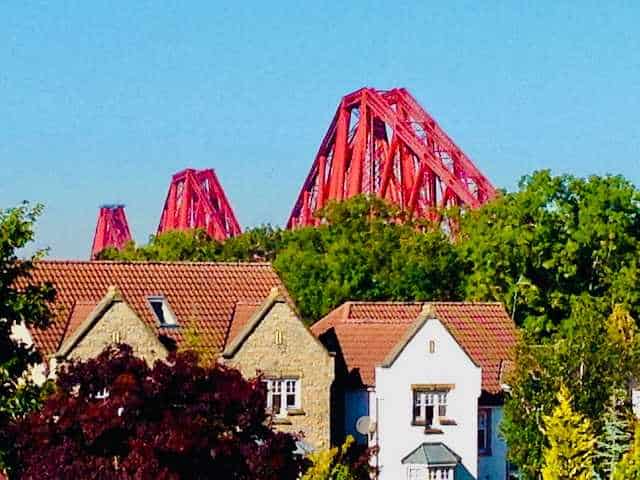
In fact, I’ve never managed to see this bridge without slowing down a bit. Even in photos, even when I already know what’s coming, it still has that effect: this vast red geometry stretching across the Firth of Forth. It’s as if someone decided a railway crossing should also be a statement.
It kind of dominates the neighbourhood – wonder what the residents think.
Then
The Forth Bridge was opened in 1890, at a time when Britain’s railway network was transforming travel, commerce, and industry.
It was built by two Victorian civil engineers, Sir John Fowler and Sir Benjamin Baker, in the wake of the Tay Bridge disaster in 1879, which showed that “good enough” engineering clearly wasn’t good enough anymore. John and Ben were determined to create something exceptionally strong, and built a huge cantilever bridge of steel, with three enormous arms balancing forces. Logic visible to all.
When they finished, the bridge stretched over 2.5 kilometres, and it quickly became an international symbol of engineering excellence.
And now
Looking at it today, it feels oddly modern in its confidence as it carries trains between Edinburgh and Fife, just as it has done for more than 130 years. That cantilever design was revolutionary in the late 19th century and is still fascinating now in the 21st.
There’s something personal about the scale of it. You don’t really view the Forth Bridge so much as recalibrate around it. From South Queensferry, it dominates the sky in a way that makes everything else feel a bit, well, temporary.
It isn’t just history frozen in place, this structure. Trains still cross constantly. This is a working piece of infrastructure that also happens to be iconic.
In 2015, UNESCO recognised that dual identity by granting it World Heritage status. The listing is about beauty and age, but above all it iss about significance: the bridge as a landmark in global engineering history, and as a defining example of large-scale steel construction. It now sits among sites considered to have outstanding universal value, which feels appropriate. This is a structure that quietly shaped how people learnt to build big things safely.
But the technical achievement and the heritage status aside, what I like, is the feeling that the bridge doesn’t quite belong to any single category. It’s industrial and elegant, heavy and precise, ordinary in function but extraordinary in presence. You don’t need to be an engineer to feel that contradiction – you just need to look at it for a minute longer than you planned.
How and where to see the Forth Bridge
If you’re on a train, the Forth Bridge will arrive suddenly, fill your window, and then disappear again. If you’re too preoccupied with your phone, you might miss it.
I like seeing it from the waterfront at South Queensferry, where you really get a feel for its scale, or, for a different perspective, go underneath those massive steel spans on a boat trip on the Firth of Forth.
Take the train from Edinburgh’s Waverley train station to Dalmeny. The trains are frequent, take 15 minutes and cost GBP 6.
World at a Glance is a series of short articles here on Sophie’s World, with a single photo, portraying curious, evocative, happy, sad or wondrous, unexpected encounters.

The Forth Bridge is a UNESCO World Heritage site.
Here are more UNESCO World Heritage sites around the world.
The Forth Bridge: Scotland’s steel icon is a post from Sophie’s World