The Asulkan Valley Trail to Asulkan Cabin is another spectacular hike in Glacier National Park featuring up-close mountain and glacier views. It’s a hard and sometimes steep hike that follows Asulkan Brook through the forest with views of waterfalls and mountains to reach a steep glacial moraine. From there it’s simply a matter of putting one foot in front of the other for about 50 minutes to reach the end of the trail. Then it’s an easy one-minute hike over to Asulkan Cabin. None of the hiking is technical.
While Asulkan reportedly means goat in one of the local First Nations dialect, we never did see a mountain goat and the best we could do was three marmots. This trail is also the domain of black and grizzly bears – so use your voice frequently to alert them of your presence and keep your bear spray handy.
The 15.8 km return hike to Asulkan Cabin gains 870 m over just 7.9 km – so expect a workout, especially on the final steep moraine. The hike is exceptional – with glaciers and mountains that feel like you could reach out and touch. While it isn’t as popular as the superlative Abbott Ridge hike with its spectacular high-elevation viewpoint or the steepest official day hike in the park – the Hermit Trail, it is very much worth doing.
This post includes some affiliate links. If you make a qualifying purchase through one of these links, I will receive a small percentage of the sale at no extra cost to you. Thank you very much for your support.
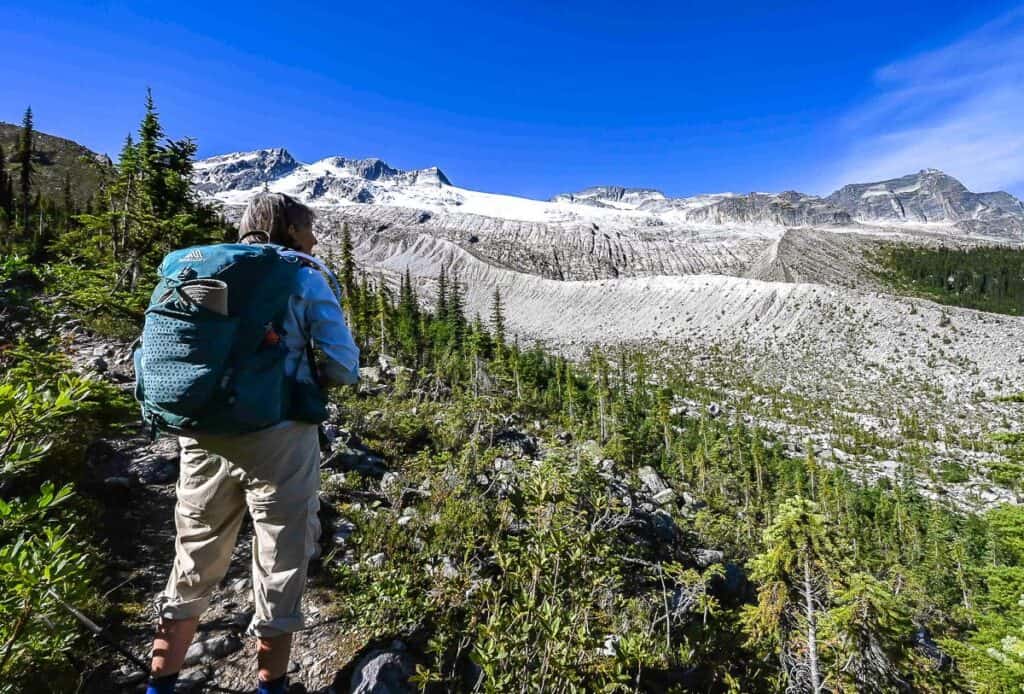
Incredible views of the moraine and Asulkan Glacier on the steep hike up the moraine
Asulkan Valley Trail: At a Glance
Hikers – please take personal responsibility for your safety by researching conditions, preparing appropriately, and making informed decisions.
Distance: 15.8 km (9.8 miles)
Elevation gain: 870 m (2,854 feet)
Difficulty: Hard
Time needed: 5.5 – 7 hours
Type of hike: Out and back
Permits: Canada National Park entry pass
Trail conditions: Always check trail reports before you go.
Trailhead: Just up from the Illecillewaet Campground (near Rogers Pass)
Best season: Mid to late July through to the end of September (depends on snowpack)
Dogs: Permitted on leash
Looking down the length of the Asulkan Valley from just above the Asulkan Cabin
Getting to the Asulkan Valley Trailhead
The Asulkan Valley Trail starts near the Illecillewaet Campground, off the Trans-Canada Highway in Glacier National Park, British Columbia. The turnoff to the campground is about 45 minutes east of Revelstoke and about an hour west of Golden, depending on traffic and construction.
If you arrive early you can park near the campground – with overflow happening along the road. There is also a parking area just after you get off the Trans-Canada Highway but it will add 2 km return to your hiking day.
How to Access the Illecillewaet Campground
Access to the Illecillewaet Campground is from the Trans-Canada Highway. If you’re heading east, there is an obvious signed turnoff. But if you’re heading west, you must continue for about 1.5 km to use a marked U-turn route. You’ll need to be in the far left lane to make the turn. After you’ve made the U-turn, you can get back on the Trans-Canada Highway heading east – and look for the signs for the Illecillewaet Campground.
View of the Illecillewaet River and Cheops Mountain from the bridge as you start on the day’s hike
Hiking the Asulkan Valley Trail
The Asulkan Valley Trail is well-signed and easy to follow. The trail follows the Asulkan Valley though the forest to meet a trail heading up a steep moraine. Once at the top the Asulkan Cabin is just a minute’s walk away.
From the Trailhead to the Asulkan Valley
From the Illecillewaet Campground head up the road and go right. Cross the Illecillewaet River to reach the trail sign pictured below. Follow the arrow passing the remains of Glacier House – a 90-room resort with service that ended in 1926.
Enjoy easy hiking on a wide trail to reach a bridge over Asulkan Brook. From there follow the trail as it parallels the brook climbing through forest. This is the section where we made a lot of noise in case there were any bears around. We did see three marmots on the rocks but that was it for wildlife.
When the forest starts to open up you can see the curving trail on the moraine ahead. Cross the temporary bridge and hike for another 10 minutes through the forest to reach the trail that heads up the moraine.
Asulkan Valley Trail signage near the start of the hike
The ruins of Glacier House
Starting off across Asulkan Brook
Morning walking before the sun has hit the Asulkan Valley Trail
Through the trees with some August wildflowers around
We can see our route up the curving steep moraine at the top left of the photo
This is the second of the bridges that gets removed on the Asulkan Trail by the end of September
Climbing the Moraine to Asulkan Cabin
Climb the steep moraine on a narrow ridge – enjoying first-class views of mountains and glaciers as you ascend. You’ll top out at a sign that says End of Trail. Look up to admire Youngs Peak and Asulkan Pass before turning left and finishing the hike to Asulkan Cabin.
We sat on the steps of Asulkan Cabin (no one was there) and enjoyed our lunch with a view. After we climbed a ridge behind the hut for even better views and followed another one just above the hut for Asulkan Valley views.
You feel like you can reach out and touch the Asulkan Glacier
Watching dads and young daughters descend the moraine after spending two nights at Asulkan Cabin
Close-up of Leda, Pullox, and Castor Peaks
It feels good when you see the End of Trail sign (with Youngs Peak behind it)
Me just above the Asulkan Cabin with the whole Asulkan Valley spread out below
What Is the Asulkan Cabin Like?
The Asulkan Cabin, owned by Parks Canada, is operated, maintained, and managed by the Alpine Club of Canada (ACC). It is through them that you can make online reservations.
Beautifully situated in the alpine, the Asulkan Cabin sleeps 10 people upstairs on bunk beds. It comes with a cooking stove (but no oven), propane-powered lighting and heat, cooking and eating utensils, and sleeping pads. Water comes from a nearby glacial stream – and there is an outhouse a short walk away. Inside there are a couple of eating tables and benches on the ground floor.
The hut is particularly popular in winter as a backcountry skiing destination, but it also makes a wonderful summer destination. We didn’t spend the night here, though my friend and I would have enjoyed it immensely.
We did meet three dads and their daughters, all around 8 years old, heading back down the trail. It was a good reminder that while you need to be prepared for an alpine hike, you don’t need to be a serious mountaineer to enjoy the spectacular mountain setting around the hut.
Over the years I have stayed in numerous ACC huts – including the Stanley Mitchell Hut near the Iceline Trail and the Kokanee Glacier Cabin not far from Nelson. If you enjoy meeting other hikers but don’t particularly enjoy tent camping, an ACC hut can be a great way to spend a night or two in the mountains.
The approach to the Asulkan Cabin
The outhouse for the Asulkan Cabin
A back view of the Asulkan Cabin showcasing its stunning location with so many peaks in view
The Stunning Setting Around Asulkan Cabin
The Asulkan Cabin sits at an elevation of about 2,100 m (6,890 feet) at the head of the Asulkan Valley near Rogers Pass in the Selkirk Mountains. There are two nearby glaciers – the Asulkan Glacier and the Youngs Glacier. The Asulkan Glacier lies adjacent to and above the cabin while the Youngs Glacier resides at the head of the Asulkan Valley, beneath Youngs Peak. The nearby Dome Glacier is located nearby to the northwest.
Looking down on Asulkan Cabin from the ridge above with Dome Peak to the far right
An incredible landscape of glaciers and mountains around the Asulkan Cabin
Dome Peak in the middle
On the ridge above Asulkan Cabin
Bands of colourful rock below the glacier
Looking down the heavily treed Asulkan Valley
How Difficult Is the Asulkan Valley Trail?
Parks Canada ranks the Asulkan Valley Trail as difficult. I would concur thanks to the elevation gain and the last two kilometres of steep climbing on the moraine. There is nothing technical about the hike, but you may need short breaks to catch your breath near the end. And beware the loose scree underfoot, especially on the descent.
Plan to do the hike before the end of September when they remove a couple of temporary bridges. One of the creeks would still be easy to cross but Asulkan Brook is cold and the rocks in it are slippery.
There is a steep glacial moraine to climb before reaching the Asulkan Cabin
When to Hike the Asulkan Valley Trail
The best time to hike the Asulkan Valley Trail is from mid-July to the end of September. You may need to deal with snow early and late in the season – depending on the year. Peak season is July and August – and that’s when parking spaces may be at a premium. Aim for a weekday over a weekend if that’s an option for you.
In September and October the trail is quieter, but the seasonal footbridges will be gone by the end of September. Then you’ll need to make a cold creek crossing.
We did it on a warm day in late August which was ideal. We hardly saw a soul – perhaps five people until we got down to Glacier House. There was no smoke to contend with, the skies were blue, and there were still some wildflowers about. It was about as perfect as we could get.
Lunch time view from the Asulkan Cabin
What to Bring on the Asulkan Valley Hike
Always pack the 10 hiking essentials and let someone know where you are going and when you are due back.
Pack sunscreen and a sun hat as the last 2 km on the moraine is exposed with no shade.
Bring layers as it can be surprisingly cold around Asulkan Cabin because of wind blowing off the glaciers.
I found trekking poles to be very helpful on the steep moraine section because of all the loose rock.
Asulkan Valley Trail Map
The map below shows the Asulkan Valley Trail (#13) in relation to the Glacier Crest Trail (#16), the Abbott Ridge Trail (#18), the Great Glacier Trail (#9), Perley Rock Trail (#17), and Avalanche Crest Trail(#11).
The Asulkan Valley Trail is #13
Tips for Hiking the Asulkan Valley Trail
Start early, especially on sunny weekends, because parking for the Illecillewaet trailhead fills fast.
Be bear aware. At lower elevations, the vegetation is thick and the brook is loud. We made continuous noise (our voice not bear bells) for a couple of hours. Also, carry quick to access bear spray in a bear spray holster so you don’t set it off accidentally. And read my post on tips for staying safe in bear country, especially if you haven’t had to think about bears before.
Consider packing the collapsible Katadyn BeFree water filter. You can literally fill it and drink. It’s my go-to because it is lightweight and reliable.
Sometime in late September the seasonal bridges are removed and the final brook crossing in particular could be cold and slippery.
Don’t go beyond Asulkan Cabin to Asulkan Pass without proper mountaineering gear and the skillset to do it safely.
The first couple of kilometres are easy hiking as you follow up along the brook. Save some energy for the steep climb on the moraine.
The smaller of the two seasonal bridges in place on the Asulkan Valley Trail
Note how thick the vegetation is – the reason you need to make lots of noise to avoid a bear
Where to Stay Near Glacier National Park
There is camping at Loop Brook and Illecillewaet Campgrounds in Glacier National Park. Some sites at the Illecillewaet Campground are first come, first served. Sites cannot be booked within 48 hours of arrival. You can reserve online at Parks Canada by clicking on frontcountry camping reservations, and then choosing Glacier National Park.
There is also the option to book a bed in the A.O. Wheeler Hut, run by the Alpine Club of Canada. In summer there are 30 beds.
You can also stay overnight in either Golden or Revelstoke. It’s about an hour’s drive to Golden and a 45-minute drive to Revelstoke.
Revelstoke Accommodation
The Regent Hotel Revelstoke rated very good, offers onsite dining at The 112 Restaurant and a continental breakfast. Rooms are comfortable and contemporary.
If you’re after a B&B experience, you’d do well to choose the Courthouse Inn Revelstoke.
If you want to be up on Revelstoke Mountain be sure to check out the Sutton Place Hotel Revelstoke Mountain Resort. It offers condominium-style accommodation.
Golden Accommodation
The Whispering Pines units offered by Lush Accommodations was a good place for a couple of nights. It’s just a few minutes’ drive from the base of Kicking Horse Mountain Resort.
In town, I’ve stayed at the Prestige Hotel and while not fancy, it’s serviceable.
On another occasion I stayed at the fabulous Home Lodge – where you can enjoy an outdoor hot tub and a delicious breakfast with great conversation.
My tent at Site #6 at Loop Brook Campground
Asulkan Valley Trail FAQ
Yes, you can do an out and back hike to the Asulkan Cabin that will take you about six hours.
The hike is rated as difficult because of the 870 m of elevation gain, with the final section up the moraine being particularly steep in spots. There is no technical climbing required to reach the cabin.
Yes, dogs are permitted on leash. There is lots of water around too.
Allow about 5.5–7 hours for the 15.8-km return hike, depending on your pace and how much time you spend enjoying the mountain landscape. We spent a full hour up at the cabin at lunch time.
The marked trail ends just a one minute hike away from Asulkan Cabin. Continuing toward Asulkan Pass is a mountaineering route and requires appropriate equipment, experience and knowledge of glacier travel. For a day hike, the cabin is the logical turnaround point.
More Great Hikes and Things to Do in Glacier National Park and Nearby
Diana Lake Hike in BC and Why It’s Worth the Drive – Near Radium, the hike to Diana Lake is prime during larch season.
The Hermit Trail Hike in Glacier National Park BC – A challenging hike in Glacier National Park that rewards strong hikers with solitude, alpine scenery, and sweeping mountain views.
Great Glacier Trail in Glacier National Park, BC – One of the easier hikes in Glacier National Park that rewards with views of Mount Sir Donald, the Vaux Glacier and waterfalls.
A Hike to Eva Lake, Mount Revelstoke National Park, BC – The hike to Eva Lake in Mount Revelstoke National Park is a rewarding alpine adventure through wildflower meadows and subalpine forest to a quiet mountain lake with big views.
11 Things to Do in Summer in Revelstoke – A curated list of the best summer activities in Revelstoke, from hiking to paddleboarding and rafting.
Click on the photo to bookmark to your Pinterest boards.
The post Asulkan Valley Trail to Asulkan Cabin: A Beautiful Hike in Glacier National Park appeared first on Hike Bike Travel.