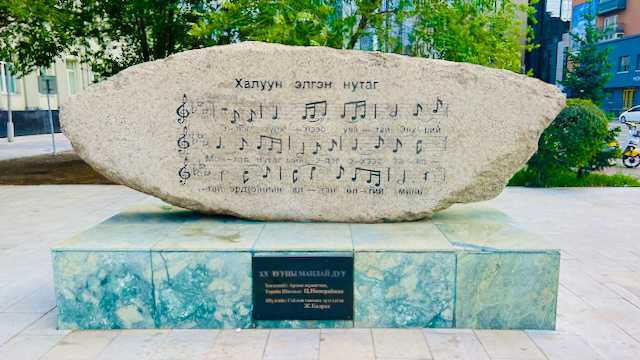
In front of the Ministry of Foreign Affairs in Ulaanbaatar, I stumble upon an unusual monument: musical notes engraved on a rock shaped like the country. Turns out it’s the first stanza of the patriotic song Khaluun elgen nutag – The Warmth of the Land. I love that Mongolia has a monument dedicated to a song. It speaks straight to the singer in me.
Red heroes in Ulaanbaatar
I have just spent a few somewhat spontaneous days in Mongolia, following an incredible journey along the Karakoram Highway (post coming up!). I was in the neighbourhood, after all. Well, sort of.
The real magic of Mongolia undoubtedly lies beyond the city limits, out in the endless, rolling steppes. Yet, spending a few days in Ulaanbaatar provides context for those vast horizons. The capital tells the deep, layered history of the people who have called this wilderness home for centuries, making any journey into the wild all the more meaningful.
Ulaanbaatar has a reputation for being a bit rough around the edges – a transit hub where travellers quickly pass through on their way to sleep in a ger (the Mongolian yurt), ride horses, or trek with two-humped Bactrian camels. Most itineraries treat it as an afterthought, but I wanted this Ulaanbaatar travel guide to look at the capital for itself. Its name translates to Red Hero, a nod to the country’s complex history.
Growing up, the Soviet Union felt like a closed-off, mysterious world to me, and Mongolia even more so. Unknown. Intriguing.
Along the streets of Ulaanbaatar
That intrigue deepens the moment you start walking the city’s streets. For nearly seven decades, Mongolia was a Soviet satellite state, a chapter of history that completely altered the layout of its capital. In the 1950s, Soviet urban planners arrived, to modernise what had been a largely nomadic, Buddhist centre, mapping out sprawling districts and lining them with grey, blocky apartment complexes.
Driving past those old blocks, I spot faded socialist-realist murals of happy working-class families and heroic soldiers. Even the public buildings and theatres downtown still echo the heavy, unmistakable signature of Soviet neoclassicism.
Sükhbaatar Square
The natural starting point in the city is Sükhbaatar Square, a huge open space surrounded by government buildings, museums, and modern towers. This is where locals gather, children race around on scooters, and it is where I get my first sense of the scale of Mongolia.
Standing on the edge of the square, gazing up at the massive butter-yellow facade of the Confederation of Mongolian Trade Unions building, I feel like I have stepped onto a Cold War film set, half expecting a shadowy figure to vanish into the entrance. He is wearing a heavy wool trench coat (in my imagination it is a bitterly cold winter day), clutching a briefcase full of heavily redacted state secrets.
All that symmetry and grandeur is typical of Stalinist Classicism architecture. The colonnades, the colours, the elaborate cornices… gorgeous! And delightfully absurd. It proclaims “bureaucracy, but make it majestic!” A palace dedicated entirely to middle management and the sacred ritual of pushing paper.
But turn your head just slightly, and the time-machine shatters. The yellow fortress stands next to gleaming glass-and-steel skyscrapers, making the whole square look like an architectural boxing match between 1950s Soviet grit and 21st century capitalism.
The Government Palace
Dominating the plaza’s northern edge is the massive Government Palace. Seated out front beneath a glass canopy is a colossal statue of Chinggis Khan – and he is absolutely huge! In the West, he is framed as a fierce, distant historical conqueror, but here he remains the ultimate living symbol of national pride. Sitting in that giant armchair, he exudes an aura that shouts “I conquered half the known world, and all you did today was answer emails.”
Meanwhile, those monumental, sweeping robes, that dramatic, wide stone throne… from a distance, he looks like Ursula in The Little Mermaid right before she belts out a musical number, no? Bit of a pop culture vibe there.
Yet despite housing the Prime Minister, the President, and heavy-duty state security, this fortress of power softens up for love. On any given weekend, the grand staircase becomes Ulaanbaatar’s ultimate bridal runway. While ordinary tourists are strictly roped off at the bottom, local security guards happily grant exclusive, VIP access to actual newlyweds on their wedding day to climb the steps. It has become a big local tradition to pose right at the feet of the great Khan, creating a whimsical contrast between his savage, world-conquering glare and dozens of ecstatic couples wearing the traditional robes known as deels and flowing white dresses, adjusting their trains for the wedding album.
A monument built on a … unique omen
If you pivot away from the giant Ursula-esque Khan and look directly into the centre of the plaza, you’ll spot the square’s original master of ceremonies: an impressive 14-metre-tall bronze equestrian statue of Damdin Sükhbaatar, the revolutionary hero who declared Mongolia’s independence from China right on this plaza in 1921. In a classic twist of folklore, urban legend says the monument was erected on the exact patch of dirt where Sükhbaatar’s horse urinated during a rally on 8 July 1921 – a moment the locals took as an undeniably good omen for the future of the nation.
This sprawling plaza is much more than a showcase for oversized statues; it functions as the literal and emotional heartbeat of modern Mongolian history. It is the exact ground where official communist parades marched through the 20th century, where the wide-spread, peaceful anti-communist hunger strikes of the 1990 Revolution unfolded, and where today, you are just as likely to witness a pop concert, a political protest – or an elaborate wedding photoshoot.
Ulaanbaatar’s museums
Other travellers I meet, recommend checking out a few of Ulaanbaatar’s museums as a way to better understand the country. Two come particularly recommended: the National Museum of Mongolia and the very contemporary Chinggis Khaan National Museum.
I decide to focus on just one – have to save something for the next visit – so I pop in to the Chinggis Khan, to find out more about Mongolia’s most famous historical figure and the empire that changed the world.
Navigating the streets a few blocks north of the square is a masterclass in urban survival. But I manage to dodge the traffic and the gigantic building comes into view. There is something about the sheer, looming scale of it that draws me in.
The exhibits cover Mongolia’s history from prehistoric times through the rise of the Mongol Empire, the Qing period, socialism, and the country’s transition to democracy following the 1990 revolution.
One of the most interesting sections of the museum explores Mongolia’s traditional nomadic culture. The exhibits explain how families have lived on the steppe for centuries, showcasing beautifully crafted saddles, horse gear, traditional deels, musical instruments, and household items used inside a ger. It provides an excellent introduction that allows for a much better appreciation of the lifestyle once you finally look beyond the capital.
The museum also houses displays on Mongolia’s many ethnic groups, Buddhist art, and archaeological discoveries. I spend a couple of hours wandering through its impressive nine storeys.
Ulaanbaatar: city of contrasts
All the stark communist planning and rapid modernisation haven’t erased the soul of the city. Old and new exist comfortably side-by-side in Ulaanbaatar. There are lively, noisy markets, and a local culture that remains deeply tied to the nomadic way of life, even in a moden, fast-growing capital.
The architecture here is an unapologetic, chaotic mix of Soviet-era blocks, traditional Buddhist temples, towering glass skyscrapers – and, somewhat unexpectedly, a Chinese gate.
It’s not a city that reveals its charms instantly, and you won’t find its true magic written down in a standard sterile Ulaanbaatar travel guide. But after a few days exploring its streets, I have truly come to appreciate the contrasts. Ulaanbaatar has a wonderfully unusual character all its own.
On the way to the airport, I see horses grazing alongside the motorway, some even getting out in traffic, as they aren’t fenced in. Not an unusual sight, according to the taxi driver. A bit like moose at home in Norway. Though I have to admit, explaining to an airline agent that you are late to the gate because of an equine traffic jam is a holiday excuse I never thought I’d get to use.
PS Near the museum exit, I spot a digital guestbook featuring two separate “Hello from Norway” messages. From today! And neither of them is mine. So much for escaping to the middle of nowhere! Seems we pop up everywhere.
The unexpected charm of Ulaanbaatar is a post from Sophie’s World