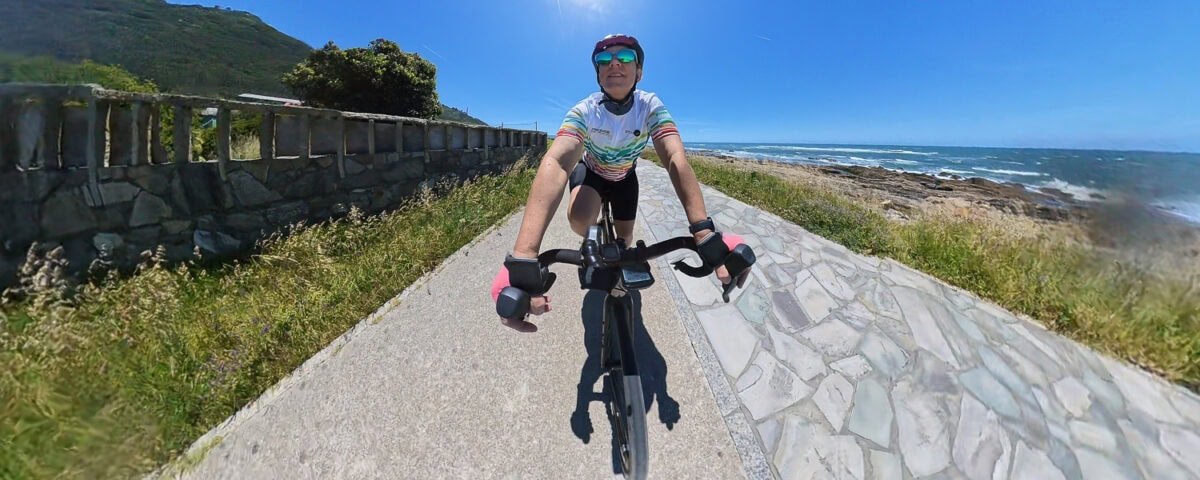
I rarely go back. Not because I have some hard rule about it — its more about the fact that I love doing new things more than repeats. I just have too long a list of places and experiences I haven’t seen yet to spend time on a repeat trip.
People ask me constantly whether I’d ever walk the Camino de Santiago again. My answer has always been no, not because I didn’t love it, but because there’s too much world left. I met pilgrims on that first Camino back in 2012 who were on their third, fourth, fifth trip, same route, year after year, and I genuinely admired their devotion even as I knew I’d never be one of them. I loved my Camino. I just wanted the next thing more than I wanted to have it twice.
So for over a decade, instead of going back, I went sideways — chasing other long-distance pilgrimages and thru-hikes instead: Japan’s Kumano Kodo, Norway’s Saint Olav’s Way, Turkey’s Lycian Way, Spain’s own Camino de Ronda. New trail, new country, same hunger. (If you’re on this same kick, I keep an ongoing list of pilgrimage routes worth thru-hiking.)
And then last month, I found myself back on the Camino de Santiago. The actual Camino. The one I thought I was done with.
Here’s the loophole I found: I didn’t walk it. I biked it.
Chasing New Instead of a Repeat
New country — Portugal instead of Spain, mostly. New route — the Camino Português, not the Francés. New method of getting there entirely: a bike, a hobby I only picked up in 2020, during COVID, like roughly eleven million other restless people stuck at home with nowhere to put their energy!
Technically, I told myself, this isn’t a repeat at all. It’s a completely different sport wearing a Camino costume!
I was mostly right. But somewhere around day three, sweating up a Galician hill, I realized this trip was giving me a lot more than a new bike trip. I’d stumbled onto the actual reason I keep chasing new things at 56, when it would honestly be so much easier not to.
Same Path, Completely Different Ride
Before I get further into what humbled me, it’s worth saying what actually carries over when you trade boots for a bike, because it surprised me how much did.
You still get a pilgrim’s passport (credential) and collect stamps along the way towards your Coompostela. You still earn a Compostela at the end (cyclists just need to cover 200 km/124 miles instead of the 100 km required on foot). You’re still treated as a pilgrim, not a tourist, everywhere you go. You still find yourself following yellow arrows and scallop shells, at least when you’re lucky enough to be riding directly on the original trail instead of a road running alongside it. And the welcome you get from locals, the strange sense of shared purpose with total strangers — none of that changed one bit.
What did change: the rhythm. Walking gave me five weeks to slowly dissolve into a place. Biking gave me six days that moved fast enough to feel more like a sprint than a meditation — less time to sit with any one town, more physical intensity packed into every hour. And the suffering simply relocated. No foot blisters this time. Instead, my hands took the brunt of it, courtesy of some genuinely brutal stretches of cobblestone!
Comfort Was Never the Point
I know my local bike trail back in Denver so well I could ride it with my eyes closed. Every incline, every gear shift, exactly when to stand up on the pedals. There’s real comfort in that kind of familiarity, and at my age, comfort is genuinely tempting. It’s easy to gravitate toward the routes we already know, the activities we’ve already mastered, the version of ourselves we’ve already proven – especially as we get older.
But comfort was never actually what I was chasing – it rarely is. New is what I crave, specifically because it’s hard, and hard things make you grow. And cycling a Camino I’d already completed on foot, using a skill I’m still genuinely new at, delivered exactly that kind of growth I didn’t fully see coming.
It showed up on a brutal, coastal headwind-into-Baiona kind of day, when I was offered an e-bike and said no out of pure stubbornness (or stupidness), then rolled into town nearly last, cursing why all castles were built on hills! It showed up a few days later when an eighty-one-year-old man in our group, riding the same non-electric bike I was, simply rode away from me on a climb. I laughed out loud, alone, because there was nothing else to do with that information. It showed up on as I pushed my bike up a ridiculously steep hill. And yet again when I got a flat tire the last day. Growth is about getting through the setbacks…and keeping going.
The Good, the Bad, and the Ugly
Back in 2012, I wrote a whole post about the ugly side of the Camino de Santiago — the industrial zones, the highway shoulders, the parts nobody puts on a postcard. I stand by everything I said in it: that stuff is part of the Camino deal, and I’d argue it makes the whole experience more honest, not less.
Cycling into Vigo, I got a fresh version of that same lesson. I followed the ExperiencePlus! white chalk arrows down through a rougher stretch of the city near the port. I would never have wandered into this area on a normal vacation, it was the kind of neighborhoods most trip itineraries route around.
And I loved it. It’s not something you stumble into by accident on a guided vacation; you have to be following something bigger than a sightseeing checklist to end up there at all.
That’s the part of a journey — walking or biking — that a regular trip just doesn’t have. You don’t get to curate it. The Camino doesn’t reroute itself around the ugly port neighborhoods to protect your vacation photos, the same way life doesn’t reroute itself around your bad weeks to protect your mood! You get the postcard coastline and the container port back to back, in the same afternoon, and you just keep pedaling through both. I’ve come to think that’s the whole point.
The Point of a Journey
Here’s the thing about a Camino, whether you cover it on two feet or two wheels: it’s not just a really nice trip. It’s a journey, and a journey demands something a normal vacation doesn’t — a destination you’re actually working toward, day after day, with your own body as the engine.
There’s something genuinely different about traveling toward a fixed point on a map that you have to earn, mile by mile, versus just being shuttled between scenic, ‘instagramable’ places. It gives every single day a shape and a purpose that a sightseeing itinerary can’t fake. You wake up each morning with somewhere real to get to, and everything that happens between here and there — the hill, the headwind, the port neighborhood in Vigo, the flat tire — becomes part of a story with an actual destination, instead of just a collection of nice moments strung together.
That’s what I’d forgotten I missed. Not the walking, specifically. The striving.
Interested in Journeys, Quests, and making your travels more purposeful? Read my article about 20 Big Travel Project Ideas to Inspire a Lifetime of Adventure
The Same Cathedral, a Different Person Arriving
On the last morning, I got a flat tire outside Padrón and had to lean on our guide to fix it. The Camino was trying to test me one last time! Not long after, I rode the final stretch into the square in Santiago, and heard bagpipes start up right as the cathedral came into view.
It hit the exact same nerve it did in 2012 — that specific, disorienting joy of finishing something you privately doubted you could finish. Standing in that square again, thirteen years and one entirely different mode of transportation later, I thought about the version of myself who finished walking the Camino back then and never, not once, imagined she’d be standing in this exact spot again. AND – if you’d told her she’d be back on a bicycle — a sport she had zero interest in at the time — she would have laughed you straight out of the square in Santiago!
I couldn’t have predicted this trip. I also couldn’t have predicted, back in 2006, that walking away from a stable corporate job with no real plan would set off the entire chain of decisions that eventually led me here, twice, by two completely different methods.
My first Camino handed me a mantra that’s steered every decision since: “Make Your Own Way”. I didn’t build this life by doing what everyone else was doing, and going back to a place I love, this time by a completely different route, felt like the truest version of that mantra I’ve lived out yet. I never know what’s next, and I’ve stopped expecting to.
None of this would have been possible without a company willing to build a route this thoughtfully. ExperiencePlus! designed this Camino Português itinerary specifically to feel personal rather than packaged — hand-drawn chalk arrows instead of a rigid group pace, guides who know this stretch of Portugal like it’s their own backyard (because it is!), enough structure to keep you safe and enough freedom to still feel like your own journey. It’s the kind of company that makes it possible to do something genuinely new inside something you’ve technically done before. (I wrote up the full trip details, route, and practical logistics for their blog, if you’re weighing whether to book it yourself.)
Delicious Ambiguity
My first Camino I left a quote at the Cruz de Ferro that has outlasted almost everything else I brought home from that trip. It is also the quote I used when I started this blog back in 2006:
“Some stories don’t have a clear beginning, middle, and end. Life is about not knowing, having to change, taking the moment and making the best of it, without knowing what’s going to happen next. Delicious ambiguity.”
— Gilda Radner
In 2012, I didn’t know that I’d ever be back in that square. I didn’t know, teaching myself to cycle in my home city in 2020, that it would eventually carry me back to Santiago. I still don’t go looking for repeats — there’s just too much world left for that — but I’ve learned that the same destination can hold an entirely new story, ugly ports and all, if you’re willing to arrive differently enough to earn it.
So if you’re someone who’s already “done” a Camino and assumes that means you’re finished with it: you’re probably not asking the right question. The question isn’t whether you’ve been there. It’s whether you’ve been there this way yet.
Biking the Camino Portugal
This approximate 215 mile route went from Porto Portugal to Santiago Spain over 6 days. We traveled along the inland and the coastal camino path. We utilized ExperiencePlus! bikes (ebikes and regular bikes), and had 3 local guides for our group. We had a support van, a guide who rode with us, and a guide who was ahead of us putting down the arrows.
EP organized all of the logistics coordinating our hotels, meals, moving our luggage, and maintaining the bikes. Most meals were included and it was a super chance to try the local specialties.
Read about more of the details of my tour in this article I wrote for ExperiencePlus!
ExperiencePlus! also offers a longer version of this trip where you start in Coimbra south of Porto.
ExperiencePlus! Bike Tours
This was my second trip with ExperiencePlus! and once again it absolutely impressed me. Some of the differentiators that ExperiencePlus! offers:
-Family owned and is now run by the founder’s daughters
-Incredible customer service leading up to the trip – it gets you genuinely excited!
-You get a free high-quality jersey (or socks)
-Great quality bikes that are extremely well maintained. The electric road bikes are also great
– You follow chalk arrows and go at your own pace. No struggling to keep up or being forced to stay with the group. Get your face out of your phone and look at the scenery instead!
-Free esim access
-Guides are really loyal to EP – you can tell that they are treated well and feel like a part of a team.
-Bring your own bike gear and bike computer, seats, pedals, etc. The guides will install them.
Hopefully this won’t be my last trip with ExperiencePlus!
The post Why I Went Back to the Camino de Santiago on a Bike appeared first on OttsWorld.