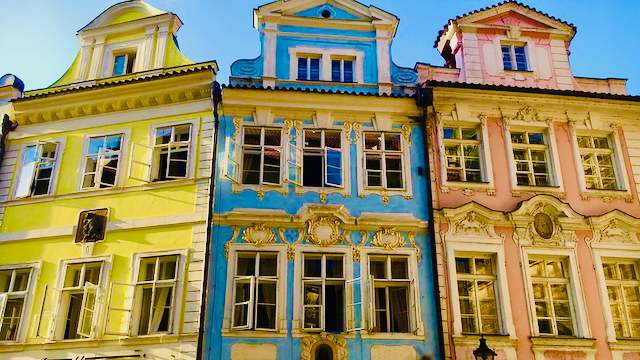
Some cities try to wow you with big monuments (looking at you, Rome!) But Prague? Prague kind of flirts with you through its walls.
Sure, you’d expect magnificent castles, cathedrals and grand squares – and yes, Prague has those in spades, and yes, they are magnificent. But what sticks with me after many visits through the years to the Czech capital, is the facades: the colours, the quirky ornaments, and centuries of history basically written on the walls along almost every street in Prague’s historic centre. It’s like the whole city is one big open-air gallery.
A city painted over centuries
Walking through Staré Město (Old Town), you’ll soon realise that Prague’s beauty is not about uniformity. No two buildings look alike. One facade glows in soft apricot, another in pale green, and next door, a cream-coloured front has centuries-old decorative plasterwork.
Cities are often built – or rebuilt – in a single architectural wave, but not Prague. This city evolved gently, over time. Gothic buildings were reshaped during the Renaissance, redecorated again in the Baroque era, and later refreshed with elegant Art Nouveau details. Which you know I love.
You’d think the result would be chaotic, but it is not. Instead, it’s all harmonious, like a visual conversation across generations.
If I look closely, I see sgraffito patterns scratched into plaster. On other walls, I see mythological figures above windows, and coats of arms hinting at long-forgotten families.
(Sgraffito? That’s a technique where you scratch the surface layer so you can see the layer underneath. Learnt that word myself just here in Prague. It’s fun to say. I like it.)
The quiet drama of Malá Strana
Across the river, Malá Strana feels softer, almost like a film set. Here, facades lean inward along winding streets. It’s as if they’re chatting. Gossiping about the residents, perhaps? Or about gawking tourists?
Before street numbers came along in 1770, the houses themselves served as signs: golden keys, red lions, painted suns. Standing there, I feel strangely aware of continuity, how merchants, travellers, and residents followed those same visual cues for centuries. Giving directions must have been a hoot. ‘When you reach the corner, turn right at the three violins, and look for the drunken duck.’ And can you imagine being a postal worker in this fairytale?
Prague’s Baroque facades look like they were designed to catch light, not just reflect it. In the morning, a façade looks painted in a gentle pastel, and in the evening, the sun turns the same building honey-gold.
Grandeur above the river
Up at Prague Castle, the monumental façades change colours with the weather.
Even structures built for power seem softened by time, with weathered rather than imposing surfaces. Still, I can’t look at this building without thinking about Prague’s long history of throwing people out windows, even here, from the castle.
Turning the other way, the city becomes a panorama of rooftops and facades stacked against the hills: pale walls, terracotta tiles, unexpected towers rising here and there, often between residential buildings. From this vantage point, Prague looks like a painting.
Further out, the Vltava (Moldau) River mirrors everything. Doubling everything. The facades look like they are floating.
Reading a city through its walls
The most fascinating bit, though, is how the facades of Prague act as biographies. Who needs history books? Wars, prosperity, neglect, restoration – you can read about it in the layers of plaster and stone.
In many European capitals, modernisation has all but erased most ordinary buildings, but not here. Prague has been spared large-scale destruction. Entire streets have been kept as they were, where everyday architecture lives alongside grand monuments. And that is what the UNESCO designation is about here: protecting not just the famous landmarks but this continuity of urban life.
As I wander around, I begin to notice small details: a faded fresco above a bakery here, a crooked centuries-old window frame there, a freshly restored facade standing next to one still gently worn.
Look up!
In Prague, I walk differently. Instead of rushing towards attractions, I constantly stop, with my head tilting upwards, looking at balconies, carvings, colours, details. A nice change from looking down at my phone. My neck thanks me for the balance.
But by ‘Facades of Prague’ I’m not really talking about architecture, though. Or at least, not only architecture. It’s more about paying attention, the simple act of looking close enough to discover history hiding in plain sight.
When you go, slow down. Put the phone in your pocket. Choose a random street and follow the façades, wherever they may take you. In Prague, the walls speak. To hear them, all you have to do is look up.

Historic Centre of Prague is a UNESCO World Heritage site.
Here are more UNESCO World Heritage sites around the world.
Facades of Prague: history written in stone is a post from Sophie’s World