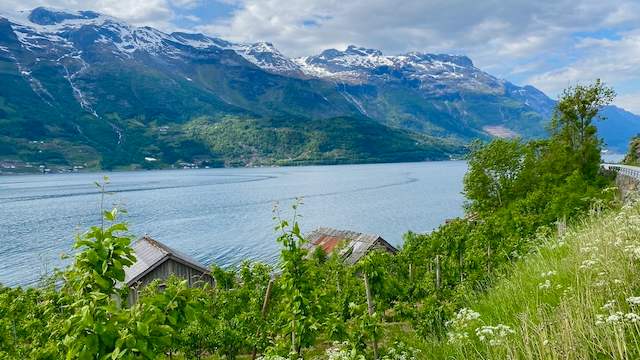
Growing up in Norway, we tend to take the extraordinary beauty of our country for granted. Mountains, forests, fjords, waterfalls – they’re all a part of the background of daily life. Something you pass on family road trips, and see through a ferry window. As children, we assume everywhere is like this.
It’s first after travelling abroad, or seeing friends from other countries experience it on their first visit here, we understand how unique this landscape is.
A landscape shaped by time itself
The story of our fjords began thousands of years ago during the Ice Age. Over the millennia, huge glaciers carved deep U-shaped valleys through solid rock, and left behind waterways that go inland from the ocean, sometimes as far as 200 km in. When the ice melted, seawater filled these valleys, and the fjords we see today were formed.
Go west!
I live in Eastern Norway, 40km west of Oslo. My city has its own fjord, and right now, as I’m writing this on my balcony, I see it whenever I look up from the screen. But the real knockouts are along the country’s jagged western coast.
So let’s go west. To fjord country!
Driving to Western Norway, it feels like I am going through a gallery of nature’s very own artwork. I go through forests and wide valleys, then cross a mountain pass. There are several passes to choose from – all impressive. Highway 52 goes through Hemsedal Valley. Best known (internationally, at least) as a winter sports mecca, Hemsedal is gorgeous in all seasons.
Hemsedal Valley in September
Out west, the fjords are not just scenery, they are orientation points. Directions are based on them; journeys are planned around them. Distances aren’t measured in kilometres, but in ferry crossings.
We grow up understanding that roads curve because the mountains allow it. Ferries exist because water comes first. Weather changes plans, and nobody gives that a second thought. The landscape sets the pace.
They don’t reveal themselves all at once, the fjords. They appear gradually, with a new surprise around every turn. The road winds endlessly around the mountain and through tunnels carved through it. Sometimes the road is so narrow, I drive slowly, in case I run into some over-confident new driver who thinks speed limits are optional. They are everywhere, aren’t they…
A debate has been going on for years, ever since I worked for the Public Roads Administration, about raising the driving licence age from 18 to 20 (some have even suggested 23) for boys, as they are heavily overrepresented in accident statistics. Controversial, as you can imagine.
World Heritage landscape
Geirangerfjord and Nærøyfjord are on UNESCO’s list of sites important to preserve for generations to come. To us locals they are familiar memories of school trips, summer drives, packed lunches at viewpoints, sometimes in the rain.
Arriving at Geirangerfjord is thrilling. We’re coming from Åndalsnes, and drive down Ørnevegen (Eagle Road), with 11 hairpin bends. Dramatic! If you’re in the habit of snapping photos while driving (occasionally guilty of that myself), don’t be tempted here, even if the views are out of this world. Just don’t!
As the snow melts in spring/summer, hundreds of waterfalls pour into the fjords. Some fall gently like silver ribbons across the green. Others thunder down vertical rock faces with full force. Exciting to watch! And hear!
These are scans of prints I snapped in June 2000:
Spot the cruise ships?
Nærøyfjord feels more intimate and a bit wilder. The water looks darker, and the silence is more profound. One of the narrowest fjords in the world, it squeezes between mountains that feel close enough to touch. There are tourists here, but not as many as in Geiranger, and no big cruise ships.
The surrounding villages offer glimpses into traditional fjord life, with grass-roofed buildings and quiet docks. Winding roads connect isolated communities that could only be reached by boat back in the day.
Everyday fjords
Some fjords feel quieter, closer to daily life, surrounded by small communities. Here, the fjord most of all represents livelihood.
Eidfjord feels relaxed and welcoming. There is tourism here, but local rhythm is the major player. There’s something grounding about it: a stillness. It feels like everyday life here moves at a slower pace. And I reckon it really does.
Eidfjord. Population: 571
Further inland, Lustrafjord stretches toward tall peaks and glaciers. The air is cool and clear, and the landscape feels calm and isolated. From here, you can see Jostedalsbreen, the largest glacier in mainland Europe.
I snapped this photo of Lustrafjorden from the doorstep of Urnes Church –
– the oldest of Norway’s stave churches, built in 1130.
Hardangerfjord and Sognefjord
The Queen of Fjords, Hardangerfjord, is surrounded by fertile terrain, thanks to generations of farmers.
Early morning in Øystese by Hardangerfjorden
Hardanger is apple growing country. I’ve driven along this fjord many times (on those crazy narrow roads curling around the mountain), but somehow I’ve missed apple blossom season.
It is sometime in May and/or June, depending on when spring decides to show up, and the season is short, so it’s not easy to plan. This is from my last attempt.
But as it turns out, I have a bit of extra time and opportunity to be spontaneous in the coming months, so I might give it another go. Look out for fruit trees in bloom along Hardangerfjorden on my Insta.
And then comes the almost overwhelming presence that is Sognefjord. This is the longest, largest and deepest fjord in Norway, reaching 205km inland, or 226km if you include Lake Sognesjøen at the end. As I drive along it, I keep losing track of distance and begin to understand why the scale is measured in hours.
They go by, those hours, and I’m still driving. The water continues, the mountains seem to go on forever. Sognefjorden doesn’t feel like one single place, but a world of its own. This vastness feels oddly comforting and steady, like something that has always been.
Sognefjorden, by Kaupanger
Standing at the edge of this fjord, well, any fjord, but Sognefjord in particular, you feel the immense scale of geological time: mountains shaped over millennia, water reflecting endless skies.
Sometimes it’s all wrapped in mist. Other times the water is perfectly still, mirroring the mountains so vividly it feels like I am looking into another world.
A quieter branch of this is Sogndalsfjord, where the landscape feels closely connected to everyday life, with small towns, farms, and student life in Sogndal, with a whopping 12,000 inhabitants, a veritable metropolis. A lived-in, modern atmosphere.
Following the sound of water
Whilst fjords define geography in Western Norway, waterfalls define movement and energy. Water is everywhere.
Waterfalls appear constantly. Some are hidden high on mountain walls, visible only as thin lines against dark rock. Others thunder beside the road; some even cross the road. Expect a good soaking. Kids love it.
The sound changes depending on where you stand. Up close, waterfalls roar. From a distance, they become a steady, meditative background flow.
Visitors often stop at every waterfall. Locals know that would make any journey impossible.
Still, some waterfalls make us pause.
Vøringsfoss, along the Oslo – Bergen road across Hardangervidda, is one of those places. As we approach the viewing platforms, I first hear the sound: a constant, powerful rumble echoing through the canyon. The water doesn’t just fall; it disappears into space. Many of us remember seeing it as kids, leaning out just a little bit too far, with parents hovering, ready to grab us at a second’s notice. Not much in the way of railings back then.
In the village of Norheimsund by Hardangerfjord is Steinsdalsfoss, almost playful in comparison. Walking behind the curtain of water is surreal – like stepping into a parallel dimension. Everything is mist. And sound.
Wish I had taken a photo from behind the veil. But… yet another reason to return.
And then there’s Låtefoss, a twin waterfall appearing suddenly along the road, like a landmark announcing I have entered fjord country for sure. I have driven past countless times, yet it never becomes ordinary. And yes, I stop every time, trying to get a photo that does it justice.
Can you guess what the word FOSS means?
Moving through living landscapes
They weren’t exactly designed for comfort or convenience, these landscapes, yet people have found ways to live in them for centuries. Small villages cling to narrow strips of land between rock and sea. Family farms have survived for generations in the hidden valleys.
Life here has always required resilience. Steep terrain limits farming space, but where there’s a will, there’s a way, and thus entered terrace farming and seasonal mountain pastures.
There’s a popular TV-series here, called Der ingen skulle tru at nokon kunne bu, which roughly translates as Where no one would think anyone could live. (The phrase comes from an old folk song; slightly awkward in English, but makes perfect sense in Norwegian.) It’s about people who live close to nature, often in old family homes at the top of impossibly steep gravel paths, constantly negotiating life with the elements.
This house was not the work of a local builder, but of Austrian-British philosopher Ludwig Wittgenstein, who came to Skjolden at the far end of Sognefjord in search of solitude.
Today, visitors meet a balance between tradition and sustainability. Electric ferries glide silently through the water, and communities work actively to protect the fragile environment that sustains them.
There’s no such thing as bad weather
Norway reveals itself fully in changing weather. We learn early that nature is not something to control – it is something to accept, and even embrace. Rough weather doesn’t take away from the experience; it adds to it. Rain strengthens waterfalls. Fog softens mountain edges. Low clouds moving through a fjord creates a mood that sunshine can’t match.
Perhaps the most remarkable feature is the light. Shadows and reflections shift as the clouds move quickly across the mountain. The same view changes, and looks different minute by minute.
Each season has a different personality:
Spring: roaring waterfalls powered by snow-melting
Summer: lush green valleys and long, white nights
Autumn: mountainsides in gold, red, and amber
Winter: fjords transformed into quiet, snow-covered worlds
Waterproofs are not accessories; they are cultural identity. One of the best-known sayings sums it up: Det finnes ikke dårlig vær, bare dårlige klær – there’s no such thing as bad weather, only bad clothes. It rhymes in Norwegian.
The landscape shapes us
The fjord landscape has shaped Norwegian culture in many ways. Living among mountains meant communities grew independent, while the sea encouraged connection and cooperation. Patience became a necessary part of life because travel has always taken time.
Even today, many Norwegians talk about the sense of calm they feel when they return after being away in other countries. The steep mountains, the steady water, and nature’s constant presence create a kind of grounding that is hard to put into words, but easy to feel.
But… we never actually take it for granted
We may grow up surrounded by fjords and waterfalls, but we never really stop noticing them. The way evening light falls, fresh snow on the peaks, or mist suddenly drifting across the water can still make us slow down.
As kids, my brother and I would sigh impatiently whenever mum stopped her little black-and-cream Hillman Minx, to make us look at the views. In the backseat, it was all ‘yeah yeah, how much further?’ Reading comic books won over views every time.
As a grown-up, I finally understood.

West Norwegian Fjords – Geirangerfjord and Nærøyfjord is a UNESCO World Heritage site.
Here are more UNESCO World Heritage sites around the world.
Fjords and waterfalls in Norway is a post from Sophie’s World