On an early January day, I trade the northern winter for southern summer. I’m expecting mornings with gourds of yerba mate, long conversations in cafes in the afternoon, and dinners that’s meant to begin at 10pm, but doesn’t really get started until midnight. Music drifts from open windows and couples move together in a sultry tango on a cobbled street in San Telmo.
Well, Buenos Aires certainly has all that. But what stays with me the most isn’t the rhythm of the city; it’s the silence. A heavy, deliberate silence that lives at Plaza de Mayo.
The square where mothers walk
In the heart of Buenos Aires is a historic public square surrounded by government buildings and colonial architecture. At first glance, this looks like any grand civic square. Tourists snap photos of the pink presidential palace, office workers hurry across the cobblestones, flocks of pigeons scatter, then regroup. The ordinary choreography of a capital city unfolds as expected.
Then I see them, painted onto the stones beneath my feet: White headscarves. Pañuelitos blancos.
Simple outlines, repeated again and again across the ground. They are easy to miss, until suddenly they’re impossible to ignore. Each one marks a woman who stood here, wearing a white headscarf, embroidered with the name of her child, waiting for an answer the government would not give.
I look around, and notice the white headscarf set into mosaic slabs, as well. These symbols belong to the Mothers of Plaza de Mayo, a group of ordinary Argentine women who transformed grief into political resistance during one of the darkest periods in the country’s history. These women challenged a brutal dictatorship, armed with nothing but photos, persistence, and motherly love.
Originally made from cloth diapers, these scarves turned motherhood itself into an act of protest. They became, and still remain, permanent reminders of absence and resistance.
Argentina’s dirty war: the vanished young
In 1976, Argentina fell under a military dictatorship after a coup led by General Jorge Rafael Videla. The regime launched what became known as the Dirty War. The aim was to eliminate political opposition.
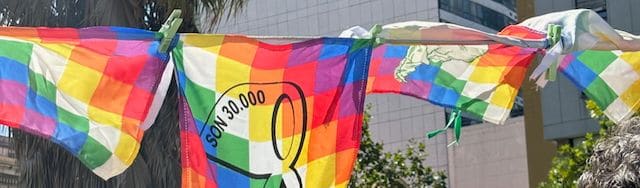
An estimated 30.000 people were kidnapped, many of them teenagers who had simply asked questions too loudly, taken from their homes or schools, or from the bus. Students were taken from universities, journalists from newsrooms. Artists, activists, and ordinary citizens were abducted from their workplaces, then brought to secret detention centres, without explanation. Some gave birth while in detention; their children were stolen from them and illegally adopted. They all became known as los desaparecidos, the disappeared.
Families searched desperately for answers. They looked high and low, in police stations, in hospitals, and in government offices. But officials denied everything. Records vanished. Names vanished. People vanished. There were no trials, and no bodies.
In those days, fear ruled Argentina; it shaped people’s daily life. Speaking out meant you could very well become the next victim. The next desaparecido. Silence became survival.
Except for a small group of mothers who refused to accept not knowing. They refused to stay silent.
The Mothers of Plaza de Mayo: how it began
On 30 April 1977, fourteen women gathered here at Plaza de Mayo. They did not shout slogans, these women. They simply asked a question:
WHERE IS MY CHILD?
Names of the desaparecidos are recited
Since gathering in groups was illegal, the women, most of them housewives, began walking around the square instead, circling, remembering, insisting that the disappeared are not forgotten.
The dictatorship tried intimidation, arrests, and even murder. Several founding members themselves disappeared. Yet every Thursday at 15.30, week after week, month after month, they continued marching, these mothers. The movement became a ritual of resistance.
Some of the women still wear the white headscarves.
It’s Thursday, a little before 15.30. I am here on Plaza de Mayo, waiting for the Mothers. And they will come, I’m assured, just like they have every week since that April day in 1977.
I amble about the square, looking at photos and memories. A couple is laughing on a bench. Two toddlers are chasing pigeons. A protest banner flutters in the distance.
Then I hear chanting. The march has begun. It is as if I have time travelled to 1977. I picture the original 14 women, holding up photographs of their missing children, scanning the crowd for faces they will never see again. The enormity of their grief feels strangely intimate, even now.
Today, the Mothers are joined by a large group of relatives and supporters.
The movement that changed the world
The Mothers of Plaza de Mayo achieved something extraordinary: they broke the regime’s carefully constructed silence. They played a key role in bringing human rights to global attention, long before social media amplified activism.
Instead of armed rebellion, they used visibility, speaking to foreign journalists and shaming the dictatorship internationally. They reframed political repression as a human story: mothers searching for their children.
As international scrutiny intensified, Argentina’s military regime came under increasing strain. By the early 1980s, a failing economy and rising public anger had eroded its power, leading to its collapse. Democratic rule was restored in 1983.
Legacy, divisions, and ongoing activism
With the return of democracy, the movement took on a new direction. Some members concentrated on pursuing justice through the courts, working to identify victims’ remains and hold those responsible accountable. Others expanded their efforts into broader forms of political activism.
The Mothers never carried weapons, held political office, or commanded armies. They simply walked and asked questions. They refused to forget, and in doing so, they reshaped Argentina’s conscience and inspired generations across the world.
Their influence can be seen in trust and reconciliation efforts worldwide, international human rights law, and in women-led protest movements on grassroots level.
Nearly 50 years after they began, the Mothers remain active and resolute, even though questions about the fate of their missing children remain unresolved.
Plaza de Mayo is no longer just a historic square. It’s a living memorial to courage and resilience, of ordinary people confronting extraordinary injustice. Every Thursday, history and everyday life live side by side here on the square.
Thoughts on souvenirs
When you think of souvenirs, you likely think of an item. Something to take home. Or at least, I do. But Plaza de Mayo left me with a different kind of souvenir, a question: What does courage actually look like?
It is not necessarily dramatic heroism, courage. Here at Plaza de Mayo, it is something quieter: repetition. Showing up again and again, even when answers never come. Refusing silence, even in the face of overwhelming fear. I am in awe of these women, and hope I could summon the same strength, if needed.
PS I visited Plaza de Mayo in January 2024. Now, in the spring of 2026, on the 50th anniversary of the military coup, the Mothers are facing troubles yet again. Argentina’s current right-wing government is downplaying the horrors of the dictatorship and has stopped state funding to the Mothers’ organisation.
The Mothers of Plaza de Mayo: Argentina’s quiet, courageous revolution is a post from Sophie’s World