I didn’t expect Shanghai to feel so personal.
Perhaps it’s the why. The reason we are here. A brief stop, or two rather, on the way to Fujian, to see the place where Cat was born. More about that here on the blog when we’re ready. For now: Shanghai, our entry and exit point into the country.
There are cities that impress you, and then there are cities that rearrange your sense of what’s possible. Shanghai does both, often along a single street.
We arrive in the early evening after a long flight, check into our lodgings near Zhongshan Park, and begin with a stroll through an indoor market nearby. That’s about all we have time for, as Cat becomes unwell. Could be a sudden stomach flu, could be food poisoning. She is more of a culinary explorer than I am.
Was it those tiny sausages?
Meanwhile, I run around Shanghai, looking for a late-night pharmacy.
Buildings glow in neon blues and purples, reflecting off the Huangpu River in a way that makes the entire city feel a bit electric.
As I walk through the rain, I wonder if we’ll get to Changting tomorrow. It’s a pretty strenuous trip if you’re unwell. First a flight to Xiamen, then finding the train station, and take a 2.5-hour train journey. But she is nothing if not determined, this kid of mine. She presses on.
As for Shanghai, we’ll get a better look on the way back.
Coming back to Shanghai
I have always imagined this city defined by its skyline, the kind you see in photos, all glass and light and ambition. And yes, that version exists.
Arriving back in Shanghai feels like stepping into a living contradiction. Glass towers pierce the sky unapologetically, and just a few blocks away, narrow alleys hum with the quiet rhythms of everyday life. Time hasn’t moved in a straight line in this city. It loops, overlaps, and occasionally collides.
It’s late morning, and we start the day on the Bund. Across the Huangpu is the famous sci-fi skyline. The Oriental Pearl rises into the sky, clear in the bright daylight. A statement, almost. Further along, Shanghai Tower twists upward, impossibly tall, looking kinda misplaced, as if it doesn’t quite belong to the same scale as everything else.
Barges move slowly along the river. Buddhist monks and other mere mortals gather along the railing.
Surprisingly, I don’t see many tourists. Then again, the sheer scale might just give that impression.
Continuing along the Bund, we pass a statue of Shanghai’s first mayor, Chen Yi, in a Mao suit. Then, a monument with engraved words: prosperity, civility, harmony, rule of law, friendship, freedom – core socialist values. A nationwide messaging campaign, blending into the environment, rather than on huge, ugly billboards. Clever marketing.
On the other side of the street, historic architecture whispers stories of another era. One shaped by trade and colonial influence: a bit American, some French, but mostly British.
Nanjing Road
Just around the corner is Nanjing Road, one of the world’s busiest shopping streets, I hear. Well, not today. Or, at least, it doesn’t feel anything like Oxford Street. Plenty of space to wander and browse in this quirky mix of old-world charm, commerce and energy. Bright shopfronts, voices, movement in every direction. It’s rather enjoyable, like being part of something constantly in motion.
The Fairmont Peace Hotel is one of the most iconic buildings in Shanghai –
– instantly recognisable by the green pyramid copper roof. Art Deco grandeur at its finest.
Back in the 1920s, it began life as the Cathay Hotel, the most glamorous address in Shanghai’s Golden Age. Celebrities, financiers, politicos from around the world… they all stayed here when visiting Paris of the East.
Onward to Yuyuan Garden
We don’t have a particular destination in mind today; we just walk, following the flow, through Gucheng Park and into quieter streets where the air smells like someone is cooking lunch just out of sight.
Shanghai’s magic lies in contrasts. It’s in the way a century-old teahouse sits beside a minimalist coffee shop. It’s in the sound of mahjong tiles clacking in a quiet courtyard while traffic rushes by beyond the walls. It’s in the blend of languages and cultures that somehow coexist without losing their individuality.
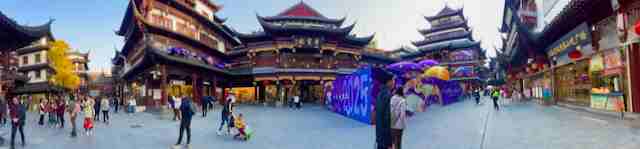
By late afternoon, we wind up at Yuyuan Garden, carried by a steady flow of people. Along the narrow paths, people move in slow waves, camera phones lifted, voices overlapping, footsteps echoing over stone. We cross curved bridges across koi-filled ponds, alive with movement.
This area is vibrant and a bit chaotic today. And yet, every so often, a small pause: a reflection in the water, a glimpse of carved wood, a corner where the noise softens ever so slightly. Even on this busy day, you can find brief moments of calm.
By the time we leave, I realise something has shifted. Shanghai shows me how to pay attention to the in-between moments, to be okay with not fully understanding everything.
What makes this city unforgettable is its momentum. This is a place constantly becoming something new, without ever fully letting go of what it was. It is as if I have received an invitation to witness that transformation, and perhaps even be a part of it.
I thought I was just visiting Shanghai. Just stopping by. But somehow, it feels like Shanghai met me halfway.
Swiftly into Shanghai is a post from Sophie’s World