I have left Cox’s Bazar and Rohingya refugees, and have landed in the land they fled. My intention was to travel north to the Naf river, where I was, just days ago, on the Bangladesh side.
Easier said than done, it turned out. Much of Rakhine State is restricted, even closed, as a result of the ongoing conflict. A permit to travel to this state is compulsory and difficult to get. Furthermore, requirements frequently change without notice. Add to that, locals strongly advising me to stay away from Rakhine. Foreign government’s advice (including my own) is one thing; listening to locals is another.
Bagan, then?
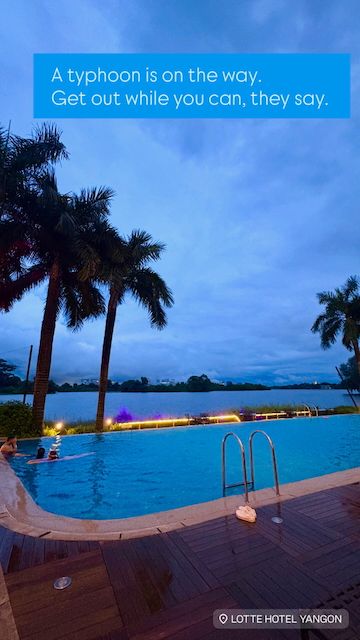
Bagan is beautiful – and safe, according to those same locals. However, trouble is brewing, of a more natural kind. A typhoon is headed this way. Unless I have oodles of time to sit out flight delays and cancellations, better move on.
Oodles of time. If only!
I book a flight out for the next morning. Myanmar, on the whole, will have to wait.
But Yangon is right here, right now. And I intend to make the most of it.
Yangon
Yangon is a city that rewards wandering. Especially the kind of wandering where you think you’re going to see one thing, and then three minutes later you’re ankle-deep in incense smoke, calculating the Burmese kyat equivalent of a ‘bargain’, and accidentally buy a small carved elephant.
My wandering begins at the Shwedagon Pagoda and ends, improbably, at a peculiar place called Happy World. In between is a delightful surprise. In gold, of course.
The Shwedagon’s Golden Gravity
Shwedagon Pagoda is the most famous landmark in Yangon, probably in all of Myanmar.
Yangon’s soul glows from the top of Singuttara Hill.
The Shwedagon pagoda doesn’t just sit on a hill; it practically exerts a gravitational pull. You round a corner, and there it is: glowing, serene, and radiating the kind of energy that makes you rethink your relationship to jewellery.
It’s wrapped in 24k gold, this pagoda, and crowned with diamonds and rubies. It shimmers differently throughout the day, a local who works a cart across the street tells me. ‘Warm at sunrise, fiery at noon, and celestial at dusk,’ he says. Quite poetic, I thought.
Its presence is immediate. Not just visually, although no other structure in Yangon quite commands the horizon like it, but in the atmosphere around it. Even before I reach the platform, it hits my senses: vendors arranging small mountains of jasmine garlands, monks in maroon robes quietly murmuring mantras, the scent of incense drifting down the stairways, the ringing of spinning prayer wheels across the plaza, and not least, gold as far as the eye can see – on the pagoda itself, and on dozens of smaller shrines. Everywhere, groups of people are chatting in open pavilions, a few even out in the rain. Some are praying or meditating, others are resting or reading. Devotion mixed with everyday life.
Me, I’m just standing in the rain, watching all the gold against the grey foreboding sky.
Birds and more birds
Across the street from the pagoda, I spot a lake. And pigeons. Full battalions of them. In fact, if the Shwedagon has an unofficial animal mascot, it must surely be the pigeon. They assemble on the rooftops, swirl over the markets in dramatic spirals, and parade across the ground like tiny, feathered security staff. If they could wear hi-vis vests, they probably would.
But not only pigeons.
Along the street, I also find vendors selling tiny birds in tiny bamboo cages: sparrows, mynas, or finches hopping restlessly inside. They are sold for the Buddhist practice of merit-release, where a person frees a living creature as an act of compassion. It’s about gaining merit while symbolically easing suffering. Originally, this was a gentle, spontaneous gesture: rescuing an animal that was trapped or in danger.
In this modern urban setting, though, the practice has shifted. Many of the birds are now caught specifically to be sold and released, in a never-ending cycle where they are recaptured again and again. For many locals, this is a small, important ritual of hope or blessing in daily life, and for the vendors it means livelihood.
It is an ethically complicated issue, this. Conservation groups in Myanmar are concerned about the stress on wild populations and the health risks for the birds.
Similar merit-release practices are found in Thailand, Laos, Cambodia, Vietnam, and parts of China, where birds, fish, or turtles are released as symbolic acts of compassion, often with the same mix of spiritual intention and ecological concern.
Meanwhile, the pigeons have declined to participate in this cycle. They are fully unionised and entirely self-employed.
Forming musical notes above the pagoda.
The park, the monk and the monument
A monk in a maroon robe approaches me, offering to show me around. I normally prefer to walk around by myself, and must have declined hundreds of ‘guides’ through the years. But there’s something about a Buddhist monk. Something slightly intriguing. So I give in. Why not. Fully expecting him to ask for a tip at the end. And he does. Only he calls it a donation to his monastery. Is it? Buddha only knows. Either way, fair enough.
I follow him, and soon find myself in a little green oasis: a calm lakeside park, with reflective waters and scattered benches. The air is softer and the traffic less noisy here. I can hear my own thoughts again.
The pigeons follow along. Perhaps out of curiosity, perhaps to supervise.
The view of the Shwedagon Pagoda across the lake: unmatched!
Some of the caged-bird sellers have set up near the park entrance, where pilgrims buy a bird to release over the lake with a whispered prayer. I watch the little creature burst out of the cage, and flutter over the water. A brief moment of freedom.
The monk then directs me to a monument. Golden figures around a tall, stone obelisk, a heroic tableau of collective effort. The monument is in honour of collective labour, he tells me. And national unity.
Teamwork: captured mid-pose and coated in gold
Spot the plaque on the right? In Burmese script, it says something along these lines:
This park is for public well-being. It exists thanks to the diligence of workers and the guidance of civic leaders. This monument symbolises the shared strength and cooperation of the people. May this place bring benefit and rest to all who visit.
Back on the street, pigeons are organising a conference in the middle of the road. Traffic halts, natch.
Not your ordinary shopping mall
Just past the Shwedagon Pagoda, is this unusual structure.
Another temple, going down a hill and across the road?
Not quite.
On the inside it looks more like a royal reception hall that somehow has accidentally become a shopping arcade:
Golden columns. Carved teak ceilings. Huge framed paintings of the Buddha, lining the upper balconies. A sense of grandeur so theatrical, I expect a king to descend a staircase with two attendants and a pair of well-trained elephants.
Mais non! No king, no elephants. Instead, hair scrunchies, monk robes, jade bracelets, lacquerware, plastic toy swords, little Buddha statues, and a man insisting I needed a giant folding fan. (I manage to resist.)
Across the street, the stairway continues:
This market hall is a kind of temple-adjacent bazaar that is part devotional supply shop, part tourist souk, part fever-dream interior design experiment.
Why do pagodas have markets?
In Myanmar, major Buddhist sites have always been community hubs. Pilgrims need offerings. Families need a place to buy snacks and umbrellas. Monks need robes. Tourists need fridge magnets. Over time, the makeshift stalls solidified into full-blown pavilions so ornate they could double as palace sets in a historical drama. So temple markets grew organically, in the time-honoured way markets do:
Someone sets out a tray of flowers to sell.
Someone else thinks, ‘Well, if he’s selling flowers, I’m selling peanuts’.
Suddenly there are 200 vendors and someone’s great-uncle is renting out space on the steps.
Over time, these ad-hoc stalls were formalised into actual buildings. At Shwedagon, the result is something spectacularly overbuilt for its function, in a very cool way: a bazaar that looks like it should be hosting a coronation rather than selling keychains.
The artwork above? Scenes from the Buddha’s life, elephants, kings, celestial beings with great hair. Basically, it’s a 360° illustrated manuscript, in the middle of a shopping area. Only in Yangon do you buy a bag of peanuts beneath a mural of Prince Siddhartha taming an unruly elephant.
Loving the layered contrast here:
Above me is a museum-worthy gallery and a forest of golden columns.
Around me are people bargaining enthusiastically.
Beneath me are tiles that have must absolutely have seen some things.
Inside me is the sinking suspicion I am about to buy something I do not need but will hopefully cherish anyway.
It is noisy, warm, crowded, and gloriously, delightfully chaotic.
No shoes, no socks, no shorts, no mini-skirts, no running, no begging, no noise, no Tik-Tok, etc – definitely not your average shopping centre
Everyday Yangon
The rain has let up. I walk past leafy residential streets, and small side streets where laundry is swaying in the wind. Small teashops with wobbling plastic stools, rattle with spoons and conversation. Along the street, vendors are arranging pyramids of oranges and dragonfruit. Steamed peanuts, grilled corn, and fresh sugarcane juice are for sale. The soft hum of daily movement.
I pass monasteries where young novices sweep courtyards, shaded parks and open fields where kids are playing football.
And then, somehow, Happy World
A small amusement park appears. Inside, it feels oddly in limbo between decades.
I’m weirdly drawn to these cute and creepy creatures
Families wander between small rides, children run around, teenagers exit joyfully from what looks like a ghost ride with skeletons suspended above.
My experience of Yangon, in a nutshell
Yangon, it turns out, is a city that doesn’t ask you to choose between serenity and energy. It offers both, in one easily walkable stretch from the majestic Shwedagon Pagoda to the retro charm of Happy World, two landmarks that couldn’t be more different, yet feel surprisingly connected.
A Yangon Walk: From sacred gold to whirling lights is a post from Sophie’s World