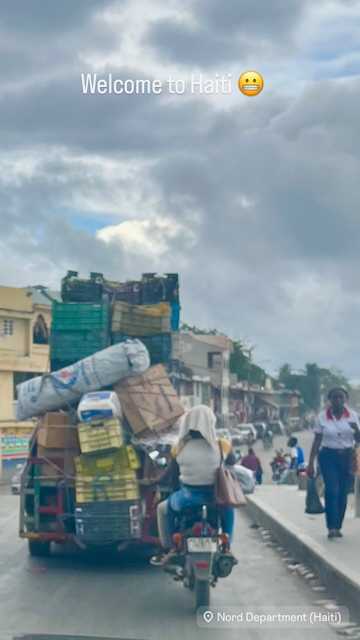
I reckon going to Haiti isn’t usually something one does spontaneously. But there I was, in Cap-Haïtien, by chance.
Just three days ago, I was in Honolulu, thinking about making my way home. I’d been hopping around in the Pacific for weeks, so it was about time. And since home happened to be on the opposite side of the planet, I’d need an intermediate stop or two. Turned out, the cheapest flights went through Miami.
Hmm… not exactly my favourite hang-out. I’d always found it loud and kinda sleazy. But… I suppose I’d give it a second chance – or fifth or sixth, more like. (In retrospect, I’m glad I did. Miami in 2026 is considerably improved.)
Back in Hawaii, almost immediately, my mind started spinning. Was there anywhere near Miami I could go for a couple of days? Ideally, somewhere I hadn’t been. And preferably somewhere that wouldn’t require much paperwork, visas and the like.
Shouldn’t be too difficult, I thought. After all, the Caribbean has no shortage of islands. Thing is, I’d visited most. And much as I like many of them (watching planes arrive at Maho Beach in Sint Maarten/Saint-Martin, or the colours and music of Old San Juan come to mind), I was really looking for something new. Something different.
Haiti
Haiti stood out. No visa required, and a new country for the travel stats.
Now, Haiti isn’t what first springs to mind when you think of an island getaway, is it? It’s a country that tends to make the headlines for all the wrong reasons. Calling it the less-travelled side of the Caribbean is probably an understatement.
Yet that unfamiliarity was precisely what made it interesting. And so, rather impulsively, I booked a flight to Cap-Haïtien, on the country’s northern coast. From a quick bit of reading, I gathered it was a city with an interesting history, multicoloured architecture and an atmosphere quite unlike that of its better-known Caribbean neighbours.
I was intrigued!
Arriving in Cap-Haïtien
Cap-Haïtien is a two-hour flight from Miami. At the time of my trip, Haiti’s own Sunrise Airways was the only airline flying that route. (Update: As of 1 November 2026, American Airlines flies between MIA and CAP).
As for lodgings, Cormier Beach Resort had been recommended, but it was fully booked, so I decided to stay in the city centre instead and found a room at Preloune Residences. It was an adequate, if somewhat unusual, hotel – particularly the prison-like doors at the entrance to the floors.
A different take on a golden cage, eh?
A note about safety and travelling in Haiti
I won’t beat around the bush: Haiti comes with considerable travel warnings. The security situation is particularly dangerous in and around Port-au-Prince, where armed gangs, kidnappings and violent crime are major concerns.
Cap-Haïtien has generally been regarded as safer than the capital and some of Haiti’s other troubled regions, with less day-to-day gang fighting. But it’s important to keep in mind that “safer” is relative. Security incidents occur here, as well.
All that said, during my stay, I found Cap-Haïtien to have a rather different atmosphere from the grim picture of Haiti often presented in the news. I never felt threatened. Overwhelmed at times, yes, but not threatened. I wandered around the compact city centre without experiencing anything hostile or intimidating.
Of course, that’s just my personal experience over three days in September 2026, and not a guarantee of safety or even an indication of the current security situation. If you’re considering a visit, check the latest official travel advice before making any plans and take appropriate precautions. Also, make sure you have travel insurance that actually covers Haiti. Many policies exclude countries subject to official travel warnings!
And, as always, use common sense.
Wandering through Cap-Haïtien
I arrived at the hotel in the afternoon and immediately set off to explore the historic centre surrounding it.
The old colonial architecture was what first caught my attention. Bold colours and faded façades, balconies, wooden shutters and buildings that had clearly seen better days. Not that this made them any less photogenic. Au contraire!
As the afternoon slowly turned into evening, I ambled through the streets, soaking up the atmosphere and observing everyday life. The daytime heat gradually gave way to a softer evening light, making the streets even more atmospheric.
One of the things I enjoy most about travelling is simply wandering aimlessly about. In my experience, it’s often unplanned moments that turn into the best travel memories. So no plans, no particular sights in mind. I hadn’t even bothered to read a travel guide. I should probably get my bearings at some point, but there was no rush.
There was plenty to take in. Street vendors, people going about their daily business, motorcycles weaving through the streets, conversations and music coming from somewhere in the background.
It felt lively, authentic and very, very different from the carefully presented tourist hotspots elsewhere in the Caribbean.
Back at the hotel, I finally settled down in the bar with a drink and my laptop – and discovered that Haiti had a UNESCO World Heritage site, and, better yet, that it was nearby. Citadelle Laferrière and Sans-Souci Palace, located in the mountains above the town of Milot, were just an hour’s drive south of Cap-Haïtien. This pleased the World Heritage geek in me no end. I asked the front desk to arrange a driver for me the very next day.
To the mountains
After the kind hotel manager had made sure I’d had breakfast (coffee and ham sandwiches), the driver and I set off towards Milot. On the way, we passed the long, rather ominous-looking stone wall topped with barbed wire surrounding the airport. Hm…
Leaving Cap-Haïtien, the coastal surroundings gradually gave way to lush green hills and dramatic mountain landscape.
The Massif du Nord shows a very different side of Haiti. I’d caught a glimpse of the peaks through the plane window when flying in, but seeing them up close was still a surprise. Perhaps wrongly so, but somehow, this rough and rugged terrain isn’t what I normally associate with the Caribbean.
Remember I mentioned feeling a bit overwhelmed? Arriving at Sans-Soucis Palace, we had no sooner parked by the gates, before a posse of self-appointed guides practically accosted me, competing rather aggressively (literally, physically fighting!) for my attention/money. It got so bad I had to tell them, very firmly, I would leave altogether if they didn’t stop immediately. That did the trick.
I chose the one that appeared the calmest to show me around the large grounds, and the driver came along. You never know…
Sans-Soucis Palace and the first Black republic
Haiti’s emergence as the world’s first independent Black republic was a remarkable achievement, born out of a revolution against slavery and colonial rule.
Following Haiti’s liberation from French colonial rule in 1804, Henri Christophe, one of the leaders of the Haitian Revolution, commissioned the construction of Citadelle Laferrière as a defensive stronghold against a possible French invasion. He also had Sans-Souci Palace built nearby, serving as his royal residence and the centre of his kingdom.
The palace, together with the fortress above it, tells the story of a period that shaped not only Haiti but also the wider history of the Caribbean and its struggle for freedom. The history behind these monuments is every bit as impressive as the structures themselves.
In 1811, Henri Christophe established the Kingdom of Haiti here in the north, declaring himself King Henri I. The two monuments became powerful symbols of freedom, sovereignty, and a nation’s determination to defend what it had fought so hard to achieve.
The guide also recounted a rather tragic story. Nine years later, faced with a rebellion and the imminent collapse of his kingdom, Henri Christophe reportedly took his own life at Sans-Souci Palace. A rather sombre ending to the story of a man who had played such a pivotal role in Haiti’s struggle for freedom.
He certainly knew his history, this guide, so kudos to him for that. But when he asked for ‘only 100 USD’ for his services – all of 20 minutes of them – I couldn’t help laughing. Eventually, he laughed too. Don’t ask, don’t get, he must have thought.
I gave him 20.
Skipping the citadelle
Citadelle Laferrière is a 2-hour steep uphill walk from the palace, so the best option in the heat is to take a motorcycle taxi.
My original plan was to get on one of those and go up, but I decided to skip it. It’s all very well being the loud and assertive person at the palace gates, but I really didn’t fancy a repeat performance. Not today, anyway.
A little beach time
On the drive back to Cap-Haïtien, I felt the need for a bit of peace and quiet before returning to the hustle of the city centre, so I asked the driver to take me to the beach.
Labadee, just along the coast, is Royal Caribbean’s private resort enclave, reserved for its passengers. A curious little bubble of cruise-ship tourism, seemingly worlds apart from everyday life in the rest of Haiti. I’ve never been there, but I gather the beaches on the other side of the headland look rather different from this.
I was also curious about the hotel I’d tried to book but which had supposedly been full. So we continued to Cormier Beach Resort.
Now, where were all those guests hiding?
There was hardly anyone around. Not on the beach, not in the restaurant, nor and in the common area.
Apparently fully booked, although you wouldn’t know it.
The place was practically deserted, apart from two bartenders looking a bit bored.
Bored or not, they did serve a delish papaya juice, right up there with the ones in Luang Prabang. Bonus points for that!
A different side of the Caribbean
So this wasn’t exactly a traditional Caribbean beach break. No endless stretches of white sand, no pools or leisurely days spent doing very little.
Instead, there was history, lively street scenes, quirky architecture, and the opportunity to discover somewhere that not many travellers get to see.
Cap-Haïtien wasn’t quite what I expected… although I’m not entirely sure what I had expected in the first place.
It was lively, colourful, occasionally overwhelming and anything but conventional.
Often, the most interesting travel experiences come from that unexpected detour, and allowing an unfamiliar place to surprise you. Haiti certainly did that.
A different side of the Caribbean, indeed.
*********
Epilogue: Leaving Cap-Haïtien
I almost left this bit out, as it doesn’t really have much to do with visiting Cap-Haïtien. But then again, it’s part of the experience, so here goes…
Leaving Haiti was no picnic, it turned out. After a five-hour delay, we boarded! Finally, yay! Or so we thought.
When boarding, I spotted a little logo saying the plane was operated by GlobalX (Global Crossing), an airline that also runs ICE deportation flights. An uncomfortable association, to say the least.
Spot the little logo?
But the plane wasn’t working as it should, so we had to deplane and were ushered back to the departure area, where the waiting continued. And continued. The passengers got increasingly restless, and tempers were beginning to fray.
After several more hours, we were herded onto a couple of rickety old school buses and driven to a hotel in the middle of nowhere, two hours away. There, we were given just one hour to sleep before having to make the journey back for our rescheduled departure.
The incoming plane was, of course, delayed again, and tempers were running high. People weren’t shy about showing their frustration. There was plenty of shoving and shouting going on. Not a place for the timid, that airport. I had to summon up my pushiest side to secure a seat on what they called a rescue plane.
I can tell you, Miami seemed like heaven after that.

National History Park – Citadel, Sans Souci, Ramiers is a UNESCO World Heritage site.
Here are more UNESCO World Heritage sites around the world.
Cap-Haïtien: A different side of the Caribbean is a post from Sophie’s World