Original content owned & copyrighted by Green Global Travel.
Climate change is having a personal impact on people’s lives worldwide. Lovely Begum, who resides in the Mohanganj, Moulvibazar district of Bangladesh, lost her home 8 times due to environmental stressors, such as floods and erosion.
But for the right person, such losses can transform into social good. In Begum’s case, it inspired her to start the United Nations-supported LoGIC Project, which spreads awareness of eco-conscious quinoa cultivation.
These climate-smart cooperatives are a form of agency that transforms into ingenuity. Women climate leaders in Bangladesh have walked through towns across their country, turning neighborhoods into symbols of community-led adaptation and collaboration.
Each corner represents innovation, told from the perspective of one of the many women working to advance economic empowerment, despite the challenges.
From water filters to island solar grids, the solutions are funded, implemented and leaving a lasting impact because of a medley of organizations and their female minds.
“Initially, people doubted me,” Lovely says. “They said it wouldn’t work, and that no one would buy quinoa. But after my first successful harvest, those same people now come to me for advice.”
READ MORE: How to Reduce Your Carbon Footprint
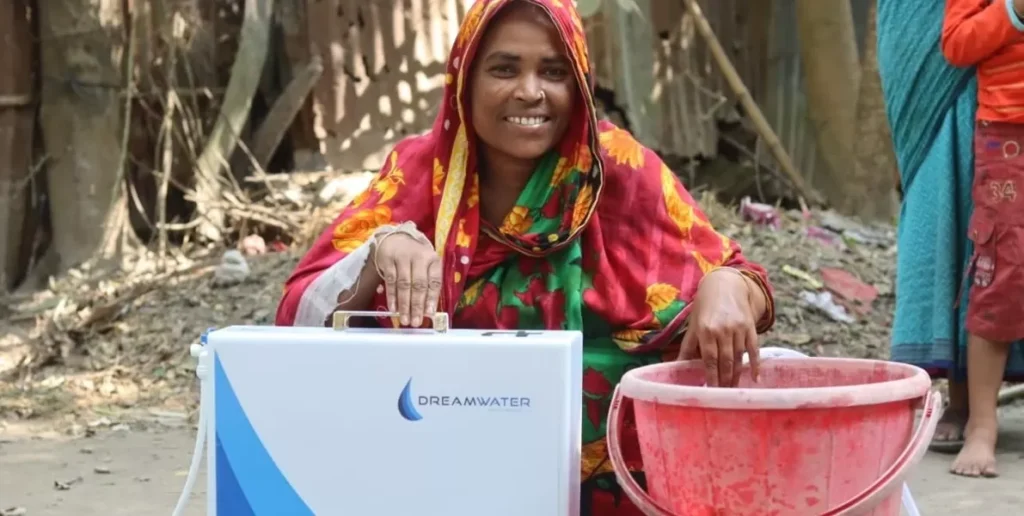
Dreamwater water filtration system, photo via Footsteps Bangladesh
Water as Opportunity: Footsteps & the Dreamwater Model
Climate innovation in Bangladesh begins by dismantling a problem until it becomes manageable, as Adhuri Begum did with the Footsteps Bangladesh project, which was founded in 2013.
The NGO’s goal was to tackle poverty and water scarcity in the country’s poorest and monsoon-afflicted areas with a portable filter called the Dreamwater. This system removes 99.99% of contaminants in a single backpack, which is equipped with nanosilver filtration and batteries to keep costs down.
Now, communities can take advantage of the floodwaters that previously stole their drinking water. Begum emphasized how this initiative has gone beyond water treatment, training 800 women with awareness and participation programs.
“We are transforming a crisis into a hope,” says Begum. “Not only are we tackling the climate crisis, but also harnessing the potential of women in communities so they can save lives and increase their own status within their communities.”
The actions communities take to adapt water management infrastructure to floods and drought are extensive. Some of it is filtration, and other times it is advanced dewatering systems made of pumps and well points for energy distribution.
Every effort contributes to the big picture of Bangladesh’s national well-being amid climate change.
READ MORE: Water.org’s Mission To Bring Fresh Water To The World
Runa Khan, founder/CEO of Friendship, photo via Friendship
Energy Independence– Friendship & Solar Villages
Runa Khan is also taking climate adaptation in Bangladesh into her own hands. She founded the Friendship NGO, which has been internationally recognized for its environmental impact, earning it £1 million in funding to provide solar home systems in the country’s chars and coastal belts.
These areas are home to communities of intra-migrants– individuals driven to other parts of the region by erosion and water threats, such as rising sea levels.
Solar power home systems can have between a 20-watt and an 85-watt capacity. Over 3,500 homes have the systems, and over 700 professionals have been trained.
These people previously relied on equipment such as kerosene lamps. Now, Friendship has impacted over 7.5 million Bangladesh citizens with its learning centers and social justice approach to climate solutions in Bangladesh.
The reason this operation is successful is that it involves community members and funds initiatives that advance their interests, such as mangrove preservation.
“We work, we expand, then we stop. We strengthen our roots, and only then do we move forward again. Our vision is not on growth. but on depth and quality. That is what ensures sustainability,” Khan mentioned when noting the importance of smart funding sources and community-led protection.
READ MORE: 5 Incredible Eco-Friendly Initiatives That Will Change the World
Photo courtesy United Nations Development Programme
Flood-Resilient Farming– LoGIC & Climate-Smart Cooperatives
The Local Government Initiatives on Climate Change (LoGIC) is a massive collaboration between donors and eco-driven thought leaders from the European Union, UNDP and the Government of Bangladesh. It has partnerships with the National Development Programme (NDP).
Shilpi Khatun is a field facilitator and advocate for the Action Against Hunger project, while Salma Begum is a cooperative
farmer in Ashabaria. Begum’s crop was being destroyed annually by natural disasters due to living by the coast.
The LoGIC project intervened, giving this mother of three (who had no arable land) the resources she needed to become a positive influence on her environment. What was once a land primarily driven by subsistence became an effort to bolster collective security.
Alongside seven other women, she was part of the Climate Resilience Fund (CRF), which would pool assets such as land and grants to help other families manage farming operations.
These cooperatives have supported an estimated 35,000 women, training them on climate-adaptive livelihood options, mobilization techniques and climate-tolerant sustainable agriculture.
READ MORE: What is Permaculture Gardening? Intro to Design & Principles
Photo via SheRAA Women’s Climate Resilience and Adaptation Alliance
Climate Education & Women’s Leadership Networks
These climate change solutions in Bangladesh only exist because of the women who spearheaded education programs and community-based learning.
One example is SheRAA, the Women’s Climate Resilience and Adaptation Alliance. This coalition of many NGO programs (including LoGIC, Footsteps and more) promotes adaptation, research, and educational justice.
Manusher Jonno is a member, and Executive Director Shaheen Anam recently spoke about how crucial women are in promoting knowledge and independence. She alluded to how much they are changing and teaching, but says they are still woefully underrepresented.
Collaborations like SheRAA and Manusher Jonno represent opportunities to amplify female voices in the climate movement by highlighting how issues of gender, discrimination and violence coincide with a truly sustainable world.
These motivations lead to community training, ensuring women know how to speak on these issues and use the tools organizations provide them with to instigate real climate adaptation and equality.
READ MORE: The 21 Best Environmental & Animal Rights Charities
Dr Nomita Halder, photo via Palli Karma-Sahayak Foundation
The Broader Ecosystem– PKSF, Government & International Support
The Palli Karma-Sahayak Foundation (PKSF) is one of the most shining examples of how the women of Bangladesh have extended beyond the nation’s borders to pool resources and encourage collaboration. Its goal is to ensure grassroots organizations receive the funds they need to implement climate adaptation measures.
This involves the Direct Access Entity (DAE) for Green Climate Fund (GCF), the Local Government Division, Ministry of Power, and many other players to execute. It keeps financial decisions within the country and its organizations, rather than leaving them to external entities.
PKSF recently supported the Growth for Climate Resilient and Environmental Entrepreneurship and Nutrition (GREEN) project, which will take six years to deploy in the Haor wetlands. It will help smallholders and drive micro-enterprises in rural areas, and promote to people of all backgrounds the impact that can be made at a small scale.
The organization is also a springboard for many other women to share their voices about climate concerns in Bangladesh. The Fisheries and Livestock adviser, Farida Akhter, raised concerns before members of PKSF and other groups to discuss the state
of pesticides, saying, “It is urgently needed to integrate pesticide-related concerns into fisheries and livestock policies.”
She then continued to discuss the importance of endangered indigenous fish and how chemical use affects food production.
In this meeting were faces from around the world, witnessing the cares of Bangladeshi women and the example they are setting. Facilitating these moments of discourse to promote policy-scale change is another way these gatherings are highlighting women’s impact.
READ MORE: Are GMO Crops the Future of Food?
Why This Model Works– The Meta-Narrative
These women have become beacons for Bangladesh because they have forced the world to change perceptions about its people and climate-resilience tactics. They are the change-makers, generating the income, social groups and resources necessary to execute disruptive ideas that could inspire the wealthiest nations.
This is evidenced by its delicate weaving of traditional, regional knowledge with a desire to embrace modern technology.
It has led to everything from floating gardens to resilient rice varieties, both of which respect nature and balance scalable power in communities of all forms.
If these women can create this degree of impact, then policymakers, investors and organizations worldwide should feel empowered to construct similar frameworks.
Eventually, finding like-minded communities focused on climate adaptation and equity will become considerably easier. –Alex S. Morrison; lead image by Balaram Mahalder via CC by SA 3.0
The post How Bangladesh’s Women-Led Climate Revolution is Transforming Communities appeared first on Green Global Travel.