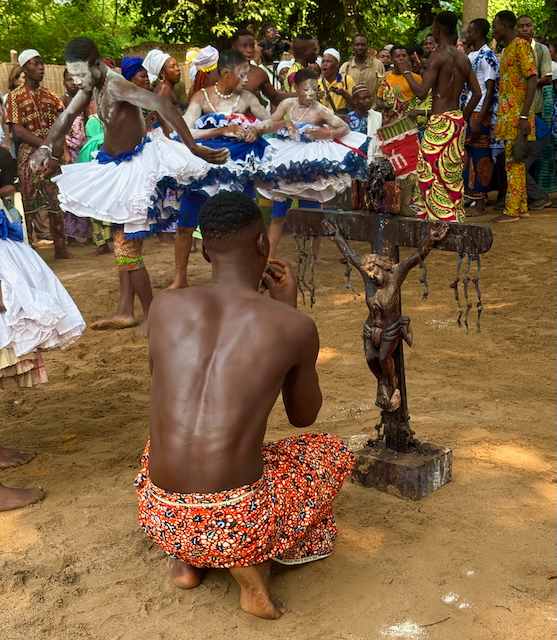
Are you curious about Vodun (Voodoo)? If so, there is no better place to experience it than in Ouidah, the very cradle of the religion. And no better time than at the annual Voodoo Festival.
Religions side by side at the Voodoo Festival
Every 10 January, the laid-back coastal town of Ouidah bursts into life for the Fête du Vodoun. Ouidah sits between the Atlantic Ocean and a vast lagoon, and what is usually a quiet place, with sandy streets and fading colonial façades, turns into a lively celebration of history and identity, about spirituality, and a complex, colonial past.
Thousands of devotees, priests, musicians, dancers, and, erm… curious travellers, gather to honour the spirits that shape daily life across much of West Africa.
Many streets are closed to cars during the festival, so tuk-tuks – or walking – it is
During the festival, stalls appear overnight, selling bright wax-print fabrics, ritual objects, grilled fish, chilled drinks, and pretty much everything else. You can hear the sound of drums through the streets from early morning. Anticipation is in the air.
10 January 2026
Hotels in Ouidah have been fully booked for ages, so Nina, David, Melissa and I have been staying in Cotonou, a 1-hour drive away. Our fixer and driver will take us to Ouidah, but they are 1.5 hours late, which means we miss the opening ceremony, the Egungun, and the Zangbeto. Safe to say we’re a bit miffed.
The Sacred Forest: where spirits dwell
But… have to make the best of it, so we head straight for the Sacred Forest.
Close to Ouidah city centre is La forêt sacrée de Kpassè, a shaded, leafy grove filled with shrines and statues representing Vodun deities. This forest is a living spiritual sanctuary, and various ceremonies take place here during the festival.
The Voodoo King enters the arena in the Sacred Forest –
– then voices rising, bodies moving, spirits drifting into trance…
In the forest, sunlight filters through thick foliage, lighting up statues of spirits painted in bright colours. Our fixer explains the stories behind them, from trickster gods to powerful ancestral forces.
According to local tradition, King Kpassè, founder of Ouidah, transformed into a tree to escape his enemies.
Sacred trees in the sacred forest
The Python Temple: Sacred serpents in the middle of town
Just opposite the Catholic basilica…
…is one of Ouidah’s most striking spiritual sites: the Python Temple, dedicated to royal serpents, symbols of wisdom, protection, fertility… all that good stuff. The contrast between church and temple is deliberate, reflecting centuries of religious coexistence and adaptation.
Inside a building in a modest courtyard, dozens of gorgeous pythons coil around branches and rest along the walls. They are not feared, but rather revered, as manifestations of Dan, the serpent god of creation and continuity.
The pythons live freely in the temple grounds, and are released at night to roam. People say they return of their own accord by morning. Killing a royal serpent is a serious offence.
Devotees drape a python gently around their shoulders for a blessing.
Peaceful coexistence. And we are both harmless.
Door of No Return: At the Edge of the Atlantic
At night, the celebrations move to the beach, by the symbolic Door of No Return, a stark memorial marking one of the departure points for enslaved Africans during the transatlantic slave trade. The setting is profoundly moving. A religion that travelled across the ocean in the hearts of those forced into slavery, is now celebrated openly and proudly in its homeland. From West Africa to Haiti, to Cuba, to Louisiana – and back again.
Ca. 200 000 attend the beach party
As evening falls and the crowds thin, the beach grows quieter. Waves break against the shore beside the Door of No Return. The drums slowly fade. Once again, I can hear the steady rhythm of the waves.
Zangbeto: Guardians of the Night
As we missed the Zangbeto ritual at the festival, our fixer brings us to a small village the next morning for a look at this unusual ritual.
Entrance to Djegbadji village
The Zangbeto are traditional guardians of the night, here represented by large, swirling structures made entirely of layered raffia (palm leave fibre). No human figure is visible beneath them, and according to belief, there is none inside at all.
As drums beat, the Zangbeto spin at astonishing speed, around and around, with flaring straw skirts.
Watching the Zangbeto whirl across the sand is hypnotic. Also, slightly eerie. One of those travel moments that just cannot be easily explained.
Sometimes, they collapse to the ground and get back up again, revealing unexpected objects underneath their skirts.
They are regarded as spiritual protectors who patrol communities and maintain order.
Voodoo Festival beyond the spectacle: Understanding Vodun
Western portrayal of voodoo have long reduced it to caricature, all about black magic and sticking pins in dolls to cause harm. hat couldn’t be further from the truth. Vodun is a sophisticated spiritual system focussing on balance: between humans and nature, the living and the dead, the visible and invisible worlds. It is about healing and protection.
People offer palm oil, gin, maize, and even animals. Not from fear, but out of respect. People consult their ancestors. Illness and misfortune are understood within a broader spiritual framework. Less exotic, perhaps, but more, well, human.
Ouidah Voodoo Festival practicals
Book accommodation well in advance! Rooms were hard to come by in Ouidah, but also in Cotonou.
Arrive early on 10 January to secure a good vantage point at the main venues.
It’s a good idea to have a local guide to help interpret ceremonies and navigate cultural sensitivities.
Dress lightly; the heat and humidity can be intense. Also, dress modestly.
Be respectful at all times; this is a religious ceremony, not a performance for tourists.
Always ask before taking photographs, this is particularly important during rituals.
For us, it’s onward to Liberia, via a road trip to Ghana, and a brief stop in Togo along the way.
All photos by David Røgler and yours truly.
Dancing with spirits at the Voodoo Festival in Ouidah is a post from Sophie’s World