In the splendid city of Buenos Aires, La Recoleta is one of those barrios (neighbourhoods) that feels special, with grand architecture, leafy streets, and a strong sense of history. There is no shouting for attention in this barrio. No need to.
It is a lovely place to people-watch at one of the many pavement cafés, or wander along stately museums standing side by side with residential buildings, or taking lazy strolls through the parks, like the locals do. In short, you don’t need a strict plan here.
Amongst La Recoleta’s many lovely spots, is what must surely be the world’s most beautiful bookshop. And just a short walk away is another iconic site: a cemetery.
Graveyards
Fascinating places, aren’t they, cemeteries. Places where history, art, and memories quietly intersect. They offer a peaceful space for reflection on time and mortality. They tell little, intimate stories of lives lived. In fact, cemeteries have been the subject of many posts here on Sophie’s World.
Here is yet another burial ground, a famous one. In Argentina’s lively capital.
Cementerio de la Recoleta
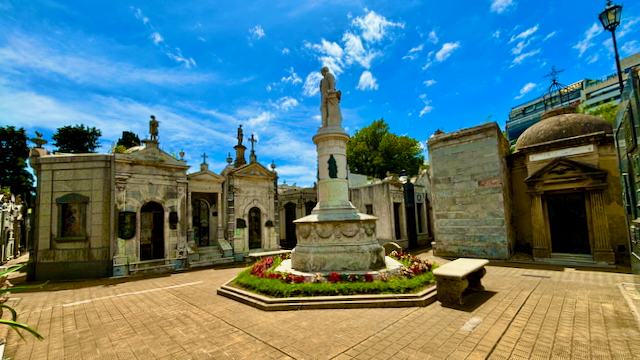
Whilst Cementerio la Recoleta is a graveyard, it feels more like a small city within the city. Instead of rows of headstones, I walk through narrow pathways with elaborate mausoleums, imagining the stories of those whose bones rest here.
Many of the tombs are decorated with statues, stained glass, and intricate ironwork.
Evita
Some of them you do not even need to imagine. The cemetery gives a glimpse into the social and political history of Argentina; with people whose lives were very public. Most famous of all is the tomb of María Eva Duarte de Perón, better known as Evita. Politician, activist, actor, philanthropist, president of the country’s first broadcaster performer’s union, first lady and spiritual leader of Argentina (a title given her by the Argentinian Congress), who tragically died young.
The Princess Diana of the 1950s
It seems almost natural that great drama would follow Evita in death as in life. Her physical remains were stolen, missing for 16 years. But she was finally found – and then buried at her family’s tomb here at La Recoleta.
After that, the government went to great lengths to ensure her tomb was secure. The tomb has a marble floor with a trap door, which leads to a room with two coffins. Below that room, is another trap door, leading to another room, with Evita’s actual coffin.
Is it a cemetery or a museum?
Some of the graves are grand and pristine, others weathered and slightly crumbling, but that only adds to the atmosphere. It feels less like a place of mourning and more like an open-air museum.
The city noise fades away here along the narrow lanes, replaced by my own quiet footsteps and soft echoes between marble walls.
Even if I don’t know the names carved into the tombs, there is something compelling about wandering past the tombs, noticing the little details: a forgotten flower here, a cracked sculpture there, a cat stretching in the sun. It is haunting, peaceful, and strangely beautiful all at once.
Interior of a mausoleum at La Recoleta cemetery
Spooky stories
You know I love a good ghost story, and a cemetery will of course have those. Cementerio La Recoleta is no exception.
They are not scary, these stories, but rather atmospheric, making the walk past the marble mausoleums delightfully mysterious, and very Buenos Aires. Here are three that add a deliciously eerie layer to the walk:
The Legend of Rufina Cambaceres
One of the most visited graves at La Recoleta, is the Art Nouveau tomb of Rufina, a girl from a wealthy family who, in the early 1900s, collapsed on her 19th birthday and was declared dead. After her burial, the tomb was later opened and scratch marks were reportedly found inside the coffin, suggesting she may have been buried alive. Since then, visitors claim to see the ghost of a young woman in a white dress wandering the cemetery at night.
The Gravedigger and the Keys
Another legend tells of David Alleno, a longtime cemetery caretaker who worked here for decades. He saved his wages to buy his own tomb, had his statue placed at the entrance of his mausoleum, and then took his own life shortly after retiring. People say his ghost still wanders the cemetery, jingling keys and doing his nightly rounds, refusing to leave the place he cared for so deeply.
The Black Lady
Locals speak of a mysterious woman dressed in black, who appears near closing time. She lures men into following her through the cemetery gates, before suddenly vanishing, leaving them alone amongst the tombs.
Walking out of the cemetery, I realise this is a place less defined by death, and more by memory. Its narrow passageways and ornate mausoleums tell stories of ambition, love, tragedy – stories that shaped Argentina itself. In the quiet between footsteps, I am reminded that history is not only written in books, but carved in stone and preserved through the echoes.
Even silence can speak volumes.
World at a Glance is a series of short articles here on Sophie’s World, portraying curious, evocative, happy, sad, wondrous, or unexpected little encounters.
La Recoleta: where the dead live beautifully is a post from Sophie’s World