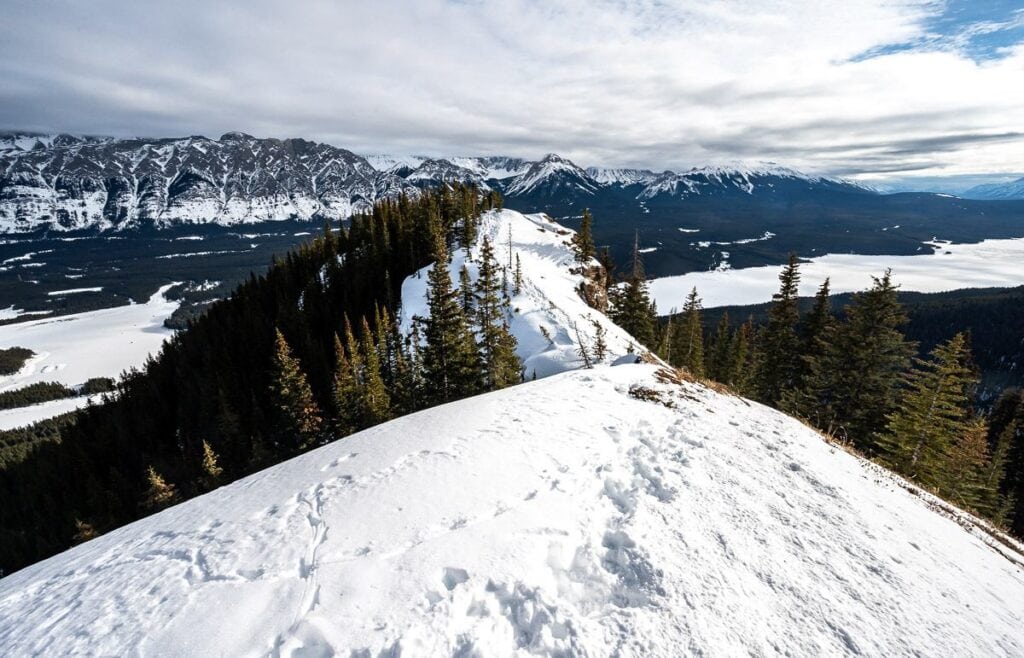
The Gypsum Ridge winter hike in Peter Lougheed Provincial Park exceeded all expectations. It’s got a bit of everything – a steep, heart-pumping climb, forested sections with occasional views, and a final ridge walk to a marvelous viewpoint over Kananaskis Lakes. It’s a quiet, unofficial trail with no signage or formal trailhead, making it the perfect half-day winter hike – less than an hour from Canmore – for experienced winter hikers, snowshoers, and dog walkers.
This post includes some affiliate links. If you make a qualifying purchase through one of these links, I will receive a small percentage of the sale at no extra cost to you. I very much appreciate your support.
A wide-angle view showing the drop-off on either side of Gypsum Ridge
Where Is Gypsum Ridge?
Gypsum Ridge is less than an hour’s drive from Canmore via the Smith Dorrien Trail – and just over 10 km from the Highway 40 South turnoff. It’s an excellent choice for a winter hike or snowshoe as there is minimal avalanche danger.
Looking back along the length of Gypsum Ridge
Gypsum Ridge map
Note starting location in relation to the Blackshale Suspension Bridge trailhead
Gypsum Ridge Trailhead & Parking (Winter Access)
The Gypsum Ridge trailhead is located 56 km southeast of the Canmore Nordic Centre via Highway 742, also called the Smith Dorrien Trail – Spray Lakes Road. It is about 150 m southeast of the Blackshale Suspension Bridge trailhead, marked on Google Maps – on the south or opposite side of the road. I found the route on Organic Maps – and drove the Smith Dorrien Trail until we saw cars right around where we figured the hike would start.
The Smith Dorrien Trail can get ugly on a winter drive. The area gets a lot of snow so it’s important you’re prepared for winter driving conditions. Pack a shovel. AWD is handy if there is a snowstorm.
The trail to Gyspsum Ridge is on the far side of the steep snowbank
Our car parked on the Smith Dorrien Trail – Spray Lakes Road beside a large snowbank
Distance, Elevation Gain & Time
Distance: 6.2 km return
Elevation gain: 504 m/ 1654 feet
Time needed: Around 3 hours
Difficulty: Hard because of steep terrain and exposed slope to viewpoint
Gypsum Ridge Winter Hike Description
Look for a boot-beaten trail on the far side of the snowbank beside Smith Dorrien Trail.
Follow it – steeply at times as you lose 70 m of elevation to arrive at Smith Dorrien Creek. In mid-January there is a bomb-proof snow bridge over the creek to cross. Be mindful of its integrity when temperatures warm up.
On the far side of the creek begin the steep 200-metre climb over 0.6 km through the forest to reach Gypsum Mine Road.
Turn right at the top and follow the road at a gentle grade. It makes a sharp left hand turn after 10 minutes of hiking.
Stay on the road climbing gradually to reach forested slopes.
The forest is densely treed in places with some peek-a-boo views out to Kent Ridge as you near the top of this section.
Follow the ridge through trees to a high point.
For the best views on the Gypsum Ridge hike continue for five minutes to the viewpoint at the far end of the ridge – but be mindful of the steep slopes dropping away from the narrow trail.
If it’s icy, the dip down and then up to the observation point can be a bit unnerving.
Crossing a creek via a snow bridge on the hike up Gypsum Ridge
Me on the steep climb up to Gypsum Mine Road
Easy hiking on Gypsum Mine Road, especially after the steep section
Through a dense section of trees on the Gypsum Ridge hike
John and our dog Mila on the summit of Gypsum Ridge
Snowshoes or Winter Boots?
You’ll have an easier time of it – especially on the steep section that climbs 200 metres over just 0.6 km – if you’re wearing microspikes rather than snowshoes. It’s similar to the footing you’ll encounter on the Green Monster – another popular Kananaskis winter hike – where traction devices are easier than snowshoes.
Snowshoes are a good idea after a heavy snowfall, before the trail has been packed down. The rest of the time stick to micropsikes, but also wear leg gaiters in case you step off trail and sink into deep snow. You don’t want wet feet.
Gypsum Ridge overlooking Kananaskis Lakes
Avalanche Safety and Winter Conditions
Gypsum Ridge travels mostly through low-angle, forested terrain, which normally keeps avalanche risk low when you stay on the main route. Even so, winter conditions can change quickly. It’s important to check the Avalanche Canada forecast and weather before heading out and adjust your plans if conditions deteriorate.
The descent on Gypsum Mine Road is quick and easy
Is Gypsum Ridge Good for Dogs?
Gypsum Ridge is a great winter hike for dogs that are in shape. Your dog will get an amazing workout and will likely sleep all the way home. Dogs are supposed to be leashed over the length of the hike, in part to keep wildlife safe.
Don’t take your dog on a bitingly cold day with a wind or it may end up with frostbite. The rest of the time should be fine. The far end of Gypsum Ridge isn’t large – so beware of other hikers if you’re walking with a large dog. Not everyone will feel comfortable on the ridge letting you pass.
Pack the following for your dog:
Dog botties – if they are prone to cold feet
A dog coat – if they don’t have a lot of fur
Extra water and treats
Our dog Mila from Mexico loved the Gypsum Ridge winter hike
Best Time to Hike Gypsum Ridge in Winter
The Gypsum Ridge hike is doable year-round with one caveat. There is a stream you must cross within about 10 minutes of starting the hike. If you go to early in winter before a snow bridge has formed, you might have difficulty. And perhaps the creek is high during spring run-off, so be careful.
You may be the one breaking trail after a fresh snowfall – and that’s a lot of work. If you want a workout, go for it. Otherwise, give it a few days for the snow to get packed down by others. Also, if it snows a lot you’ll need snowshoes rather than microspikes to navigate the trail.
Compared to the Chester Lake winter hike or snowshoe, Gypsum Ridge will never see many people. It’s not signed. You need to know the trail’s location to even get started. Going mid-week or on weekends isn’t going to matter a lot regarding crowds. You’ll see people, but not a lot of them.
Final Thoughts: Is Gypsum Ridge Worth it in Winter?
The Gypsum Ridge hike in winter exceeded all expectations. I loved it for the workout – especially on the super steep section, and the expansive views at the very end of the ridge overlooking Kananaskis Lakes. It’s a solid winter hike if you’re looking for a half-day outing not far from Canmore. Choose one of the longer Banff winter hikes if you want to spend more time outdoors.
Interested in more winter outings in Alberta & BC?
5 Outstanding Fernie Winter Hikes – Discover Fernie’s snowy playground with winter hikes that showcase rugged peaks, backcountry forests, and gorgeous alpine scenery.
Easy Winter Walks Within 40 Minutes of Calgary – Discover easy winter walks within 40 minutes of Calgary, featuring low-effort trails ideal for snowy strolls, families, and casual winter outings.
Snowshoeing to the Ink Pots in Banff National Park – Snowshoeing to the Ink Pots is a rewarding winter adventure featuring forested trails, and the striking Ink Pots that never freeze.
Ice Walks in Alberta – 4 Unforgettable Experiences – Discover some of Alberta’s most memorable winter adventures, exploring frozen canyons and icy waterfalls.
16 BEST Winter Hikes in Canmore & Nearby – A quick guide to the best winter hikes in and around Canmore, with options for all abilities.
Click on the photo to bookmark to your Pinterest boards.
The post Gypsum Ridge Winter Hike Near Canmore (Smith Dorrien Trail) appeared first on Hike Bike Travel.