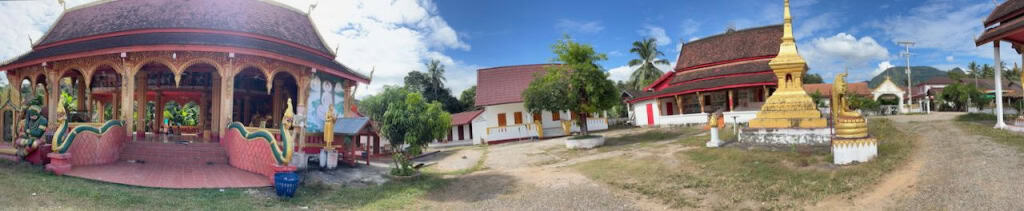
I am at the tail end of a jaunt in South-East Asia, in Luang Prabang, sort of by chance.
I was going to explore Myanmar – more of the country than just Yangon, that is. But a typhoon was on the way, and if I had any kind of time constraints, I would do well to leave and come back another time, I was told. Flights would be cancelled or at the very least much delayed.
Time constraints. My middle name. Trying to fit in a lot in little time, get as much out of every vacation day as possible. That’s working life. No time to wait out a typhoon.
And so I am in Laos instead. Luang Prabang specifically. Not a bad trade-off.
Not bad at all
Luang Prabang: Temples and Tradition
Just where the Mekong meets the Nam Khan River, lies the former royal capital of Laos. I have been curious about Luang Prabang, and it’s fun to finally be here.
If you are an early riser, the streets come alive at dawn, with almsgiving rituals. Long lines of monks in saffron robes, walk barefoot through town to collect offerings of sticky rice. It’s fascinating to watch. A bit humbling, too. The monks move silently, gliding almost, through the morning mist.
It feels like I’m in the middle of a live postcard. Golden temples shimmer in the sunlight. Luang Prabang is home to more than thirty Buddhist wats, each with a character of its own. They are architectural masterpieces, these temples, all sweeping rooflines and intricate gold details.
No wonder UNESCO has added this little town to its World Heritage list.
There’s a scent of frangipani in the air, one of my favourite flowers. And freshly brewed Lao coffee, which smells divine. Tastes a bit too strong for my taste, though. But then, to be fair, I prefer single shot latte. Or even half a shot.
Beyond the City
Just beyond the town, is a wilder side to Luang Prabang.
It’s early still, and I’m persuaded to take a taxi to a waterfall. There are several, all promising stunning nature.
I decide I want to see Tad Sae, a multi-tiered waterfall, close to the town centre. It takes about 25 minutes on a bumpy road to the small village Bak En –
A temple in every village
– then a short ride in a long, low-slung boat along the Nam Khan River, and finally a short hike.
And what a sight it is, Tad Sae. A dreamy cascade of milky blue-green water, flowing over limestone terraces, with jungle landscape all around.
Like liquid opals
There are more dramatic waterfalls, as well. The most famous is Kuang Si, a bit further from town. There’s swimming, kayaking and hiking opportunities there, and an elephant sanctuary nearby. A good day trip, I’d say.
Luang Prabang Night Market Magic
After dark, the town comes alive at the Night Market, and it.is.fabulous.
As the sun dips behind the mountains, the main street transforms into a glowing ribbon of red tents. I can smell grilled meat, but I’m more intrigued by a little stall selling coconut pancakes. So good!
Fresh papaya shake, whiskey optional
The hum of friendly bargaining and the genuine smiles of the vendors make this market feel both intimate and enchanting. A great place to buy some souvenirs (fridge magnets aplenty), grab a bowl of khao soi or grilled chicken skewers, and watch the slow rhythm of Lao nightlife happen.
This is not just a shopping experience, this. It is an all-round sensory one. I love the kaleidoscope of colours here. The handmade textiles, bamboo crafts, silver jewellery, the traditional lanterns, all lit by the warm glow of streetlamps.
One stall gets my attention. Metal rings, key rings, other trinkets, all made from bombs. Unexploded ordnance. I buy a key ring with a metal map of Laos, and decide to read up on this.
The UXO Centre and the American War on Indochina
Turns out I can do more than just read. The next day, I take the 20-minute walk to the UXO centre.
UXO, if you don’t know (I didn’t), means unexploded ordnance: bombs, shells, grenades, landmines, and other military munitions that were meant to detonate, but didn’t. They are found in rice fields, school yards, on hillsides, in rivers, along roads, and even in the middle of villages and town centres. They can go off at any time.
Laos holds a unique and tragic place in modern history as the most heavily bombed country in the world. During the American Secret War on Indochina (1964 – 1973), the USA dropped over 2 million tonnes of bombs on Laos. That’s about a planeload of bombs every 8 minutes. 24/7. For nine years!
The point of this campaign was to disrupt the Ho Chi Minh Trail, a network used by North Vietnamese forces to move troops and supplies into South Vietnam. Rural communities were heavily affected, and UXO remains a danger even today, impacting farming, schools, daily life.
Luang Prabang was one of the most impacted provinces, but all around Laos, locals have to deal with injuries and deaths from UXOs on a regular basis, even today, 50 years later.
At the excellent little UXO Lao Visitor Centre, I see this sobering history through maps, photographs, videos, and bomb casings. I read survivor stories.
Metal skeletons
Clearing efforts
I also learn about the efforts to remove unexploded bombs to make the land safe, including all-female clearance teams, (here’s a short film about one such heroine) – and I come away wiser, with a deeper understanding of the lasting effects of a war being forced upon you.
The UXO Centre is free to visit; they appreciate donations, which you can leave in a box by the door. You can buy souvenir items created from UXO metal here, as well. (Expect UXO Christmas presents, folks).
A Place to Pause
In Luang Prabang, locals smile at you, and monks chant softly. I enjoyed exploring the temples, strolling through the markets, and hiking up to the waterfall. What made the greatest impression on me, though, was learning more about the tragic history and the remarkable resilience of the Laotian people.
This town has quickly jumped to a spot amongst my top 5. It’s lovely and lively, and has a special rhythm. Life moves slower here, without being boring. And that’s saying something. My boredom threshold is, ahem… on the low side. Next time, I am taking the kids, and the little ones. They will adore this town.
Luang Prabang practicals
Best Time to Visit: November to February for cool, dry weather; June to October for lush greenery and more power in the waterfalls.
Getting there and getting around: Direct flights from Bangkok, Hanoi, or Siem Reap, or take a scenic slow boat along the Mekong River. I met a couple of fellow Norwegians who arrived by train from Kunming on the new high-speed LCR (Laos – China Railway). Luang Prabang is walkable, even at night. (Just mind the traffic). Many hotels have bikes guests can borrow, and you can rent scooters. Open-air taxis are cheap and fun.
Where to Stay: numerous cute little places: French colonial guesthouses, riverside resorts, boutique hostels, or family-run homestays.
What to Eat: Luang Prabang is brimming with cafes and restaurants. My favourites: street food at the Night Market and coffee and croissants at the Indigo Cafe.
What to wear: Modest dress in the temples.
Money: There are plenty of cash points/ATMs by the night market and around the town centre, fewer out in the country. This is largely a cash community, so make sure to carry Lao kip (LAK). Also, you’ll feel like a millionaire. 1 million kip = ca 40 EUR/46 USD.

Town of Luang Prabang is a UNESCO World Heritage site.
Here are more UNESCO World Heritage sites we have visited around the world.
Luang Prabang: Where time slows and beauty flows is a post from Sophie’s World